Portuguese
  Spanish


A Surprising Railroad Innovation Is Transforming Discarded Tire Rubber Into a ‘Shield’ That Promises to Double the Lifespan of Tracks, Reduce Costs, and Solve a Serious Environmental Problem.
A new study in Australia demonstrated the effectiveness of an unprecedented system of impact absorbers made from recycled tires. The railroad innovation, which acts as a shield for the tracks, has proven capable of protecting the railway from damage, reducing high maintenance costs while also addressing the issue of tire disposal in the country.
Maintenance Costs and the Problem of Discarded Tires
Rail networks face a constant challenge: wear and tear. The continuous passage of heavy trains degrades the ballast, a layer of crushed stone that supports the tracks. This degradation demands frequent and costly maintenance, as well as possible closures of the track. At the same time, Australia, like many countries, deals with millions of old tires discarded annually, which is a significant environmental liability.
How Impact Absorbers Made of Rubber Work
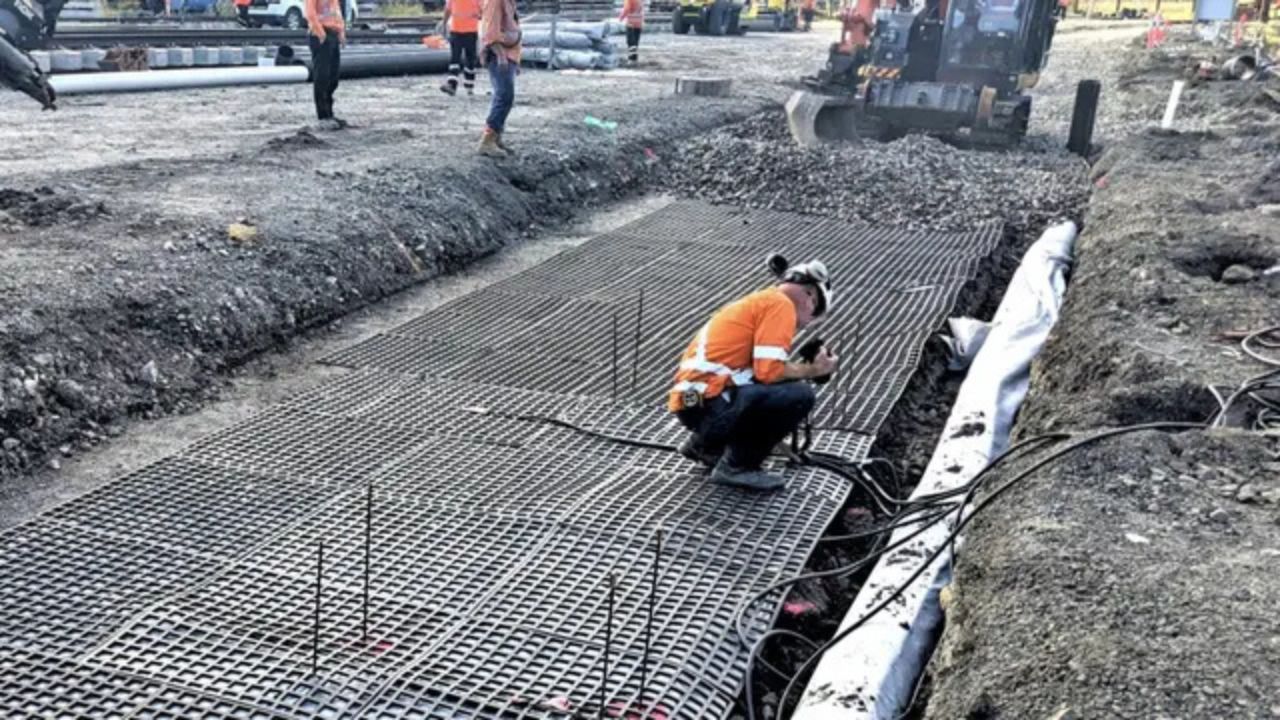
The railroad innovation developed by researchers at the University of Technology Sydney (UTS) addresses both problems. The solution consists of installing a rubber mat, similar to a honeycomb-patterned carpet, directly below the ballast layer. This mat is produced from rubber from tires that have reached the end of their useful life. It acts as a shock absorber, absorbing the impact of trains and distributing the load more evenly.
-
South Korea to Sink 20 Massive Concrete Coffers Off Busan Coast to Build 1.4 km Breakwater at Jinhae New Port, Part of $9.4 Billion Expansion to Rank Among World’s Top 3 Ports

-
Venice Deploys 78 Massive Steel Gates to Shield City from Extreme Adriatic Tides

-
China Uses 432 Robots to Move a 7,500-Ton Historic Building in Shanghai, Preserving Architecture While Creating Space for Underground Center
-
World Cup Ball Chip Uses Technology to Detect Invisible Touches, Confirms Offside, Secures Portugal’s Victory Over Croatia


Tests Confirm the Effectiveness of the New Railroad Technology
To validate the technology, researchers installed sections of track with the rubber mat next to conventional sections. Under real operating conditions, they monitored vibration and ballast degradation. The results confirmed that the sections with the rubber protection exhibited significantly lower wear and greater stability.
Cost Savings, Sustainability, and Less Noise
By protecting the ballast, the technology extends the lifespan of the entire railway structure. This directly translates to lower maintenance costs and greater reliability of the network. In addition to economic gain, the project creates a new and important application for discarded tires, promoting a circular economy and preventing tons of rubber from ending up in landfills. An additional benefit is the reduction of noise and vibration generated by passing trains.
The Promising Future of Recycling in Railway Construction
The success of the tests opens a promising path for the use of recycled materials in large infrastructure projects. The patented technology not only represents a more efficient engineering solution but also offers a model of how the industry can intelligently solve environmental problems by transforming waste into valuable resources.