






 Portuguese
  Spanish





Lawyer Cíntia Brunelli Explains How Police Power Functions in Daily Life in Fines, Interdictions, and Seizures, and What Are the Checks Against Excesses
The police power in daily life appears in everyday situations: the shutdown of a restaurant for violating health codes, the traffic ticket issued for illegal parking, or the interruption of excessive noise by municipal authorities.
According to lawyer Cíntia Brunelli, this instrument allows the State to limit individual rights to protect the collective interest, but always within legal limits.
This balance is essential. On one hand, there is the supremacy of the public interest, which justifies restrictions; on the other, the fundamental rights, which prevent arbitrariness.
-
Brazil’s 2026 Tax Refund: Record 9.58 Million Filers in Largest Payout Ever, But a Key Detail on Priority Recipients Draws Nationwide Attention

-
Itaú Alters Hybrid Work Model, Increasing Office Days from 2028, Prompting Employees to Adjust to New Routine
-
Facing Labor Shortage, Japan Plans to Invest $34 Million to Attract Foreign Workers in Construction, Healthcare, Industry, and Commerce

-
Brazilian City Makes Remarkable Leap, Becomes 4th Wealthiest in the Country with GDP of R$ 134.1 Billion




Therefore, police power in daily life must be exercised with proportionality, reasonableness, and clear motivation.
Who Exercises and Who is Subject to Police Power
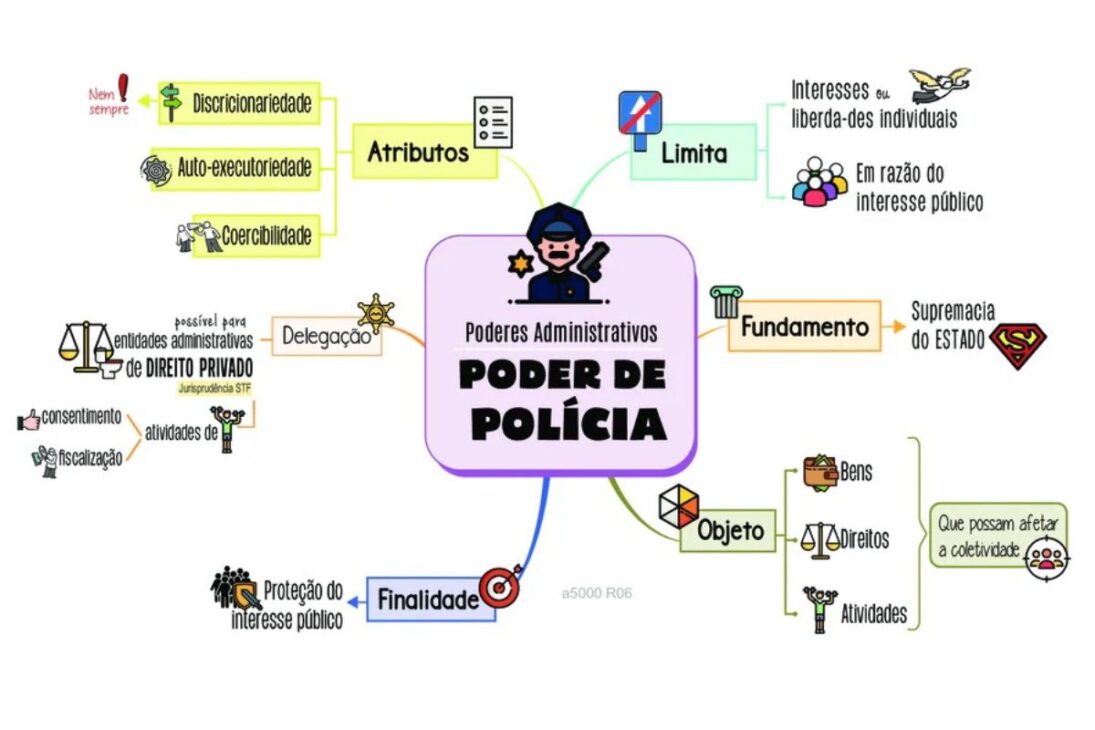
The active subject of police power is the State — Union, States, Municipalities, and the Federal District — and it may extend to entities of indirect administration, provided that the law authorizes it.
The passive subject is always the individual, whether a natural person or a company, who must submit to the limitations imposed in the name of the collective interest.
Cíntia Brunelli emphasizes that this power manifests itself in four phases: order (norms that establish rules), consent (authorizations and permits), inspection (visits and inspections), and sanction (fines, interdicts, and seizures).
Thus, police power is not only punitive but also preventive and educational.
When the State Can Fine, Interdict, or Seize
Among the classic attributes of police power in daily life are discretion, self-executability, and coercibility.
Discretion allows a certain margin of choice for the public agent, as long as it is grounded in law.
Coercibility authorizes the imposition of decisions even using force when necessary and proportional.
Self-executability, however, is the most sensitive point.
According to Brunelli, the Administration can only act immediately — interdict, seize, or fine — if there is legal provision or real urgency to prevent irreparable damage.
If not, it needs to resort to the Judiciary. This prevents abuses and preserves due process.
Limits That Prevent State Abuse


Cíntia Brunelli highlights that police power in daily life should not be confused with arbitrary power.
The Constitution itself requires that any restriction of rights be justified and proportional.
Thus, even in the face of urgency, the public agent needs to justify the measure, under penalty of state accountability.
Another consideration is to differentiate regulatory power (the issuance of decrees by the Executive head to detail the law) from police power, which is the concrete application of rules to individuals.
While a decree can regulate the Traffic Code, the imposition of a fine results from the police power exercised by the authority.
The Impact of Police Power in Everyday Life
Police power in daily life is one of the most visible expressions of the State.
It appears in the shutdown of polluting industries, in the inspection of bars, in the closure of roads for maintenance, and in the enforcement of traffic sanctions.
For citizens, understanding this mechanism ensures legal security and clarity about the limits of state action.
The topic is recurrent in public competitions and serves as a basis for discussing the balance between individual freedom and collective protection.
The central message, Brunelli reminds us, is that police power is legitimate only when grounded, proportional, and exercised within the law.
And you, have you witnessed situations where police power in daily life was applied correctly or abusively? In your opinion, do the current limits sufficiently protect the citizen? Leave your comment — we want to hear your experience.








