






 Portuguese
  Spanish


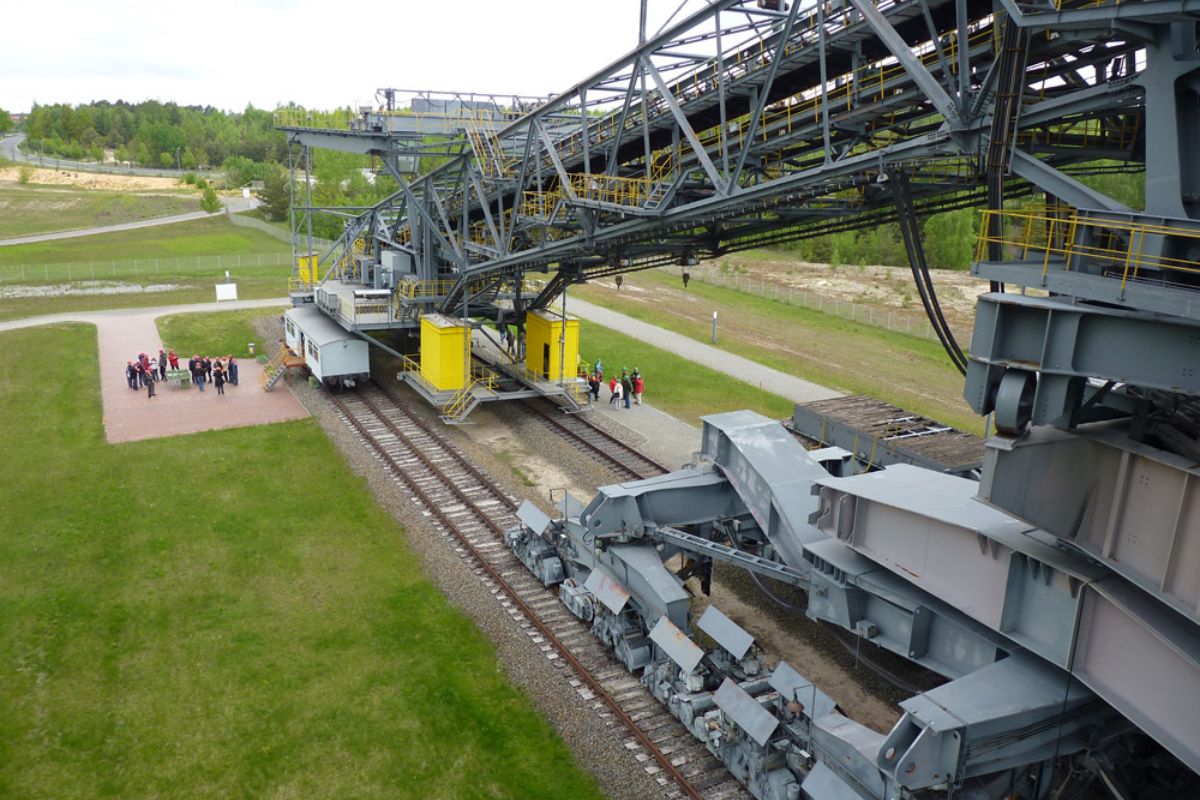


Meet the F60 Conveyor Bridge, one of the largest mobile machines in the world, its role in coal mining in Germany, and its impressive industrial legacy.
The F60 series conveyor bridges are a pinnacle of heavy machinery engineering, designed for open-pit lignite mining in Lusatia, Germany. Built by the former state-owned VEB TAKRAF Lauchhammer, they are the largest mobile technical industrial machines in the world, intended to remove and transport the overburden that covers the coal seams.
At 502 meters long, the F60 conveyor bridge earned the nickname “The Reclined Eiffel Tower”, surpassing the height of the famous Parisian structure. This report details its scale, engineering, operational history, and cultural significance.
F60 Conveyor Bridge: A Marvel of Heavy Engineering
The F60 conveyor bridge was designed to optimize the extraction of lignite (brown coal) in the vast fields of Lusatia. Its main function is the efficient removal of the “overburden”, the layers of soil and rock above the coal, a vital process for open-pit mining. This colossal machinery represents a milestone in land movement capability.
-
14-Year-Old Australian Entrepreneur Goes Viral After Y Combinator Rejection, Runs Two Startups Including an AI Company After Sock Business Failure

-
100-Year-Old Brazilian Sets World Record by Swimming 50 Meters in 1 Minute and 9 Seconds, Inspired by Tarzan Films
-
Brazil Introduces New Digital ID with Home Delivery, Linked to Unique Tax Number, Amidst Nationwide Notification Campaign.
-
World’s Stinkiest Flower: At 111 cm Wide and Up to 11 kg, It Emits a Rotten Meat Odor and Remains Hidden for Years.


The comparison to the “Reclined Eiffel Tower” underscores its monumentality. At 502 meters long, the F60 is significantly longer than the height of the Paris tower (approximately 330 meters), justifying its iconic nickname and transforming it into a visual landmark in the German landscape.
Dimensions and Capacities
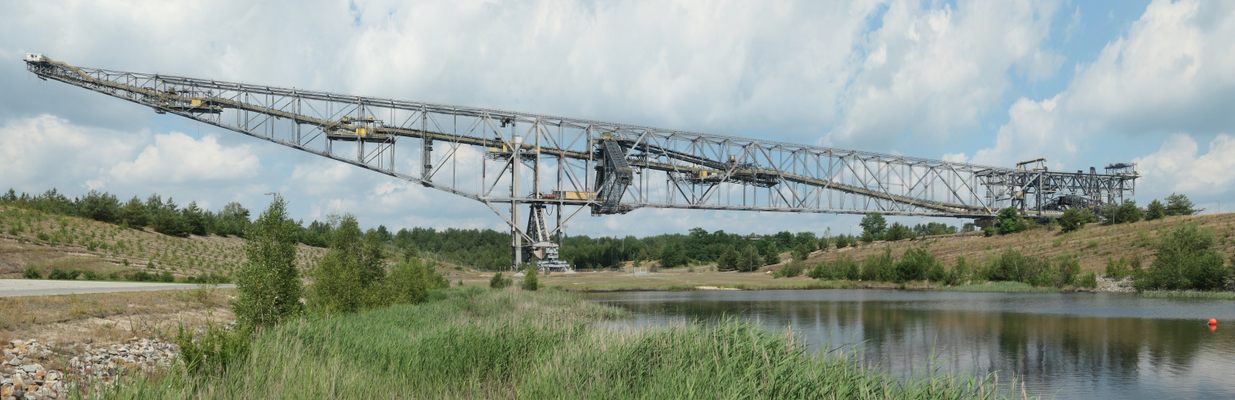
The technical specifications of the F60 conveyor bridge attest to its grandeur. In addition to its 502 meters in length, its width ranges from 204 to 241 meters, and its height can reach 80 meters. In operation, an F60 weighs 13,600 metric tons, classifying it as one of the heaviest land vehicles ever built. The preserved unit in Lichterfeld, even after disassemblies, weighs 11,000 tons.
Despite its mass, the F60 is mobile, moving on 760 wheels on tracks, with 380 of them motorized, at an operational speed of 0.54 km/h. Its total installed power, including excavators, is 27,000 kW (27 MW), powered externally. The designation F60 refers to its ability to remove a layer of overburden up to 60 meters high, moving up to 50,000 tons per hour with its two bucket chain excavators of the Es 3750 type.
The History of the Five F60 Giants: Construction, Operation, and Destinies
A total of five F60 conveyor bridges were built by VEB TAKRAF Lauchhammer between 1969 and 1991. TAKRAF, a company with roots dating back to 1725, became one of the world’s leading suppliers of mining systems. The first F60 was delivered in 1973 to the Welzow-Süd mine.
Four of these giants remained in operation until recently at the Jänschwalde, Welzow-Süd, Nochten, and Reichwalde mines, managed by the LEAG company. The longevity of these machines, operating for decades in harsh conditions, attests to the robustness of their design and construction. The Jänschwalde mine, however, began a transition to recultivation at the end of 2023, which may alter the operational status of the local F60.
The Legacy of the F60 Conveyor Bridge in Lichterfeld
The fifth F60 conveyor bridge, assembled in Klettwitz-Nord between 1988 and 1991, had a short lifespan. It operated for only 13 to 15 months, being decommissioned in June 1992 due to changes in German energy policy after reunification. Initially destined for scrapping by the mining operator LMBV, its fate changed thanks to local enthusiasts.
The municipality of Lichterfeld-Schacksdorf acquired the structure in 1998, transforming it into a central project of the International Building Exhibition (IBA) “Fürst-Pückler-Land”. The F60 in Lichterfeld became a visitor mine in 2002, offering tours and cultural events alongside Lake Bergheide, formed in the former mine pit. This is an example of how industrial heritage can be reimagined, generating a positive impact on the local economy and cultural identity of the region.
Impact of Mining and Post-F60 Recultivation


The operation of the F60 conveyor bridge is linked to the deep environmental impact of open-pit lignite mining. These operations drastically alter landscapes, destroy ecosystems, and affect the regional hydrological regime through groundwater pumping. A serious problem is Acid Mine Drainage (AMD), which can contaminate rivers such as the Spree.
German legislation requires extensive post-mining recultivation work. In Lusatia, this includes reforestation, creation of agricultural areas, and flooding of pits to form lakes, such as Cottbuser Ostsee and Lake Bergheide. These efforts aim to transform the former mining areas into new landscapes with ecological and recreational value, healing the “scars” of the industry.


