






 Portuguese
  Spanish
  3 min of reading
  1 comment


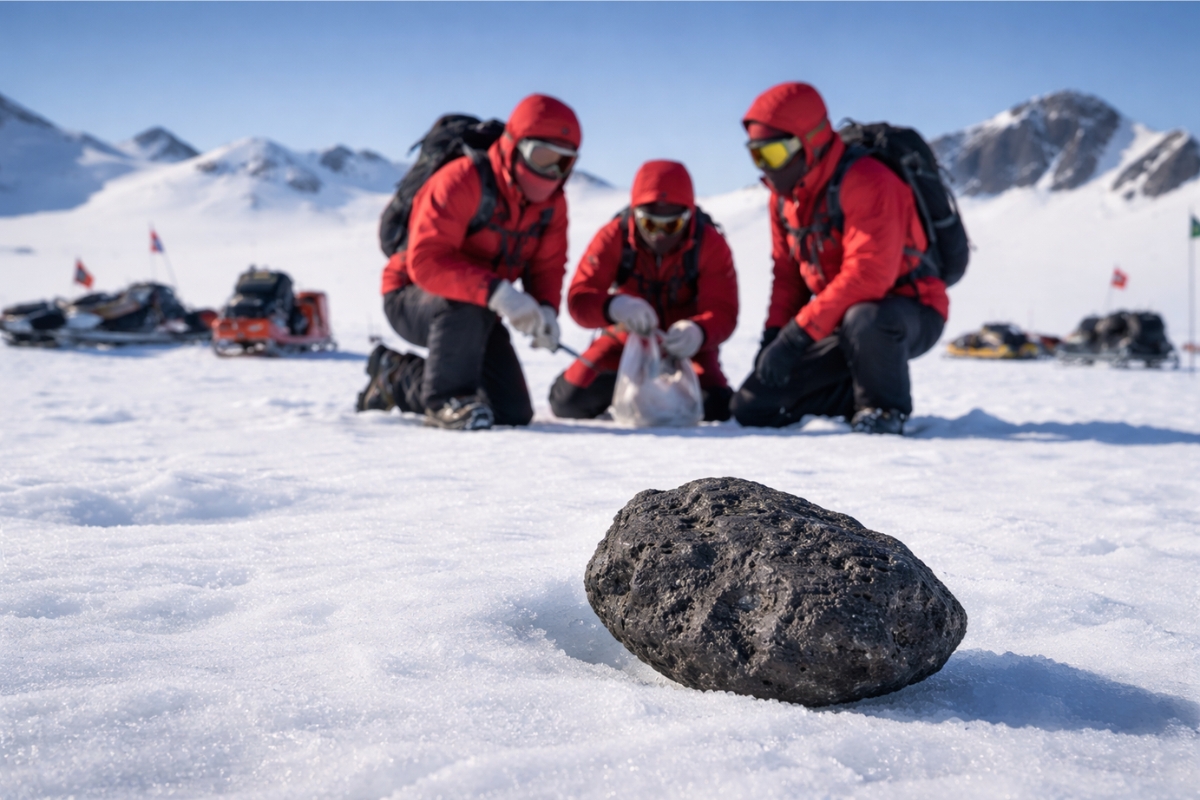


The Combination of Antarctic Ice, Natural Conservation, and Scientific Research Explains the Concentration of Space Fragments on the Continent
The Antarctica holds 60% of the meteorites found on Earth, even though it is not the place where the most space rocks fall from the sky. The decisive factor lies in the ease of identification, natural preservation, and the constant movement of ice, which gathers these fragments in specific areas.
The Antarctic landscape creates unique conditions for this accumulation. The white, clean surface makes any dark rock visually stand out, while the extreme cold reduces deterioration processes common in other regions of the planet. This turns the continent into a true natural archive of space.
In addition to the favorable environment, there is a continuous scientific effort focused exclusively on collecting these materials. Structured programs traverse the ice in search of meteorites, consistently increasing the number of fragments recovered over the decades.
-
Helicopter Drops 180 Tons of Sand and Gravel on Swedish River to Revive Ecosystem Damaged by Decades of Exploitation

-
Brazilian Company Launches Retro Smartphone with 48 MP Camera, T9 Keyboard, and Privacy Features for Social Media-Free Use

-
Self-Taught Chinese Farmer Builds 5-Ton Submarine from Scrap, Launches It in Anhui River
-
Invisible Induction Technology Enables Wireless Power for Blenders, Coffee Makers, and Air Fryers, Reducing Countertop Cables





The Visual Contrast of Antarctica Facilitates the Identification of Meteorites
Within the continent, the landscape is dominated by snow and nearly pure ice, creating an immediate contrast with any dark object. A meteorite the size of a walnut becomes visible from great distances, something that does not happen on rocky soils or urban areas.
In other parts of the world, space fragments easily blend in with common stones. In Antarctica, this contrast makes the search a straightforward process, reducing identification errors and speeding up the fieldwork of teams.
This simple visual factor has a direct impact on global statistics, as many meteorites that would go unnoticed in other environments end up being located on the Antarctic ice.
The Extreme Cold Helps Preserve Meteorites for Long Periods

Humid environments accelerate the oxidation and decomposition of space rocks, causing them to lose characteristics that allow identification. In the Antarctica, the cold, dry climate drastically slows these chemical processes.
Regions far from the coast offer even more stable conditions, allowing meteorites to remain practically intact for long periods. This increases the chances of recognition even after a long time since the fall.
This natural preservation explains why ancient fragments continue to be found and cataloged, expanding scientific knowledge about the origin and composition of these materials.
The Movement of Ice Concentrates Meteorites in Specific Areas
The Antarctic ice is in constant movement, albeit slowly. This movement, combined with the gradual loss of the surface due to wind and climate action, causes meteorites to be transported and concentrated in specific points.
These areas function as natural accumulation zones, where different fragments end up gathered over time. When the surface ice is removed, the meteorites are exposed and ready to be collected.
This geological process explains why certain regions show a much higher density of finds, even without receiving more falls than other parts of the planet.
The Role of Science in the Systematic Collection of Meteorites
The presence of scientific programs dedicated to Antarctica makes a direct difference in global numbers. Specialized teams traverse the continent using standardized methods, ensuring that the fragments are located, cataloged, and preserved correctly.
The ANSMET program, active since 1976, is one of the main examples of this ongoing work. By the end of 2022, the project had recovered over 23,000 specimens, making a decisive contribution to the global total.
Adding international initiatives, the number of meteorites collected in Antarctica exceeds 50,000 fragments, consolidating the continent as the largest natural repository of this type of material.
What the Concentration of Meteorites Reveals About the Planet
The large number of finds in Antarctica does not indicate a higher incidence of impacts, but rather an ideal environment for preservation and discovery. This changes how global data on meteorites is interpreted.
The continent functions as a natural filter, collecting fragments that fell at different times and allowing for more comprehensive analyses of the history of the solar system.
With the advancement of research and the continuation of scientific expeditions, Antarctica is likely to maintain its central role in the discovery of meteorites, providing valuable insights into the origins of these space visitors and the natural processes of the planet itself.





Ué…uma pedra caindo do espaço não afunda no gelo ?