






 Portuguese
  Spanish
  3 min of reading
  0 comments


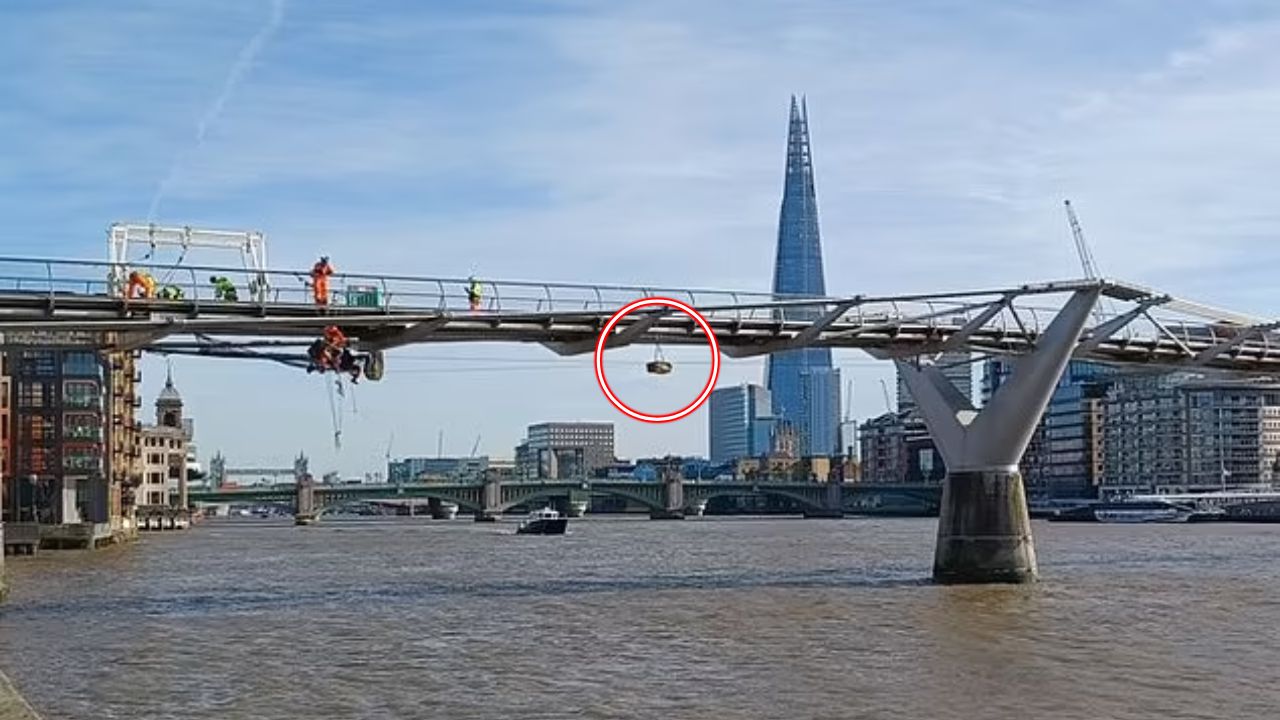
Bales Of Straw Hanging On The Bridges Of The Thames River Follow An Ancient River Safety Rule That Still Affects London.
London is a city where past and present coexist in a curious way. Among modern buildings and historic bridges, one detail stands out to locals and tourists: bales of straw suspended on some bridges over the Thames River.
Far from being an aesthetic intervention, the object serves as an official safety warning, used whenever works temporarily alter the available height for navigation.
This method, used by contractors and monitored by port authorities, originated in the 18th century and remains mandatory to this day. Next, understand how this practice originated, why it persists, and in which situations it is used.
-
The Brazilian woman who may be the oldest living person on the planet is 119 years old, lives in Itaperuna, in the state of Rio de Janeiro, likes bananas, does not use medication, and is now facing a race against lost documents to enter the Guinness World Records.

-
Brenda dropped out of college due to a high-risk pregnancy and, years later, she achieved her long-awaited diploma alongside her twin daughters.

-
Brazilian supercentenarian: The nun from Rio Grande do Sul, whom doctors did not expect to survive childhood, became the oldest person in the world at 116 years old, had her age validated by Guinness World Records and LongeviQuest, overcame COVID-19 at 114 years old, and concluded her centenarian journey in 2025.

-
Cearense João Marinho Neto, 113 years old, is recognized by Guinness as the oldest living man in the world.


What Does The Law Say About The Bales Of Straw On The Bridges Of London?
Before modern lighting, radar, or electronic navigation systems existed, safety on the Thames River depended on simple, easily recognizable signals.
It was in this context that the bales of straw began to be used as a warning.
The object hanging under the bridge indicates that the clearance is lower than usual. Thus, vessels are alerted to reduce speed or adjust their course, avoiding collisions with the structure.
The practice is not optional. It is provided for in an old regulation of the Port of London.
According to clause 36.2 of the statutes, a bale of straw must be hung whenever “the headroom of an arch or the span of a bridge is reduced compared to its normal limits.”
This means that any intervention, even a small one, that alters the height of the bridge requires the installation of the warning.
The rule remains valid, and its non-compliance results in penalties.
Why Did The Thames River Need This System?
The Thames River was, for centuries, the main trade route of London. Ships loaded with goods crossed the bridges daily, making navigation control essential for the city’s economy.
Any structural change posed a direct risk. In this scenario, the use of a physical, large, and visible signal was the most effective solution to alert navigators.
The bale of straw thus emerged as a practical response to a real problem.

Even with technological advancements, the system was not abandoned. Although there are now more modern resources, the historic legislation remains in effect.
Furthermore, the Port of London understands that any extra layer of warning contributes to river safety.
That’s why bales of straw continue to be used, even in the 21st century, reinforcing the relationship between tradition and prevention.
When Do The Bales Of Straw Reappear On The Bridges?
The application of the system occurs whenever works reduce the height of the bridges over the Thames River. In recent years, several cases have drawn attention.
In 2023, the warning was installed during repairs on the Millennium Bridge. In 2024, the East India Dock Road Bridge went through the same procedure.
In 2025, it was the turn of the Barnes Railway Bridge and Charing Cross Bridge to adopt the signal.
In all these situations, the responsibility fell to the contractors of the works. If the bale of straw is not placed, the fine can reach £5,000, an amount close to R$36,000.
Old Laws That Still Shape Daily Life On The Bridges Of London
The use of bales of straw is not an isolated case. The United Kingdom maintains other historic norms that are still valid.
Some of them define that whales, dolphins, and sturgeons belong to the Crown.
There is also the Salmon Act, which criminalizes the “suspicious handling of a salmon,” created to combat illegal fishing.
At the same time, certain old laws, such as the one prohibiting public drunkenness in the 19th century, have fallen into disuse.
More than a visual curiosity, the bales of straw on the bridges of the Thames River show how London preserves old rules without compromising safety.
Source: Xataka






-

-

2 people reacted to this.