





 Portuguese
  English
  Spanish
  3 min of reading
  1 comment


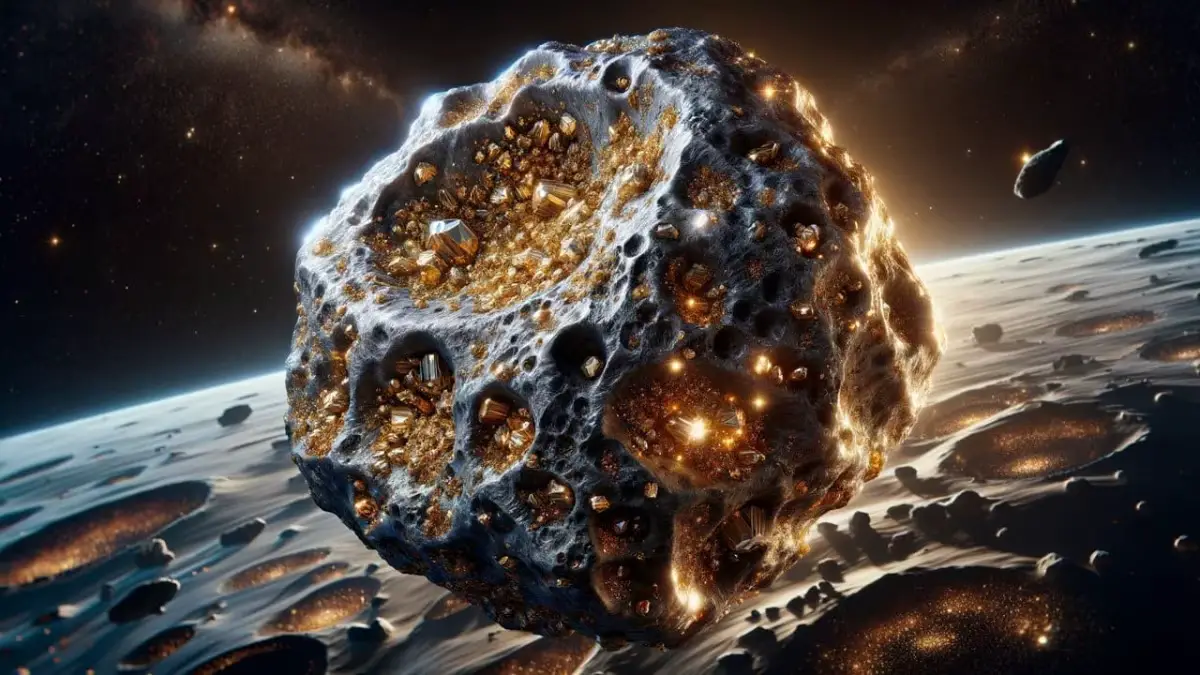


Despite the economic potential of the asteroid Psyche, estimated at US$ 10 trillion due to its metallic composition, space mining faces technological, logistical, and economic challenges that prevent its exploration at the present moment.
The NASA Psyche mission, launched on October 13, 2023, aims for an ambitious goal: to explore the asteroid 16 Psyche. Located millions of kilometers away from Earth, this celestial body is rich in precious metals, such as platinum and palladium.
Its value is estimated to exceed 100 trillion dollars. This space treasure could provide valuable clues about planetary cores and pave the way for extraterrestrial mining.
The encounter with the asteroid is scheduled for 2029. Until then, the mission will gather crucial data about the composition of Psyche, offering a unique opportunity to learn more about the early days of the Solar System and the economic potential beyond Earth.
-
Larger than any rocket ever launched, the Sea Dragon was designed to emerge from the ocean like a burning skyscraper, standing 150 meters tall, 23 meters in diameter, and weighing over 15,000 tons: Aerojet’s monster would place 550 tons into low orbit and seemed too big even for NASA’s plans.

-
Presented as the world’s first floating megacity, the Freedom Ship promises to be 1.6 km long, 30 stories high, and powered by nuclear energy to accommodate up to 80,000 people at sea, in a project valued at around 81 billion reais that still depends on financing.

-
More durable tires may result from an MIT discovery that makes plastic break the right way, absorb impacts at 750 meters per second, and reduce wear related to microplastics.
-
Russia offered India around 40 fifth-generation stealth fighters Su-57, with technology transfer and rare access to the aircraft’s source code, in a proposal gaining momentum amid the arms race in South Asia and the military rapprochement between China and Pakistan.


Challenges of Mining in Space
Asteroid mining is a feasible dream, but still distant. The necessary technology exists, but it faces practical limitations.
Equipment needs to be adapted for low-gravity environments and intense radiation, in addition to operating autonomously.
This is because communication with Earth can take up to 20 minutes, depending on the location of the asteroid.
On NASA’s Technology Readiness Index, which ranges from 1 to 9, the tools for space mining currently sit between levels 3 and 5. For actual missions, levels 6 or 7 would be required.
Funding is also a significant obstacle. Private companies, such as AstroForge and TransAstra, have already shown interest, but the high costs of turning laboratory technologies into real operations still limit progress.
Experts believe that small-scale mining could begin within five years, provided the necessary investment is secured.
However, bringing materials from these asteroids to Earth may not be economically viable. Transportation costs are high, and prices for precious metals, like platinum, tend to fall with increased supply.
On the other hand, resources such as water extracted from asteroids could be used to produce space fuel, making even deeper explorations feasible.
Focus on Exploration
In the meantime, space exploration takes the lead. The Moon, for example, also contains valuable resources, albeit in smaller concentrations.
The advantage of the Moon is its proximity: missions take days, not years, to reach. Still, asteroids like Psyche continue to attract attention due to their high metal content and economic possibilities.
The current missions, however, have a scientific focus. Recently, NASA’s OSIRIS-REx brought back samples from the asteroid Bennu.
Prior to that, Japan’s Hayabusa2 returned with material from Ryugu. The European Space Agency also plans to study asteroids, but with a focus on planetary defense.
Asteroids represent a window into the past of the Solar System, as well as potential resources for the future.
Although there are technologies capable of mining them, progress depends on financial support and political decisions that turn the dream into reality.





Quanta tolice… Preocupados e focados com a “vida” extraterrestre, enquanto a humanidade morre a míngua em uma irreparável autodestruição.