






 Portuguese
  Spanish


Unusual Situation Involves Pole Positioned in the Middle of the Street in Campo Grande and Exposes Challenges of Urban Infrastructure Works, Impacting Traffic, Residents’ Routine, and Revealing Planning Problems Among Public Agencies.
Chaos in Traffic Due to Pole in the Middle of the Street
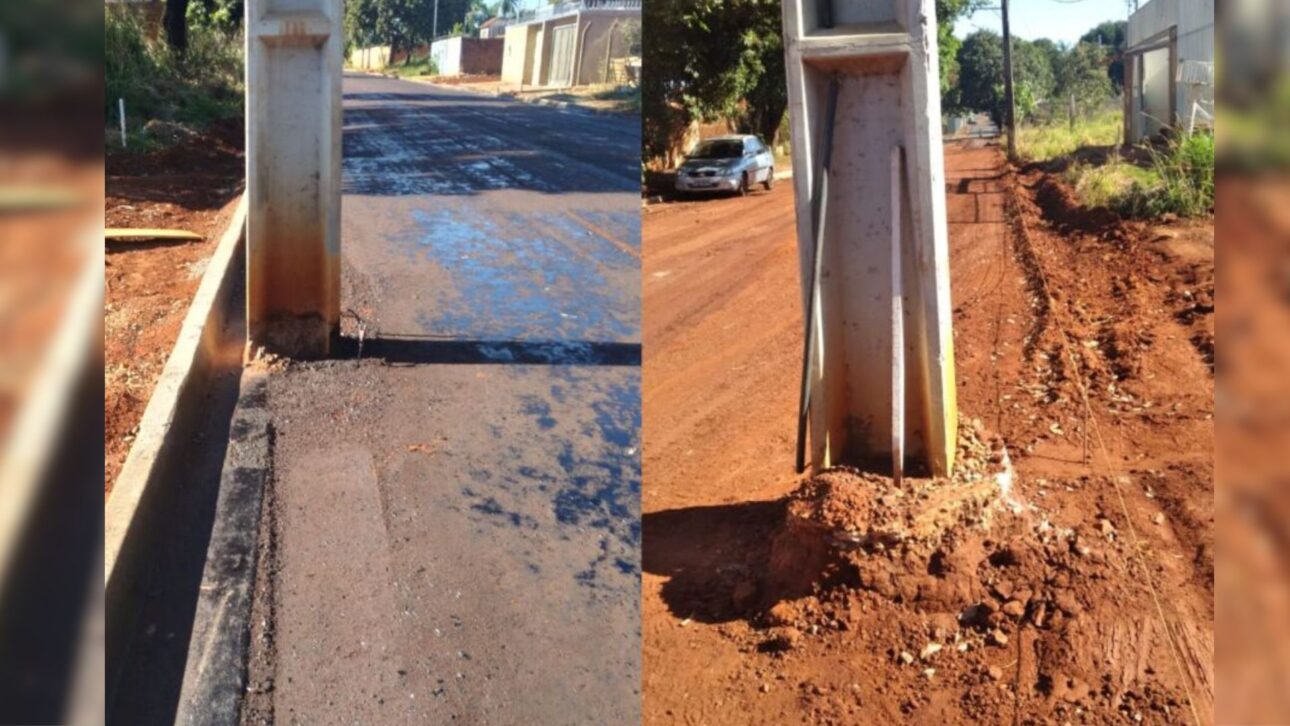
Residents of the neighborhoods Vila Vilas Boas and Jardim Mansur, in Campo Grande, Mato Grosso do Sul, have been facing an unusual situation since a pole was installed in an irregular location and has remained “parked” in the middle of Antônio Francisco Street, completely altering the flow of traffic and highlighting issues in the execution of paving works.
The fact gained attention especially because the arrival of asphalt needed to be adapted, with workers maneuvering around the concrete structure that should be alongside the sidewalk but remains in the middle of the street, creating unexpected obstacles for drivers and pedestrians.
Impact of the Pole Disrupts Traffic and Routine
Images taken last week, around number 643 on Antônio Francisco Street, clearly show the presence of misaligned poles, set away from the sidewalk line and positioned on the opposite side of the curb, a scenario that exposed the problem to the entire neighborhood.
-
Major Brazilian Supermarkets, Including Carrefour and Assaí, May Close Earlier to Prevent Price Increases

-
Coca-Cola Shuts Down 100-Year-Old Factory in the U.S., Impacting 85 Workers and Shaking Local Community with Historic Consequences
-
Bianca Andrade Invests $30 Million of Her Own Money in Boca Rosa, Launches Over 100 Products in a Year, Aiming for $400 Million by 2026
-
Belo Horizonte Becomes First Brazilian City to Fund Housing, Utilities for 100 Homeless Families with $900,000 Initiative


According to reports, the responsibility for the paving belongs to the Municipal Secretariat of Infrastructure and Public Services (Sisep), while the removal of the poles would fall to the concessionaire Energisa, responsible for supplying electricity in the capital of Mato Grosso do Sul.
Antônio Darilo Cesco, a resident of the region for nearly ten years, stated that he sought the responsible parties for the work in search of explanations regarding the schedule and planning for the removal of the poles.
According to him, Energisa workers removed only three or four structures, leaving several others in place, including some in the middle of the already applied asphalt.
“Energisa’s employees said it wasn’t their responsibility. Meanwhile, the asphalt team informed that they would pave regardless, even with the poles in the street,” reports Cesco.
Planning and Execution Problems in Campo Grande
The episode reignited discussions among residents about the quality of public services and the lack of coordination between the city hall and concessionaires.
For many, the pole in the middle of the street represents not only a physical obstacle but a symbol of chaos in infrastructure works in the capital.
In an interview with the portal Correio do Estado, residents expressed concern about the possibility of additional damages and frequent repairs if the issue is not corrected before the completion of the works.
In a statement sent on the afternoon of June 11, the Municipal Secretariat of Infrastructure and Public Services (Sisep) acknowledged that the poles pointed out by residents are indeed in the wrong place and confirmed that it has already requested the removal of the structures from the area by Energisa.
“After the removal, Sisep will complete the paving work in the sections where the poles have been removed,” informed the agency.
Despite this, what was observed the following morning was the continuation of asphalt works around the pole, which ended up being surrounded by the new layer of pavement, further complicating circulation and bringing insecurity for those traveling in the area.
Public Lighting Contracts and Costs for the City
This situation is part of a broader context of challenges faced by the municipal government in the public lighting sector.
In the first months of 2025, Campo Grande approved a package of fiscal measures and spending cuts amid demands from employees who had been without adjustments for three years.
The budget crisis directly reflected on the lighting contracts, which experienced successive increases.
In June, the extract of the first amendment to a contract for purchasing poles was published, raising the value to more than R$ 3 million.
Just in March of this year, three other contracts were adjusted by almost 25%, totaling about R$ 2.7 million in increases for Empresa Construtora B&C Ltda, according to official data.
Surveys from the Municipal Secretariat of Finance (Sefin) show a significant increase in the collection of the Contribution for the Maintenance of Public Lighting Services (Cosip).
The residents of Campo Grande paid R$ 153.46 million in 2023 and R$ 196.86 million the previous year, an increase of 28.2% in just one year.
Established in the municipality during André Puccinelli’s administration, Cosip has become a significant source of revenue, allowing the capital of Mato Grosso do Sul to collect more from public lighting than larger cities like Curitiba, despite having half the population.
Residents Question Effectiveness and Safety
The municipal executive justifies the increases by stating that the expansion of the city and rising community demands necessitate an increase in services, both in implementation and maintenance of public lighting.
However, the contrast between the high amounts invested and episodes like the pole in the middle of the street highlight the difficulties in planning and executing urban works in Campo Grande.
While the city hall acknowledges the need for improvements, residents report a lack of clarity in the schedule of works and a lack of information on deadlines for the definitive removal of obstacles.
In addition to the direct impact on traffic, the permanence of the pole that disrupts traffic poses risks to drivers and pedestrians, especially at night when visibility is reduced.
The risk of accidents increases, and the makeshift signage in the area does not guarantee the safety of those circulating in the region, exacerbating residents’ concerns.
The permanence of the pole that “disrupts traffic” is just one of the signs of the mismatch between planning and execution of public works in Campo Grande.
For the inhabitants of Vila Vilas Boas and Jardim Mansur, the expectation for a definitive solution intertwines with distrust regarding the effectiveness of public authorities’ actions.
In light of this scenario, a question arises: will the integration between different agencies and concessionaires be sufficient to prevent issues like the pole in the middle of the street from continuing to impact urban life in Campo Grande?








Be the first to react!