






 Portuguese
  Spanish


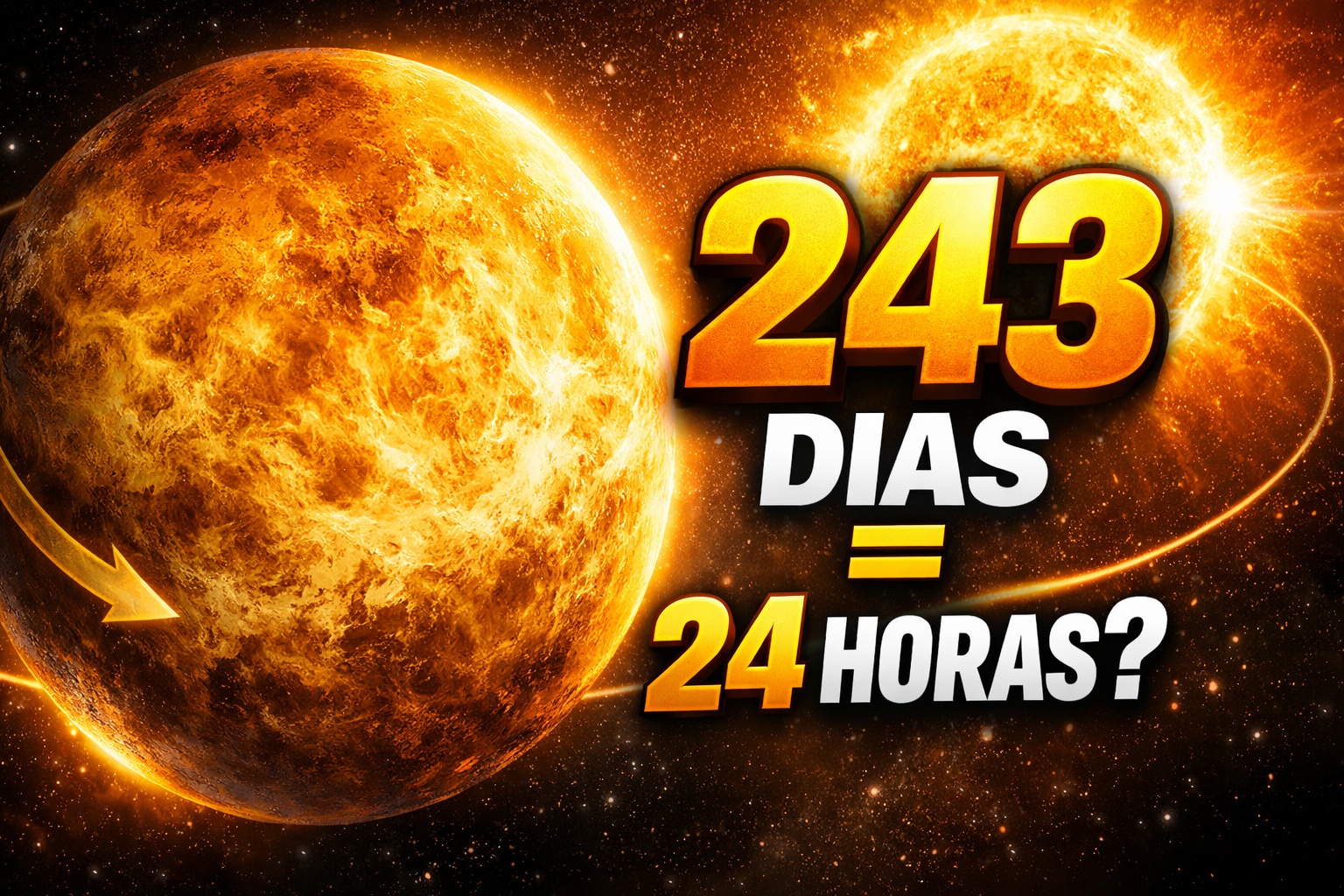


Venus Takes 243 Earth Days to Spin and 225 to Orbit the Sun, Making Its Day Longer Than Its Own Year.
Few people know, but the second planet in the Solar System has one of the strangest dynamics ever observed in astronomy. On Venus, a single complete spin around its own axis takes approximately 243 Earth days. Its orbit around the Sun, on the other hand, is completed in about 225 Earth days. This means that, technically, a Venusian day lasts longer than the planet’s own year.
The data is widely documented by radar observations made since the 1960s and confirmed by missions such as NASA’s Magellan, as well as recent measurements by ground-based radio telescopes. Venus’s extremely slow and peculiar rotation makes it one of the most intriguing objects in the Solar System.
Retrograde Rotation and an Inverted Calendar – 243 Days = 24h
The first peculiarity is that Venus spins in the opposite direction to most planets. This phenomenon is known as retrograde rotation. While Earth spins from west to east, Venus spins from east to west. This means that, if someone could observe the Sun from the Venusian surface, it would rise in the west and set in the east.
-
China Develops Custom 140-Ton Electric Mining Truck with 770 kWh Swappable Battery, Deploys 290 Units in Xinjiang’s Largest Zinc Mine

-
Meta to Launch Arena, a New Prediction App Targeting 3.56 Billion Users, Competing with Polymarket and Kalshi

-
Scientist Challenges Famous Human Evolution Theory, Argues Homo Sapiens Evolved Gradually Over Thousands of Years
-
15-Year-Old American Builds Ocean Generator with PVC Pipe and 3D-Printed Propeller for $12, Wins National Prize, Presents at White House, and Makes Forbes 30 Under 30 List




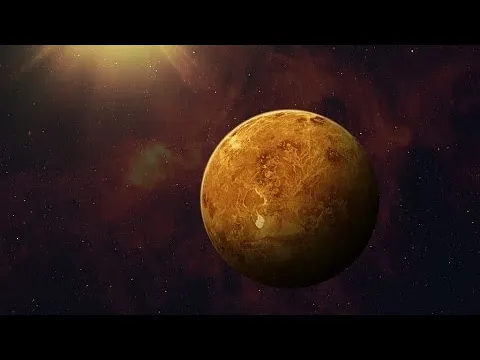

Retrograde rotation, combined with the extreme slowness of the spin, creates an unusual situation: the complete rotation cycle is longer than the orbital period.
However, there is a significant difference between the sidereal day and the solar day. The sidereal day corresponds to the time it takes the planet to complete one full rotation relative to distant stars, in the case of Venus, 243 Earth days. The solar day, which represents the interval between two consecutive sunrises, is approximately 117 Earth days due to the combination of slow rotation and orbital movement.
Still, the orbital mathematics remains surprising: the planet completes its orbit around the Sun even before finishing one full spin around itself.
Why Venus Spins So Slowly and 243 Days = 24h

The exact reason for Venus’s extremely slow rotation is still a topic of scientific debate. There are main hypotheses.
One suggests that massive collisions during the formation of the Solar System drastically altered its axis and rotation speed. Another hypothesis points to the Sun’s gravitational influence combined with Venus’s thick atmosphere.
Venus has an atmosphere composed mainly of carbon dioxide, with surface pressure about 90 times greater than that of Earth. This dense atmospheric layer may have exerted torque over billions of years, progressively slowing the planet’s rotation.
Climate models and simulations indicate that the interaction between atmosphere and surface can generate forces sufficient to alter rotational speed over geological timescales.
Extreme Temperature and Uncontrolled Greenhouse Effect
The strangeness of the weather on Venus is only part of the picture. The planet has an average temperature of approximately 465 °C on the surface, making it the hottest in the Solar System, despite not being the closest to the Sun.
This extreme heat results from an uncontrolled greenhouse effect. The carbon dioxide-rich atmosphere traps infrared radiation, preventing heat from escaping into space. Thick clouds of sulfuric acid complete the hostile environment.
The combination of slow rotation, thick atmosphere, and intense heat creates a climatic system entirely different from that of Earth.
Comparison with Other Planets
In the Solar System, all other planets have days shorter than their years. Mercury, for example, takes about 59 Earth days to spin and 88 days to orbit the Sun. Even in this case, the year is longer than the day.

Venus is the only planet where the sidereal rotation period exceeds the orbital period. This makes it a unique case in celestial mechanics.
Furthermore, its slow rotation means that a hypothetical observer on the surface would experience long periods of light and darkness, although the thick cloud cover practically prevents direct sunlight visibility.
Scientific Impact of the Discovery
The confirmation of Venus’s slow rotation was made possible thanks to radar observations. Since the planet is permanently covered by dense clouds, optical telescopes cannot visualize its surface. The use of radar allowed mapping of the terrain and accurate measurement of rotation speed.
Future missions, such as those planned by the NASA (VERITAS) and ESA (EnVision), should deepen the study of the planet’s internal structure and rotational history.
Understanding Venus is essential not only for planetary astronomy but also for understanding extreme climate processes and possible atmospheric fates of rocky planets.
Few people know, but the weather on Venus really challenges logic. The planet takes 243 Earth days to complete a rotation, while it finishes its solar orbit in just 225 days. Its day is longer than its year.
This peculiarity is not just a curious detail. It reveals the complexity of planetary dynamics and shows that the Solar System still harbors phenomena that defy human intuition.
On Venus, the calendar does not follow the rules we know. And this cosmic inversion continues to be one of the most intriguing demonstrations that, in the universe, not everything obeys Earth’s pattern.






