Portuguese
  Spanish




The First Ultraprecise Nuclear Clock May Be About to Launch, Surpassing the Precision of Atomic Clocks and Enabling New Discoveries About Gravity, Gravitational Waves, and Dark Matter
Closest Nuclear Clock. Modern science and technology fundamentally depend on the precision of clocks for a wide range of applications, from verifying fundamental scientific theories to the functioning of systems like GPS and telecommunications.
Currently, cesium atomic clocks are considered the gold standard in terms of precision. They rely on energy transitions of electrons in the cesium atom to keep time with impressive accuracy.
However, researchers are about to inaugurate an era in timing with the arrival of the first prototype of a nuclear clock, which promises to be even more precise.
-
Welder Discovers 16th-Century Diamond Ring in England After 7 Hours with Metal Detector; Gold Jewel Linked to Edward I Pattern Auctioned for £17,000

-
Former Merchant Marine Captain Invents Fuel-Free Barrier, Removes 20,000 Tons of Trash from Chennai Rivers
-
14-Year-Old Maxim Harris Turns School Project into Anti-Rage Gaming Accessory, Sells 1,000 Units Across 46 U.S. States, Donates 20% of Profits to Charity
-
Brazilian Health Agency Approves First Oral Medication for Cancer Patients




The Jump from Atomic Physics to Nuclear Physics
Historically, nuclear physics has not been used for high-precision measurements, primarily due to technological limitations. However, recent research published in the journal Nature opens a new chapter.
Physicist Jun Ye from the University of Colorado Boulder and his team developed the first prototype of a nuclear clock, specifically using the isotope thorium-229. As explained by Hannah Williams, a physicist at the University of Durham, this achievement is a notable technical accomplishment.
She highlights that while current timing relies on energy transitions of electrons, Ye’s team has paved the way to explore the energy transitions of the atomic nucleus, being much less susceptible to environmental interference, ensuring greater accuracy.
How an Atomic Clock Works and the Evolution to the Nuclear Clock
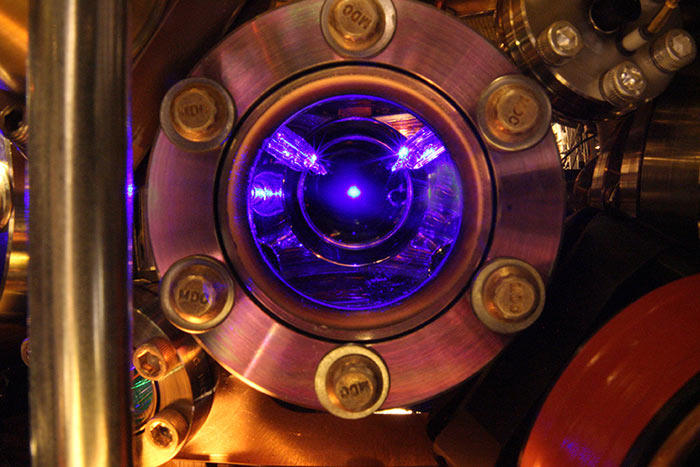
Credit: The Ye group and Brad Baxley, JILA
Current atomic clocks use lasers to stimulate electrons to jump between different energy levels, allowing for precise timing. However, the atomic nucleus—a tiny structure made up of protons and neutrons—also has energy levels that can be alternated, just like electrons.
The nucleus is much smaller and denser than the rest of the atom and, protected by the cloud of electrons around it, is less influenced by external factors, making it an excellent choice for ultraprecise timing.
However, exciting an atomic nucleus is a challenge. The energy needed for this process is significantly greater than that used to excite electrons, typically in the gamma-ray range.
This is where thorium-229 comes in, the only known element whose nuclear transition can be stimulated with a beam of ultraviolet light, making it an ideal candidate for the creation of a nuclear clock.
The Challenges and Recent Advances
The major difficulty in creating a nuclear clock was accurately determining the amount of energy required to excite the thorium-229 nucleus. In recent years, researchers worldwide have made significant advances in this area.
In 2023, a European team managed to measure the energy gap between the two nuclear states of thorium at 8.4 electron-volts. Soon after, a group of scientists in Germany was able to further refine this measurement to 8.35574 electron-volts.
Despite these advancements, the precision was still not sufficient to build a viable nuclear clock. It was then that Jun Ye’s team used a frequency comb, a specialized laser capable of measuring light frequency with extremely high precision.
This device can generate 100,000 discrete light frequencies, like the fine teeth of a comb, and was essential for the researchers to accurately identify the frequency needed to excite the thorium-229 nucleus.
The Night of Discovery and the Team Celebration
Near midnight on a night in May, Chuankun Zhang, a graduate student of Jun Ye, finally captured the signal indicating that the thorium-229 nucleus had transitioned between the two energy states. “No one could sleep that night,” Zhang recalled. The team celebrated in the lab and even took a selfie at four in the morning.
This advance increased measurement precision by a million times, and although the nuclear clock prototype is still not as precise as current optical clocks made of strontium atoms, it contains all the elements necessary to become the world’s first nuclear clock.
The Promising Future of Nuclear Clocks
With the development of nuclear clocks, science will be able to measure fundamental physical constants with a precision that atomic clocks have never achieved. Constants such as the speed of light, for example, are pillars of our understanding of the universe.
However, some theories suggest that these values may vary slightly over time. A nuclear clock would allow for the detection of these variations, opening new possibilities for scientific exploration.
Moreover, such a precise timing device could measure the small ways gravity affects time, detect gravitational waves, and even provide clues about dark matter—the invisible substance that makes up about 27% of the universe. This is because the interaction of dark matter with the thorium-229 nucleus would alter the frequency needed to excite the nucleus.
However, for all this to become a reality, it is still necessary to reduce the uncertainty in thorium measurements by at least tenfold. “What remains to be done now is the technical development work,” said Thorsten Schumm, co-author of the study and physicist at the Vienna Center for Quantum Science and Technology. He predicts that nuclear clocks will surpass atomic clocks in precision within two to three years.
With few technological obstacles ahead, researchers are confident that the era of nuclear clocks is about to begin. “Now the fun begins,” said physicist Eric Hudson. “We can really make these things happen.”
Nuclear clocks promise to revolutionize not only how we measure time but also how we understand the most fundamental principles of the universe.