Portuguese
  Spanish


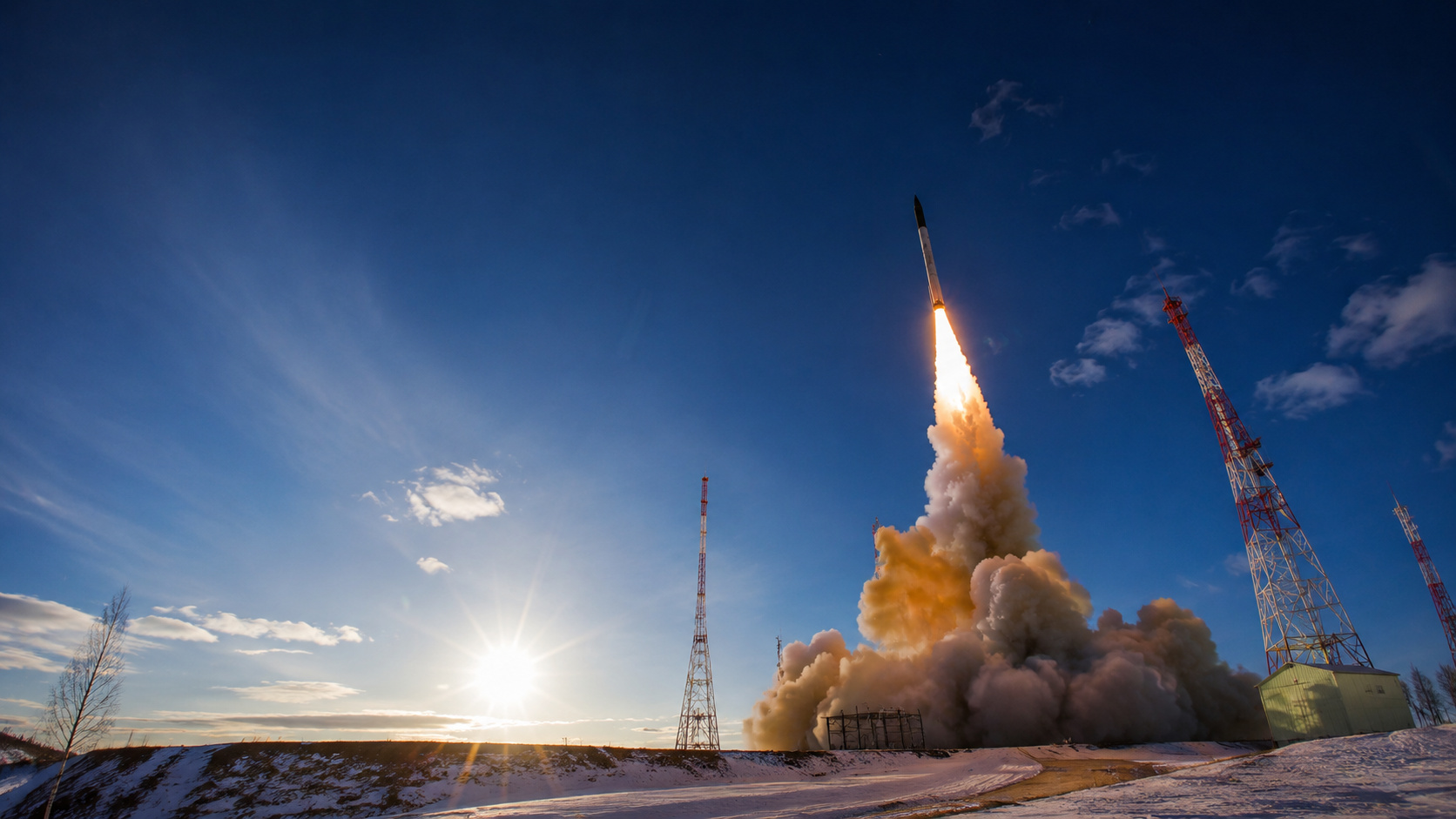

Final test of the RS-28 Sarmat reignites international attention on Russian nuclear capability, the extreme range of the weaponry, and the military strategy presented by Vladimir Putin.
Russia announced, this Tuesday (12), the completion of the final test of the RS-28 Sarmat, an intercontinental ballistic missile with nuclear capability and an estimated range of up to 35,000 kilometers. According to Moscow, the weapon can travel through both poles of the planet and hit strategic targets in Europe in less than ten minutes.
The information has once again placed the Sarmat at the center of discussions on nuclear defense and global military balance. President Vladimir Putin stated that he intends to put the missile into operation by the end of this year, while the system is treated by the Russian government as one of Moscow’s main strategic assets.
Final test reinforces Russian nuclear strategy
The commander of Russia’s strategic missile forces, Sergei Karakayev, confirmed that the final testing phase was successfully completed. The conclusion of this process represents the last step before the operational use of the system, as announced by Russian authorities.
-
15-Year-Old American Builds Ocean Generator with PVC Pipe and 3D-Printed Propeller for $12, Wins National Prize, Presents at White House, and Makes Forbes 30 Under 30 List

-
$12 Billion Invested in AI Data Centers in Semi-Desert Mexican State, But 17 of 18 Municipalities Now Face Water Shortages, Residents Receive Water Only 3 Days a Week
-
How Much Does Starlink Satellite Internet Cost for Cars, Trucks, and RVs? Prices for Antenna, Accessories, and Plans

-
Scientists Convert Food Waste into Aviation Fuel, Successfully Test 50% Blend with Conventional Kerosene to Cut Emissions and Promote Sustainable Flights




The RS-28 Sarmat is part of the new generation of weaponry presented by Putin in 2018. On that occasion, the Russian president classified these systems as capable of overcoming modern defenses and stated that the Sarmat could “defeat all modern anti-aircraft systems”.

Nickname “Satan” amplifies missile impact
NATO nicknamed the Sarmat “Satan” due to its extreme range, high speed, and ability to evade radars. The missile can also carry ten or more nuclear warheads, according to a report by the United States Congressional Research Service.
The Russian Ministry of Defense describes the Sarmat as the most powerful missile in the world in terms of target destruction range. This capability, according to Moscow, significantly increases the combat power of Russian strategic nuclear forces.
Chronology marks the advancement of the RS-28 Sarmat
The RS-28 Sarmat was officially presented by Vladimir Putin in 2018, as part of a package of new Russian strategic systems. The first test of the system took place in 2018, according to information released by Russia.
A new experimental launch was conducted in 2022, extending the missile’s validation phase. The final test announced this Tuesday (12) concludes the stage before the weapon’s operational entry.

Global reach increases international attention
The nuclear capability and global reach of the Sarmat keep the missile under strong international observation. The announcement also reinforces Russia’s strategy of highlighting weapons capable of enhancing its military response capability.
The Russian government continues to present the Sarmat as one of the pillars of its modern nuclear defense. The advancement of this military program increases attention on the strategic balance among the major nuclear powers.
Does the advancement of the Sarmat nuclear missile represent merely a demonstration of Russia’s military strength, or could it redefine the strategic balance among the world’s major powers in the coming years?