Portuguese
  Spanish



See How Much It Costs Per kWh to Charge an Electric Car at Home, the Impact of Red Flag 2 and How It Compares to Charging Stations and Gasoline. With Updated Numbers, Sources and Real Examples.
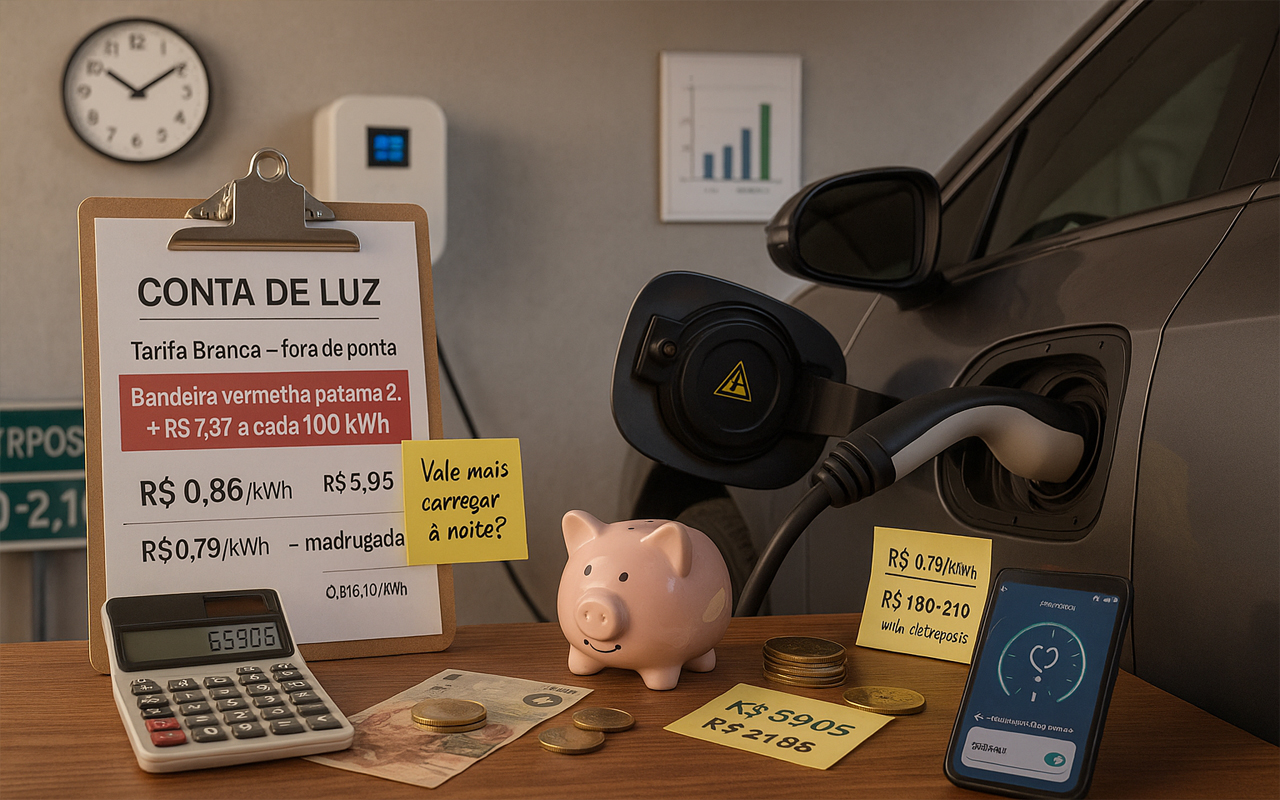
The question “how much does it cost to charge an electric car at home?” has an objective answer and varies according to the tariff per kWh, the tariff flag of the month, and the battery capacity. In Minas Gerais, for example, where Cemig serves most households, the official values per kWh are published and allow you to simulate your charging bill accurately.
Another crucial point is the tariff modality, those who opt for the White Tariff and charge off-peak (overnight and part of the business day) usually pay less per kWh than in the conventional modality. ANEEL itself explains that the White Tariff has different prices by time of day, peak (more expensive), intermediate, and off-peak (cheaper).
In August and September 2025, ANEEL maintained the red flag level 2, which adds R$ 7.87 for every 100 kWh on the bill. It is an additional charge on consumption that affects the final cost of charging the electric car and needs to be included in your calculation.
-
Chery Offers Lifetime Battery Warranty and Car Replacement for Major Failures Under New Chinese Regulations

-
Nissan Discontinues Qashqai SUV Amid Cost-Cutting, Chinese Competition, and Product Line Review
-
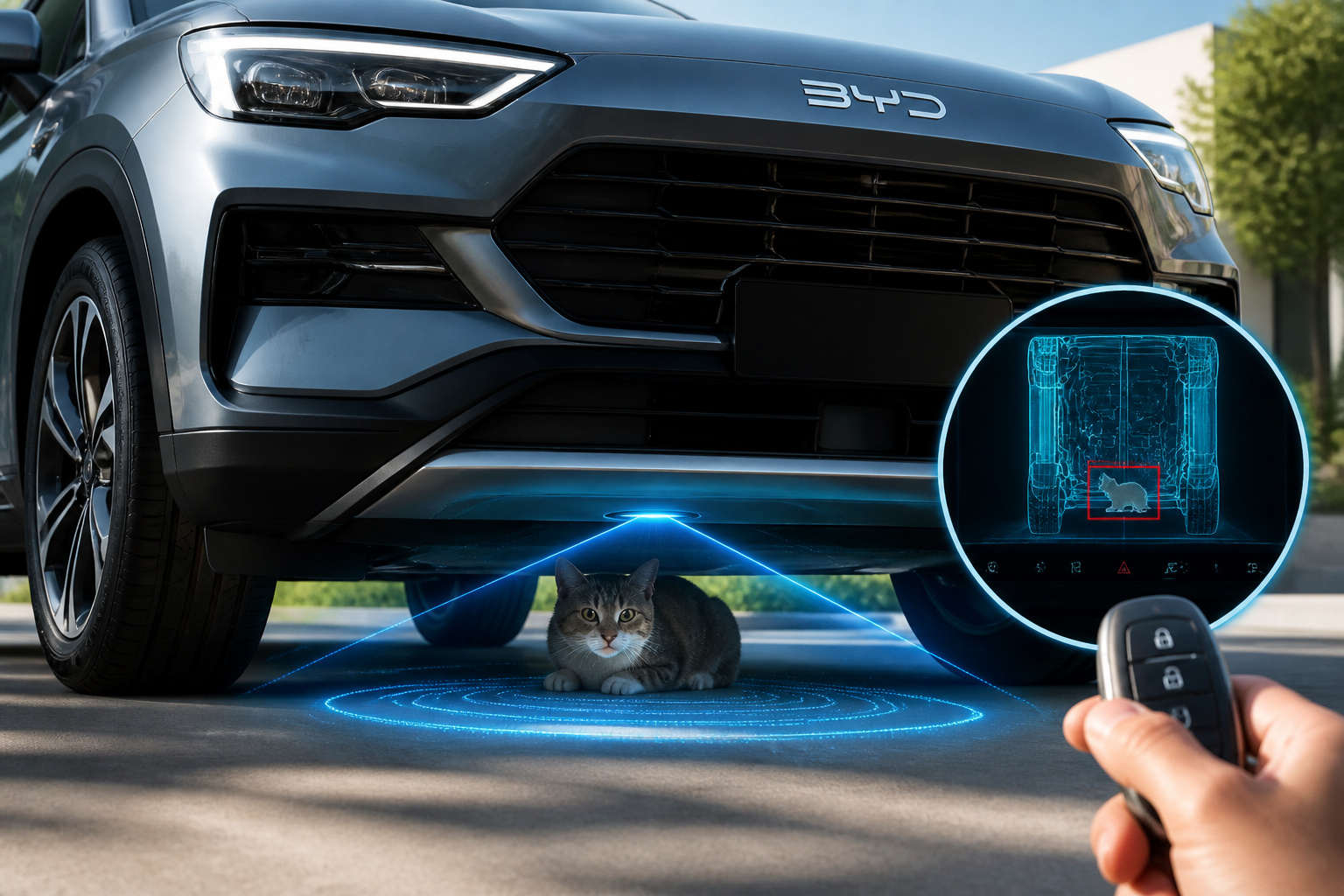
BYD Patents Revolutionary System Using Computer Vision to Detect Animals Under Cars Before Starting, Preventing Tragedies

-
BMW Completes $1.7 Billion Investment in the U.S. for Electric Vehicle Production, Positions South Carolina for New Generation as Rivals Reassess EV Race



It’s worth noting that prices vary by region and distributor, the numbers below take Minas Gerais (Cemig) as a reference, as it is one of the hubs of electromobility in the country, and are useful as a benchmark for other regions in Brazil.
How Much It Costs to Charge an Electric Car at Home (Cemig/MG)
In the “White Tariff – Off-Peak”, Cemig’s public table indicates R$ 0.70933/kWh with green flag and R$ 0.78810/kWh with red flag 2 (values “before taxes”). These prices result from the adjustment approved by ANEEL valid from 28/05/2025 to 27/05/2026. Practical translation: charging at night is cheaper.
Example 1 — 63 kWh battery (empty to full):
• Off-Peak (green flag): 63 × 0.70933 = R$ 44.69 (before taxes).
• Off-Peak (red flag 2): 63 × 0.78810 = R$ 49.65 (before taxes).
If you are in the conventional modality (without White Tariff), the economic base sums TUSD 541.30 + TE 317.28 = R$ 0.85858/kWh (green) and goes to ~R$ 0.937/kWh with the red flag 2 — hence a full charge costs around R$ 59.05 (before taxes).
Example 2 — 44.9 kWh battery:
• Off-Peak (green flag): 44.9 × 0.70933 = R$ 31.85.
• Off-Peak (red flag 2): 44.9 × 0.78810 = R$ 35.39.
• Conventional (red flag 2): 44.9 × 0.93728 ≈ R$ 42.08 (before taxes). Moral of the story: programming charging off-peak consistently reduces the electricity bill.
Charging Station (Public Charger), Price Per kWh and When It Makes Sense
In paid charging stations, the typical price range in Brazil is between R$ 1.50 and R$ 2.10/kWh, depending on the power and charging network — a value well above the off-peak residential kWh. In July 2025, market reports and guides reported these levels at networks like Tupinambá and Shell Recharge.
In recent launches, such as the EZ Volt hub in RJ, the rate was R$ 2.50/kWh (fast DC) and R$ 2.07/kWh (slow/AC). In other words, convenience and speed cost more — useful for travel, but can weigh on the budget if done regularly.
Comparison per 100 km (average consumption of 15 kWh/100 km):
• At home off-peak (green): 15 × 0.70933 ≈ R$ 10.64/100 km.
• At home off-peak (red flag 2): 15 × 0.78810 ≈ R$ 11.82/100 km.
• Charging station at R$ 1.80/kWh (example): R$ 27.00/100 km; at R$ 2.50/kWh, R$ 37.50/100 km.
The consumption of 15 kWh/100 km is a market parameter cited in technical materials and international comparisons.
Electric Car vs Gasoline, Cost per Km with ANP Price
For gasoline, the national average price during the week of 17–23/08/2025 was R$ 6.19/l. If the car achieves 12 km/l, every 100 km consumes 8.33 l, which results in ~R$ 51.58/100 km — 4 to 5 times more than electric when charged at home off-peak.
Summary: even with red flag 2, the electric remains cheaper per km for daily use.
Growth of Electric Cars and Infrastructure: The Scenario in Brazil
Sales of electrified vehicles (BEV, PHEV, HEV, and HEV Flex) continue to rise in 2025; ABVE indicates consolidated participation in the range of 8% and progress month after month — with the Southeast maintaining ~46–47% of registrations, a sign of faster adoption where income and infrastructure are also growing.
The charging infrastructure is also advancing. In February 2025, Brazil already had 14,827 public and semi-public charging points, compared to 350 at the end of 2020 — a leap that improves the viability of trips and reduces range anxiety.
How to Pay Less to Charge an Electric Car: White Tariff, Flags and Charging Efficiency
If you have the availability to charge at night and on weekends, the White Tariff tends to yield cheaper kWh; during weekdays, off-peak hours have a lower tariff than conventional, ANEEL explains. Set the timer on your car or wallbox for the overnight hours and reap the benefits.
Keep an eye on the tariff flags, with red flag 2 in effect, the additional charge is R$ 7.87/100 kWh — including it in your calculations prevents surprises on your bill. Quick example: 200 kWh in the month adds up to R$ 15.74 just in flag charges.
Finally, consider the charging losses, at home, with a wallbox, practical tests show losses around 5–10%, lower than with a standard outlet. Translation: if the battery “gained” 40 kWh, the grid may have delivered ~44 kWh. Plan your bill using a small technical additional.