Portuguese
  Spanish


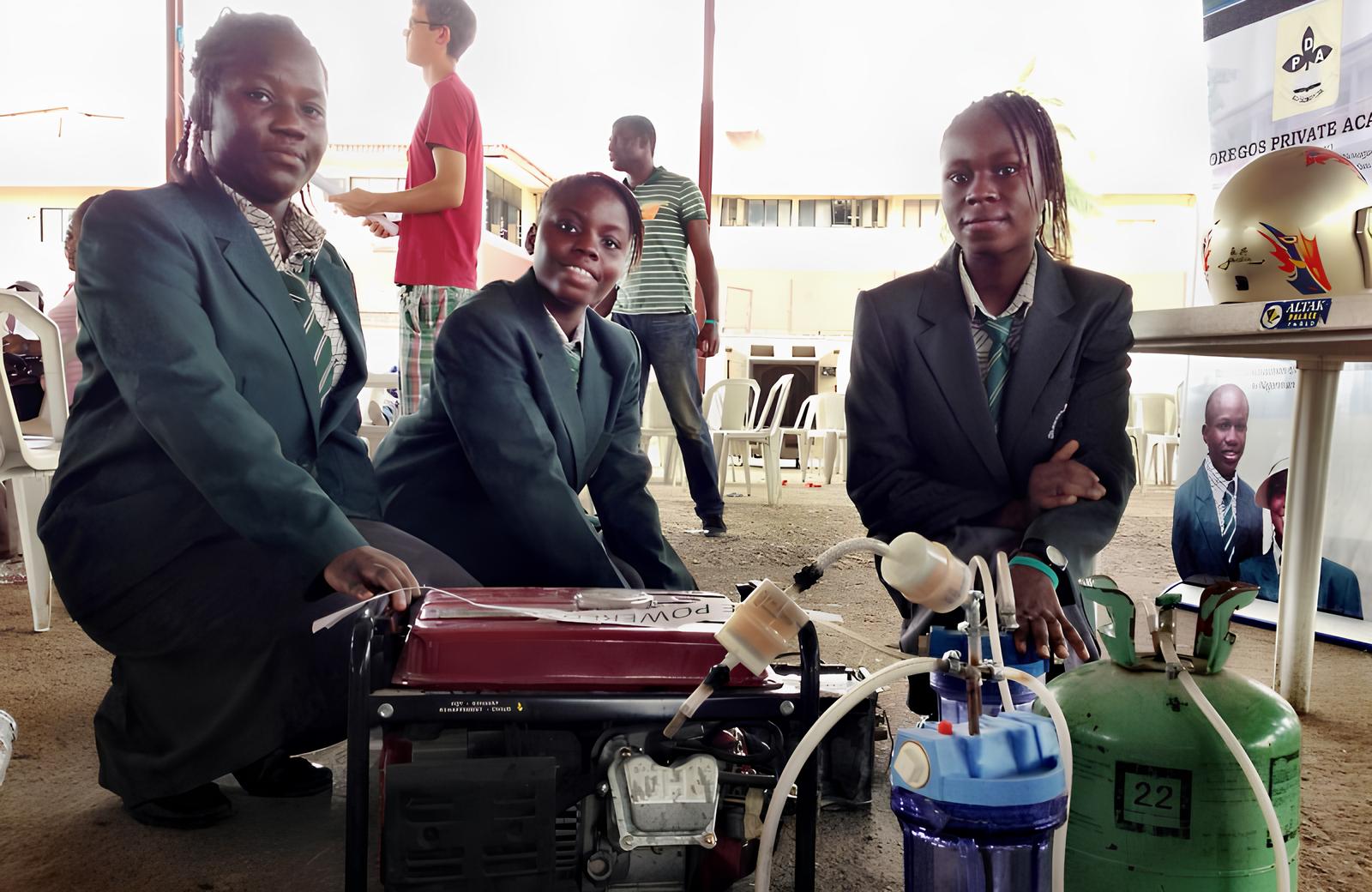


In 2012, Four Nigerian Teenagers Created a Prototype of a Urine-Powered Generator. Creative Idea Gained Worldwide Attention, but Has Technical Limitations.
In 2012, during the Maker Faire Africa, in Lagos, four Nigerian teenagers surprised the audience with a bold prototype: a urine-powered generator. The young women — Duro-Aina Adebola, Akindele Abiola, Faleke Oluwatoyin, and Bello Eniola — presented the project as a creative alternative to a chronic problem in their country: constant power outages and the difficulty of accessing reliable energy. The proposal seemed like something out of a futuristic experiment. Using one liter of urine, the device would be able to generate up to six hours of electricity. The idea immediately went viral in newspapers, technology blogs, and social media, provoking astonishment, curiosity, and heated debates about the potential of this innovation.
How the Urine-Powered Generator Works
The principle of the prototype lies in the hydrogen present in urea, the main component of urine. The process can be summarized in steps:
- The urine is placed in an electrolytic cell, where electrolysis occurs to separate hydrogen.
- The extracted hydrogen passes through a water filter and then through another one with borax, reducing explosion risks.
- This gas, now purer, feeds the generator and produces electricity.
In theory, it is a way to use an abundant and free waste product as fuel. Besides the reduced environmental impact, it would be a means of generating energy in communities with limited resources.
-
Longest Solar Eclipse of the Century Will Turn Day to Night for Over 6 Minutes, Allowing Star Gazing; Won’t Recur for 156 Years

-
Brazilian Researcher Develops Protein Supplement from Tilapia Waste, Combining Innovation and Sustainability with Economic Potential

-
Women in São Paulo Unknowingly Tracked by Coin-Sized Tags Hidden in Cars and Belongings, Raising Stalking Concerns
-
Near a $750 million AI data center in Brazil, a resident’s well runs dry, leaving her unable to afford the $25,000 needed for repairs.


Potential and Limitations
Despite the enthusiasm, experts were cautious. The process of electrolysis consumes energy, raising the question: does the system really produce more energy than it consumes? Additionally, the safety of handling hydrogen is a delicate point, as it is a highly flammable gas.
The initial reports themselves — like the famous slogan “one liter of urine generates six hours of electricity” — did not make it clear what exactly was being powered.
Were they LED bulbs? A fan? Or larger appliances? This lack of technical data prevents any talk of a scalable or commercially ready solution.
Still, the prototype was considered a milestone of creativity and social awareness. In a country where over 40% of the population experiences a lack of reliable electricity, the proposal symbolizes the search for local solutions to local problems.
The Symbolic Impact
More than the immediate technical viability, the urine-powered generator gained prominence for another reason: it represented the ability of young people, especially girls, to innovate in science and technology fields in challenging contexts.
The four Nigerian girls became an inspiration in educational and scientific campaigns, showing that disruptive ideas can arise from anywhere. For many, the project served as a warning that investing in scientific education in Africa can generate talents capable of tackling global issues.
An Open Future
Since the presentation in 2012, there have been no reports of the prototype advancing to large-scale use. But the idea planted important seeds: today, various energy laboratories are studying ways to utilize urea to generate hydrogen more efficiently and safely.
Even if the “urine-powered generator” of the Nigerian teenagers still remains more symbolic than practical, it played an essential role: to provoke reflection on energy alternatives in a planet that is seeking cleaner and more accessible sources.
The case of the four young women shows that innovation does not solely depend on cutting-edge technology, but on creativity in the face of scarcity.
If, in the future, more advanced methods of extracting hydrogen from urine become viable, we might look back at this prototype as a first step — a moment when four teenagers dared to imagine energy coming from where no one expected.