Portuguese
  Spanish


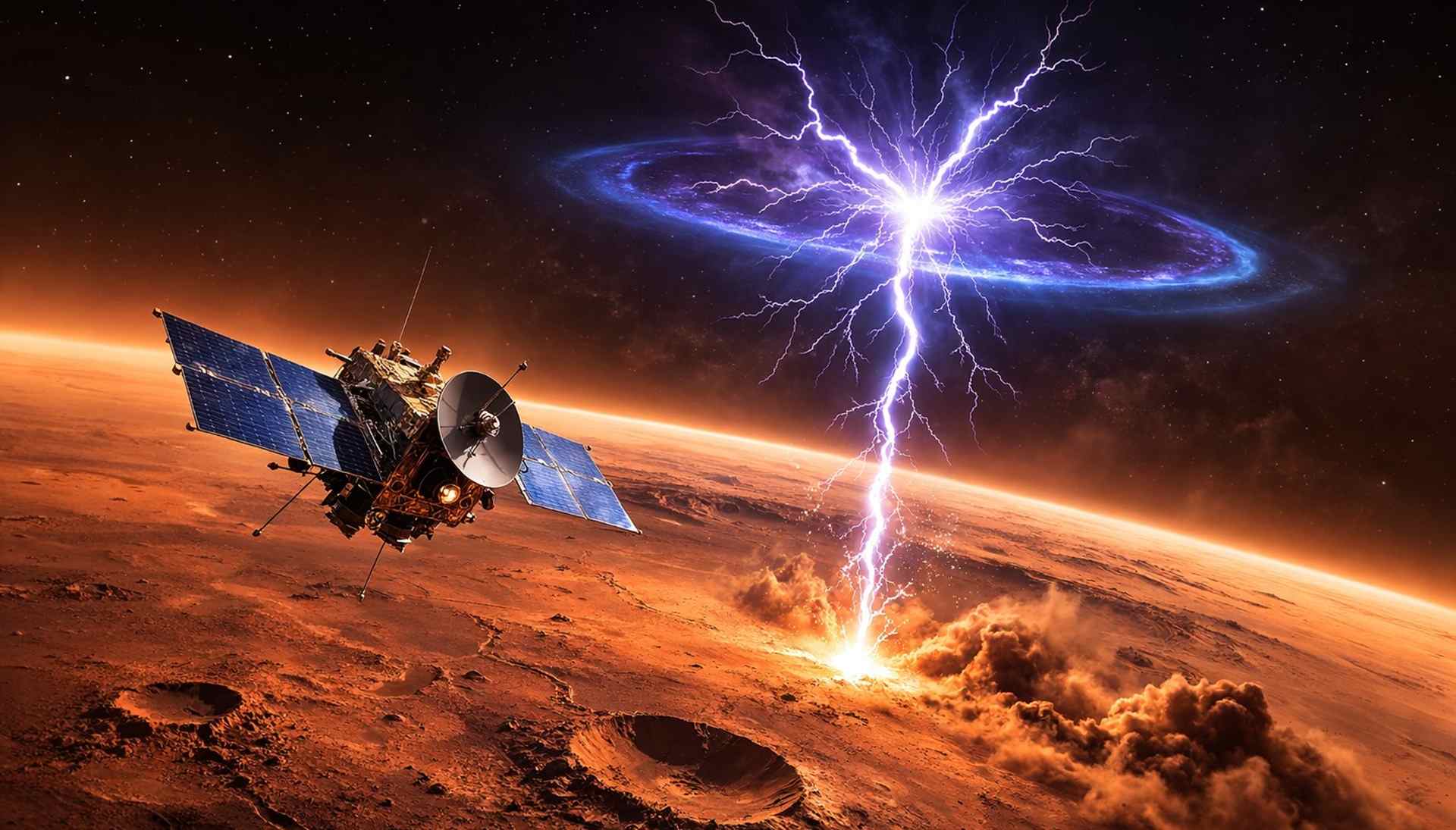

Unprecedented Detection of Whistler Lightning Recorded by the MAVEN Probe at an Altitude of 349 Kilometers on the Night Side of Mars Confirms Propagation of Plasma Waves Similar to Earth and Strengthens Evidence of Electrical Activity Associated with Dust Storms in the Martian Atmosphere
A lightning bolt was identified on Mars for the first time after the detection of an unusual electromagnetic signal recorded by NASA’s MAVEN probe on June 21, 2015, indicating the occurrence of electrical discharge in the Martian atmosphere and expanding evidence of electrical phenomena on the red planet.
Unprecedented Detection of Lightning on Mars Was Recorded by the MAVEN Probe
The characteristic signal associated with a lightning bolt was captured while the MAVEN probe orbited Mars during its scientific operations that began in 2014. The recording revealed a phenomenon known as “whistler,” a dispersed radio wave produced by electrical discharges.
This type of signal occurs when electromagnetic emissions generated by lightning traverse a planet’s ionosphere and begin to propagate as plasma waves along the lines of the magnetic field.
-
Extreme Heat of 41.3°C Warps Roads in Germany, Causes Autobahn Asphalt to Crack, Injures People, and Forces Snowplows to Cool Down Highways

-
AI Security System in Brazil Aims to Cut False Alarms by Differentiating Pets from Intruders, Enhancing 24/7 Monitoring for Homes and Businesses

-
Archaeologists Discover 1,500-Year-Old Byzantine Mosaic with Greek Biblical Inscription in Israel, Uncover Ruins of 10 Buildings Near Kiryat Gat
-
Ohio Carpenter Finds 308-Gram Meteorite the Size of a Baseball After Dreaming of Its Location




Researchers demonstrated that the recorded signal exactly corresponds to this physical pattern. The discovery confirms that electrical discharges can occur in the Martian atmosphere and that their waves follow principles similar to those observed in terrestrial lightning.
Although Mars shares several characteristics with Earth, atmospheric differences have always prevented direct confirmation that similar electrical phenomena occurred on both planets.
Formation of Lightning on Mars Occurs Without Significant Presence of Water Vapor
On Earth, lightning is normally associated with clouds loaded with water vapor. Mars, however, has an extremely dry atmosphere, which has raised doubts for decades about the possibility of natural electrical discharges.
Scientists emphasize that moisture is not necessary for the formation of a lightning bolt. Electrical discharges also occur in terrestrial environments like large clouds of volcanic ash, where moving particles accumulate electric charge.
Mars experiences intense and frequent dust storms. The friction between suspended sand particles during these weather events can generate sufficient charge accumulation to produce electrical discharges similar to those observed in other planetary environments.
The year prior to the study, researchers had already announced the detection of electrical discharges likely associated with the movement of particles during Martian dust storms.
Electromagnetic Whistler Confirms Propagation of Lightning Through the Martian Ionosphere
When lightning occurs, it emits electromagnetic radiation at various frequencies, including low-frequency radio waves. These waves can travel upwards through the ionosphere and move as plasma waves guided by the magnetic field.
As higher frequencies propagate faster than lower ones, the signal disperses over time. When converted to audio from the scientific data, it produces a descending sound similar to the distant call of a whale.
Mars does not have an active global magnetic field, which initially made the propagation of this type of signal unlikely. However, the planet maintains localized regions with preserved magnetic fields in magnetized minerals of its crust.
These crustal fields are fossilized remnants of an ancient global magnetic field and had been pointed out in studies conducted decades ago as possible facilitators of the propagation of electromagnetic whistlers.
Analysis of 108,418 Records Led to the Identification of the Only Lightning Event
The team led by atmospheric physicist František Němec from Charles University thoroughly analyzed 108,418 recordings of plasma waves obtained by MAVEN in search of signals compatible with a whistler lightning bolt.
The analysis revealed only one confirmed event. The signal was detected over a region with a crustal magnetic field, at an altitude of 349 kilometers on the night side of Mars.
The location was considered crucial. Under direct sunlight, the Martian ionosphere compresses, preventing the efficient propagation of the plasma waves necessary to create the detectable whistler.
The phenomenon exhibited characteristics almost identical to those observed in terrestrial lightning. The signal lasted approximately 0.4 seconds and showed a gradual decrease in frequency over time.
The recorded intensity was about ten times higher than the background noise measured by the scientific instruments.
Scientific Modeling Indicates Discharge Comparable to Strong Lightning on Earth
The researchers modeled the local magnetic field and plasma density in the event region. By combining this data with the estimated travel time of the signal from the Martian surface, they obtained an almost perfect match with the recorded signal.
Although the detected signal in orbit was relatively weak, the analysis accounted for natural losses during propagation through the ionosphere.
With this correction, the energy estimated at the origin of the phenomenon indicated an electric discharge comparable to that of strong lightning according to terrestrial standards.
The study also explained why similar signals are rarely detected on Mars. In addition to the limited number of orbiting probes monitoring the planet, the necessary conditions are extremely specific.
Less than 1% of the analyzed records were obtained in regions with magnetic geometry suitable for allowing signal propagation.
Extremely Rare Conditions Explain Low Frequency of Lightning Detection
For a Martian lightning bolt to be recorded, it is necessary for several factors to coincide simultaneously. The event must occur in a region with an almost vertical magnetic field, on the night side of the planet, and under sufficiently weak ionosphere.
Furthermore, the electrical discharge needs to be powerful and occur exactly at the moment when a spacecraft equipped with suitable instruments is passing over the location.
These constraints indicate that lightning may occur on Mars more frequently than currently recorded, even if they are rarely detected directly.
Electrical Discharges Expand Studies on Prebiotic Chemistry on Mars
Laboratory experiments on the origin of life have shown that electrical discharges can trigger the formation of essential organic molecules.
Processes similar to lightning are considered possible drivers of prebiotic chemistry on primitive Earth.
If equivalent discharges occur on Mars, they become yet another element analyzed by astrobiologists in the investigation of potentially favorable past conditions for life on the planet.
The research results were published in the scientific journal Science Advances.