Portuguese
  Spanish


Discovery challenges a classical rule of physics by showing that the path of energy in turbulent flows can be altered in the laboratory
Turbulence, long seen as one of the most difficult phenomena to predict in physics, has gained a new chapter. Researchers have demonstrated that the direction of energy flow in a turbulent system can be manipulated, contradicting a rule used for over 80 years to explain how whirlpools, currents, and chaotic movements distribute energy.
The discovery does not mean that airplanes, seas, and storms can be controlled immediately. The advancement lies in another, deeper point. It shows that turbulence is not just chaos, but a physical process that can respond to the geometry of the forces applied to the fluid.
The study was conducted by researchers from the University of Pittsburgh, in the United States, in collaboration with scientists from the University of Turin, in Italy, and published in the journal Science Advances. The basis of the work is the attempt to understand whether turbulent energy must always follow the path predicted by classical theory or if it can be redirected under certain conditions.
-
Spanish Startup Develops Europe’s Densest Solid-State Battery at 402 Wh/kg

-
Telescope Launched 80 Billion km from Earth Could Use the Sun as a Giant Lens to Magnify Exoplanets, Potentially Revealing Continents, Oceans, and Signs of Life

-
Australian Researcher Turns Discarded Coffee Grounds into Eco-Friendly Bricks with 80% Less Pollution and Double the Strength Required by Law

-
Scientific Tool Developed in Brazil Aims to Prevent Femicide by Identifying Risk Factors and Strengthening Women’s Protection


What the discovery changes in the theory of turbulence
Turbulence occurs when fluids like water, air, or gases stop moving smoothly and start forming whirlpools, vortices, and seemingly disordered movements. It is found in ocean waves, ocean currents, the air around airplane wings, blood in certain medical devices, and even in industrial systems.
Since the studies of Andrey Kolmogorov in 1941, physics has worked with a central idea. In three-dimensional flows, like seas and the atmosphere, energy tends to pass from larger structures to smaller structures until it is dissipated. In two-dimensional flows, like very thin layers of fluid, this behavior is usually the opposite, with energy migrating from smaller scales to larger ones.
The new study challenges this rigidity. Instead of accepting that the direction of energy is defined solely by the dimension of the system, the researchers showed that it can also depend on the alignment between forces, deformations, and internal stresses of the fluid.
In practice, this means that turbulence may be less “immutable” than previously thought. The phenomenon remains complex but is now seen as something that can be oriented, at least in controlled environments.
How the researchers managed to reverse the path of energy
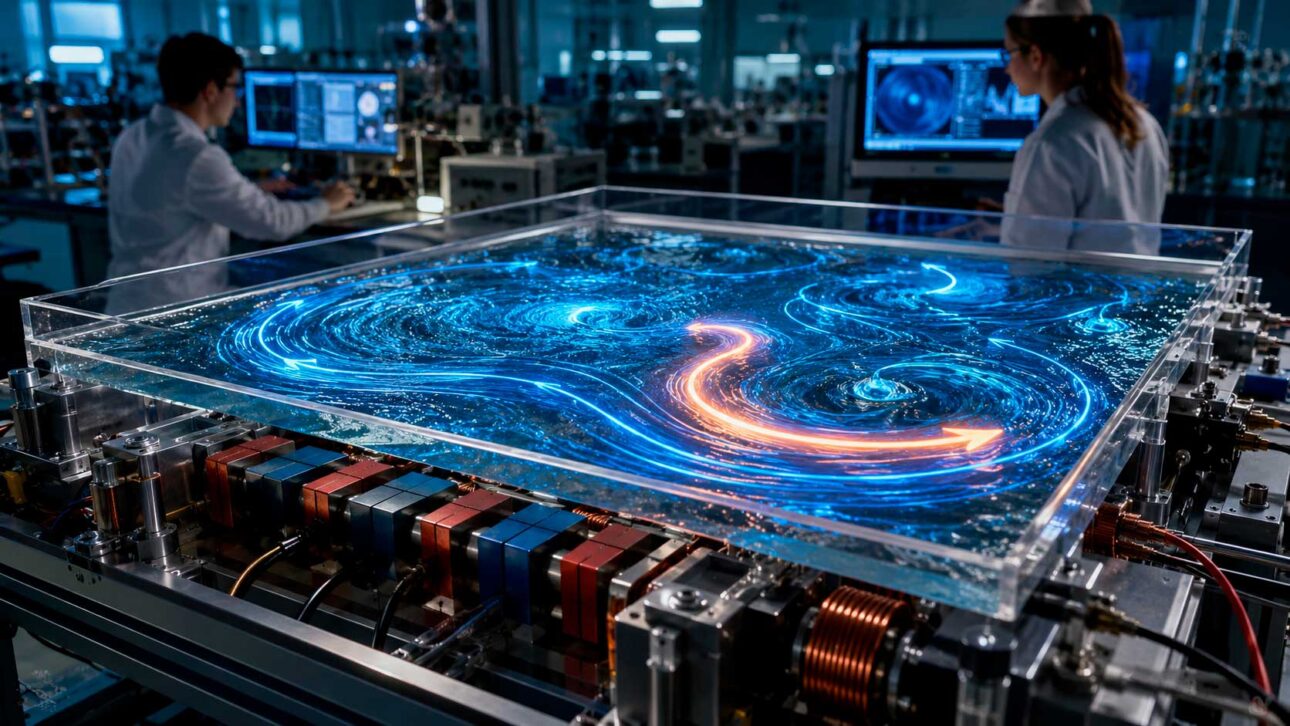
To test the idea, the team used a thin-layer flow system, driven by electromagnetic forces. The experiment involved a shallow layer of liquid, magnetic fields, rods to disturb the movement, and tracer particles to visualize how the fluid moved.
This type of setup allowed for the creation of a kind of two-dimensional turbulence. The decisive point was adjusting the geometry between the applied forces and the fluid’s response, using a mathematical approach based on tensors, objects used to describe direction, stress, and deformation in physical systems.
When this alignment changed, the energy transfer also changed. Instead of following only the expected pattern for two-dimensional turbulence, the system began to exhibit energy flow to smaller scales, something contrary to the classical expectation for this type of environment.
The results appeared in both physical experiments and numerical simulations. This combination makes the finding stronger because it reduces the chance of the effect being just a measurement error or a peculiarity of the equipment used in the laboratory.
Why this may matter for oceans and coastal pollution
One of the most cited applications by researchers involves ocean currents and transport barriers at sea. These barriers function as regions that hinder the dispersion of substances, sediments, nutrients, or pollutants.
By better understanding how energy moves within turbulent flows, scientists can develop more accurate models to predict how contaminants spread in coastal areas. This can be relevant for sewage, leaks, industrial waste, and other substances that reach the sea.
The research suggests that small physical disturbances, when well-positioned, could influence much larger transport structures. The group itself cites the possibility of barriers up to ten meters disturbing coastal structures on a kilometer scale, although this depends on new studies before any practical use.
This point is important because it’s not about “taming the ocean,” but understanding which forces can alter the organization of energy in natural systems. The difference is significant, as the real sea involves wind, salinity, temperature, depth, underwater relief, and many other factors.
Medicine and microfluidics also enter the radar
The advancement may also have impact on medical and laboratory technologies that work with microfluidics. In these systems, liquids move through extremely small channels, often less than a millimeter.
At this scale, mixing fluids is often difficult. Viscosity dominates the movement, and turbulence practically disappears. This can limit laboratory tests, chemical analyses, biomedical devices, and systems that need to mix small amounts of substances quickly and precisely.
The new approach points to an interesting possibility. By aligning force and displacement in a specific way, it would be possible to generate a weak form of turbulence at a low scale, sufficient to improve mixing without relying on intense movements.
This could aid in the development of lab-on-a-chip devices, portable medical tests, and devices used to manipulate drugs, reagents, and biological fluids. It is still a prospect in the research phase, but it shows how a basic physics discovery can cross boundaries and reach applied areas.
What this has to do with climate and weather forecasting
Turbulence is a central piece in climate and atmospheric models. Ocean currents and air circulation help distribute heat, moisture, and energy across the planet, influencing rainfall, temperatures, formation of weather systems, and behavior of air masses.

When models do not accurately represent turbulence, forecasts can lose precision, especially on smaller scales. Therefore, any advancement that improves the understanding of energy flow in fluids can have implications for climatology and meteorology.
The authors treat this possibility with caution. They do not claim that the study immediately improves climate forecasts, but indicate that the new model can help scientists better represent certain processes related to winds, currents, and energy transfer in the ocean and atmosphere.
The relevance lies in the fact that climate depends on interactions between very different scales. Small disturbances can influence larger structures, and larger structures can feed smaller movements. Understanding this exchange is one of the great challenges of climate science.
Discovery is promising, but still does not solve the problem of turbulence
Despite the scientific impact, the discovery does not solve the mystery of turbulence. It remains one of the most complex problems in physics, precisely because it involves nonlinear movements, multiple scales, and strong sensitivity to initial conditions.
The study shows that the direction of energy flow can be manipulated in a controlled environment and in a specific configuration. This is very relevant, but still far from direct applications in airplanes, storms, entire oceans, or large industrial systems.
The main contribution is in changing the question. Instead of just trying to predict where turbulent energy goes, scientists now have a conceptual tool to investigate how the geometry of forces can alter this path.
This change could open a new phase of research in fluid dynamics. From it, other groups may test if the same principle applies in more complex three-dimensional systems, in natural environments, and in engineering equipment.
An advancement that transforms chaos into a scientific tool
Turbulence is often associated with disorder, but the new research reinforces an increasingly important idea in modern science. Even chaotic phenomena can carry patterns, internal rules, and control points.
By showing that turbulent energy can be redirected through the geometry of forces, the study expands the understanding of turbulence in fluids, ocean currents, microfluidics, and climate models. The advancement is still in its early stages, but it shakes one of the foundations of fluid physics.
If future studies confirm the method’s scope, the discovery could help create technologies to mix fluids on a microscale, improve predictions about pollutant dispersion, and refine models used to study the climate.