






 Portuguese
  Spanish


20 kilometers from Catolé do Rocha, in the sertão of Paraíba, UEPB researchers found hundreds of rock carvings spread over 4.6 kilometers of rocks — after almost 30 years of prospecting, what seemed to be just another rocky outcrop hides what may be Brazil’s largest archaeological complex
According to a report by Portal Correio, researchers from the Archaeology and Paleontology Laboratory (LABAP) of the State University of Paraíba (UEPB) discovered a complex of rock carvings in Malhada de Areia, a rural area of Catolé do Rocha, which may be the largest in Brazil.
The area extends for approximately 4.6 kilometers of rocky outcrops.
Hundreds of rock images have been documented — and researchers believe the actual extent is even greater than what has been mapped so far.
-
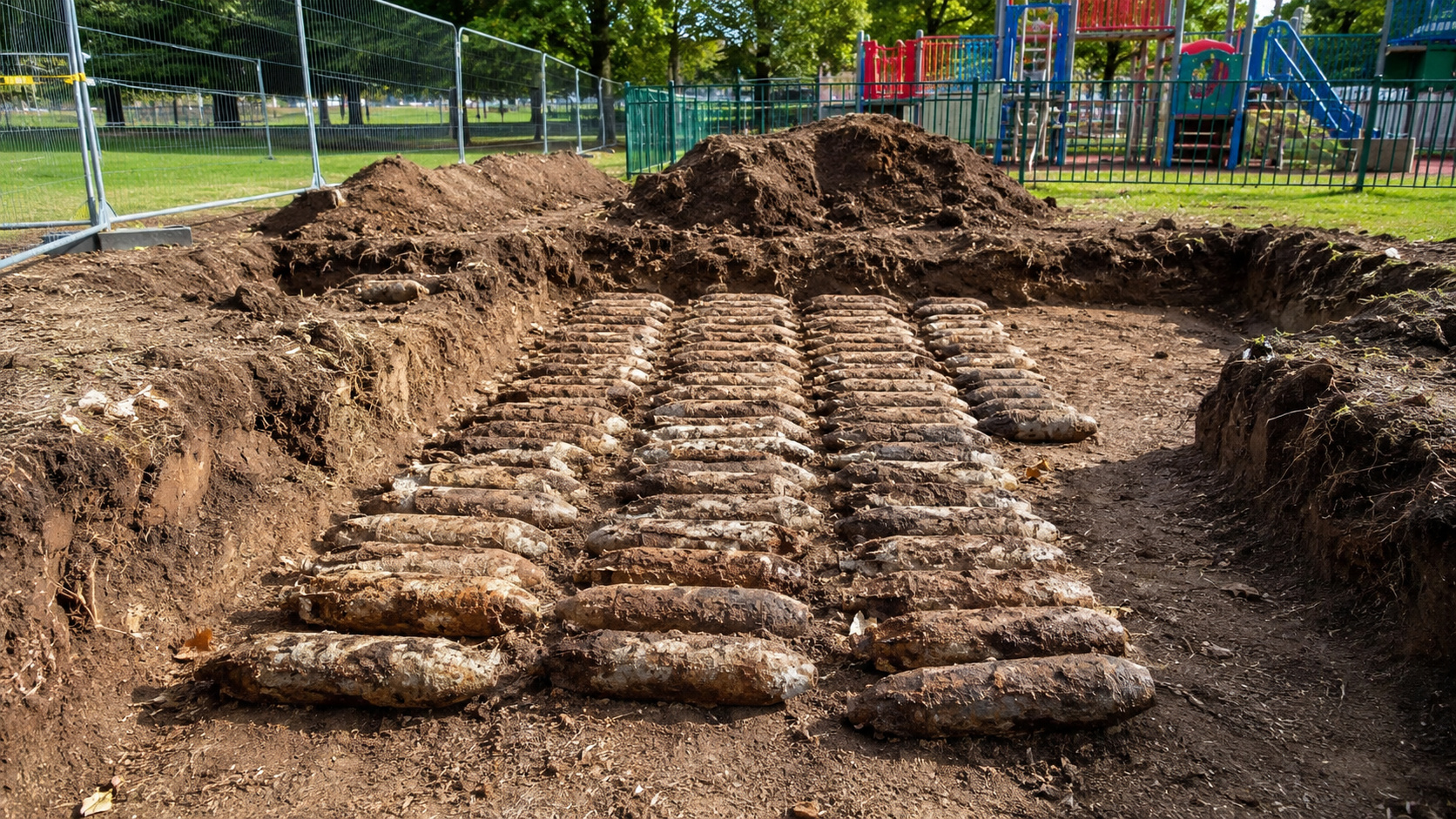
Workers renovating a playground in northern England uncover 176 World War II bombs buried underground; training artifacts still contained explosives.

-
Brazilian Architect Transforms Waste into Sustainable Homes with Solar Power and Rainwater Systems for 40 Years

-
Security Guard Becomes Doctor at Louisiana Hospital Where He Once Worked, Studied Chemistry Between Shifts

-
Engineers Develop Fridge-Sized Machine to Produce 95-Octane Synthetic Fuel from Air and Water, Aiming to Sustain Combustion Engines Without Oil




A discovery that took almost 30 years of searching
Professor Juvandi de Souza Santos, coordinator of LABAP, explained that the laboratory has been conducting prospecting throughout the Paraíba territory for almost three decades.
In the last three years, the focus has been on the state’s Sertão region.
It was during one of these expeditions that the team arrived at the private property in Malhada de Areia.
What they found there surprised them: rock after rock, for kilometers, was covered with carvings made by prehistoric peoples.
Furthermore, according to a Canaltech report, the site is located about 20 km from the center of Catolé do Rocha.

The marks of a people who lived, passed through, and inhabited the sertão
Rock carvings are inscriptions made directly on rock by peoples who lived in the region thousands of years ago.
According to Professor Juvandi, the inscriptions were left by “a people who existed, passed through here, and lived.”
The authors of the carvings were gatherers, hunters, and fishermen who inhabited the Paraíba sertão in prehistoric times.
However, the exact age of the carvings has not yet been determined — the complete mapping of the area is expected to take years, given the complexity and extent of the site.
Currently, the Pedra Branca and São Mamede sites are considered the largest in Paraíba.
However, researchers from UEPB believe that Malhada de Areia will surpass both once the survey is complete.

Why this could be Brazil’s largest archaeological site
Brazil has thousands of cataloged archaeological sites, but few have the continuous extension found in Catolé do Rocha.
Most known rock art sites occupy concentrated areas — caves, rock faces, or isolated outcrops.
In Malhada de Areia, the carvings spread continuously for 4.6 kilometers, occupying multiple rocky outcrops in the same region.
This extension is what leads researchers to believe that it is a complex — not just a site — with countless points yet to be explored.
To give an idea, the famous Serra da Capivara National Park, in Piauí, houses the largest collection of prehistoric sites in the Americas.
If Malhada de Areia confirms its total extension, Paraíba will enter the map of Brazilian archaeology with a comparable heritage.
- Location: Malhada de Areia, rural area of Catolé do Rocha, Paraíba
- Distance from urban center: ~20 km
- Mapped extension: 4.6 km of outcrops with carvings
- Type of artifacts: rock carvings (hundreds documented)
- Institution: LABAP/UEPB, coordination Prof. Juvandi de Souza Santos
- Prospecting time: almost 30 years in Paraíba territory

The challenge now is to map and preserve
The site is on private property, which adds a layer of complexity to preservation.
Detailed mapping is underway, but researchers warn that it will be a long and complex task.
The same Paraíba that houses the largest carnivorous dinosaur footprint in Brazil, in Sousa, may now also have the largest complex of rock carvings in the country.
It is a reminder that the northeastern sertão, often associated only with drought and scarcity, holds under its rocks a historical richness that science has barely begun to unravel.
Furthermore, the sertão of Paraíba already hosts other important archaeological sites, such as those of Pedra Branca and São Mamede, currently considered the largest in the state.
However, UEPB researchers believe that Malhada de Areia will surpass both once the complete survey is concluded — transforming Catolé do Rocha into the archaeological epicenter of Paraíba.
In this sense, the discovery reinforces a trend that Brazilian science has confirmed in recent years: the Northeast holds a much greater prehistoric heritage than previously imagined.
Similarly, other regions of the northeastern sertão have revealed sites with rock art, fossils, and vestiges of human occupation dating back thousands of years — challenging the narrative that the interior of the Northeast was always an empty land.
Therefore, each new discovery like that of Malhada de Areia is not just an academic finding. It is a window into understanding how ancient peoples lived, hunted, and organized themselves in a landscape that today we know only by drought and scarcity.
Above all, the fact that a complex of this magnitude remained unknown until 2021 — on a private rural property just 20 kilometers from a city — raises an inevitable question about how much more has yet to be found.
Thus, LABAP’s work in the coming years will not only be to map Malhada de Areia but also to ensure that the heritage is preserved — something that, on private property and without formal protection, is far from guaranteed.
Likewise, funding for archaeological research in Brazil is historically scarce, and mapping projects like this depend on limited university resources and competitive calls for proposals that do not always prioritize regional archaeology.
Thus, the preservation of the Malhada de Areia complex depends on articulation between the university, the state government, and the landowners. Furthermore, without official listing by IPHAN, the carvings are vulnerable to vandalism, erosion, and even agricultural expansion in the region.
How many other Malhadas de Areia exist scattered throughout Brazil, hidden on rural properties that no one has even thought to investigate?


