Portuguese
  Spanish


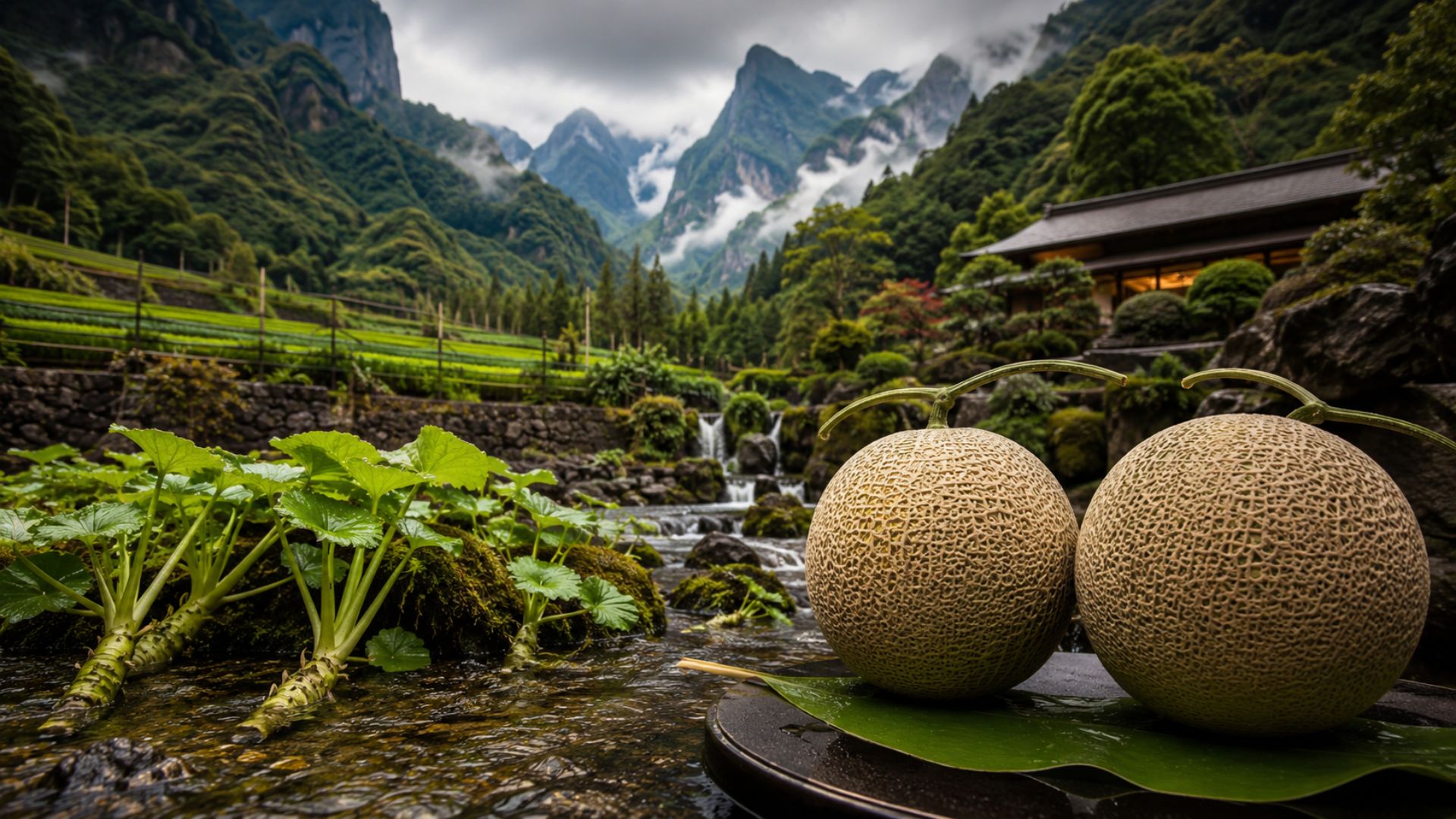


The most recent proof came this month: on May 22, 2026, a pair of melons was auctioned for about $36,000 in Sapporo, a historic record. Behind the prices is an obsession with perfection where each fruit grows alone on the vine, and real wasabi takes up to two years to mature.
In a country where about 75% of the territory is mountainous and little land is left for planting, Japan has achieved a rare feat: turning scarcity into luxury. Instead of competing for volume, Japanese producers have bet on perfection, selling pairs of Yubari melons for values reaching tens of thousands of dollars and cultivating real wasabi, a delicacy that about 90% of the world has never truly tasted.
The logic is fascinating and was reinforced a few days ago. On May 22, 2026, a pair of Yubari melons was auctioned for about 5.8 million yen, equivalent to approximately $36,500, at the first auction of the season in Sapporo, the highest price ever paid for these fruits. This type of figure helps to understand how Japan, even with so little arable land, became a world reference in high-value-added foods.
Little land, high value
Japan’s starting point is unfavorable for agriculture. With most of the territory covered by mountains and only a small fraction of arable land, much less than in countries like the United States, the country could have resigned itself to relying on imports. Instead, it took the opposite path, investing in quality, strict control, and traceability to extract maximum value from each available hectare.
-
Researchers Turn Discarded Mango Pits into Hydrogel That Absorbs 400% of Its Weight in Water, Offering Agricultural Solution for Droughts and Waste Reuse

-
Flower strips in Brazilian farms become pest control strategy, attracting predator insects and reducing the need for chemical pesticides.

-
Yara acquires Texas ammonia plant for $1.3 billion, boosting global fertilizer competition with 1.3 million tons annual capacity
-
At 35, Lawyer Leaves Corporate Career to Turn 1-Hectare Farm into Organic Supplier for Schools in Southern Brazil


This philosophy permeates the entire Japanese food chain, from the sea to the mountains. Instead of just aiming to produce faster and in larger quantities, Japanese producers have spent decades, in some cases centuries, perfecting methods until they are almost forms of art. The result is foods that function as status symbols, often gifted on special occasions and sold in sophisticated packaging.
The melon that costs a fortune
The most emblematic example is the Yubari King melon, cultivated in the Hokkaido region. Originating from an old coal mining town that sought a high-value crop after the decline of the mines, it found ideal conditions in the well-drained volcanic soil. Auction prices vary greatly from year to year, depending on the economy and exchange rates, but they are usually impressive: the current record, about $36,500 for a pair, was set in May 2026.
The secret lies in the almost obsessive care. In many greenhouses, only one fruit is left per plant, so that all nutrients concentrate on it. Producers rotate the melon to receive light evenly, control temperature, light, and humidity as in a laboratory, and even use white gloves during inspection. It is worth remembering that the record values of the first auctions function more as a promotional gesture than as a real market price, as common melons of the same variety cost much less.
The wasabi that almost no one has tasted


Another Japanese treasure is the real wasabi, from the species known as Wasabia japonica. Here is a piece of information that surprises many people: most of what is served as wasabi around the world, and even in many restaurants, is not real wasabi, but a mixture of horseradish, mustard, and green coloring. Authentic wasabi is so rare that many Japanese have never even tasted the original version.
The reason for its rarity lies in the extremely demanding cultivation. The plant only thrives in cold, running mountain water, at temperatures ranging from 8 to 15 degrees, and any change in temperature, flow, or water quality can ruin the harvest. Additionally, a single root takes one to two years to reach the ideal point. The taste of real wasabi is also different: instead of aggressive spiciness, it brings a milder aromatic sensation that quickly dissipates in the mouth.
From the icy sea, more luxury
The obsession with perfection also comes from the sea. In the icy waters surrounding Japan, high-quality snow crab can be sold for thousands of dollars at auction, with each specimen inspected claw by claw. Only adult males within the standard are kept, while females and juveniles return to the sea to preserve the next harvest, in a care that combines luxury and sustainability.
There is also the hamachi, or yellowtail, raised in marine farms under strictly controlled conditions of temperature, oxygen, and feeding, to develop a soft and balanced fat that makes the meat shine like marble in sashimi. This type of fish can reach prices comparable to the famous wagyu beef, reinforcing how Japan treats even seafood as products of the highest refinement.
Tradition and fermentation
Not everything in Japan is expensive or sophisticated, and part of the charm lies precisely in popular and ancient delicacies. The wind-dried winter salmon, for example, is a centuries-old preservation technique from northern villages, made only with salt, sea breeze, and natural cold, without modern machines, preserving the umami flavor that has sustained Japanese cuisine for centuries.
Another curious case is natto, made from soybeans fermented by specific bacteria. With a strong aroma and sticky texture, it is a dish that often divides opinions and that many foreigners find strange at first taste. Even so, natto has existed for over a thousand years and remains present in millions of Japanese breakfasts, showing that tradition and identity weigh as much as sophistication at the country’s table.
Japan has turned its geographical limitations into a cultural and economic advantage, proving that a scarcity of land does not mean a scarcity of value. From melons that cost the price of a car to wasabi that takes years to grow, to seafood treated like jewels, the country has built a relationship with food where every detail matters. More than just feeding, Japanese production has become a showcase of discipline, patience, and an unrelenting pursuit of perfection.
And you, would you pay a high price to taste a Yubari melon or real Japanese wasabi? Did you know that much of the wasabi served around the world isn’t even real wasabi? Leave your comment, tell us which of these Japanese delicacies surprised you the most, and share the article with those who love gastronomy, Japanese culture, and food curiosities.