Portuguese
  Spanish


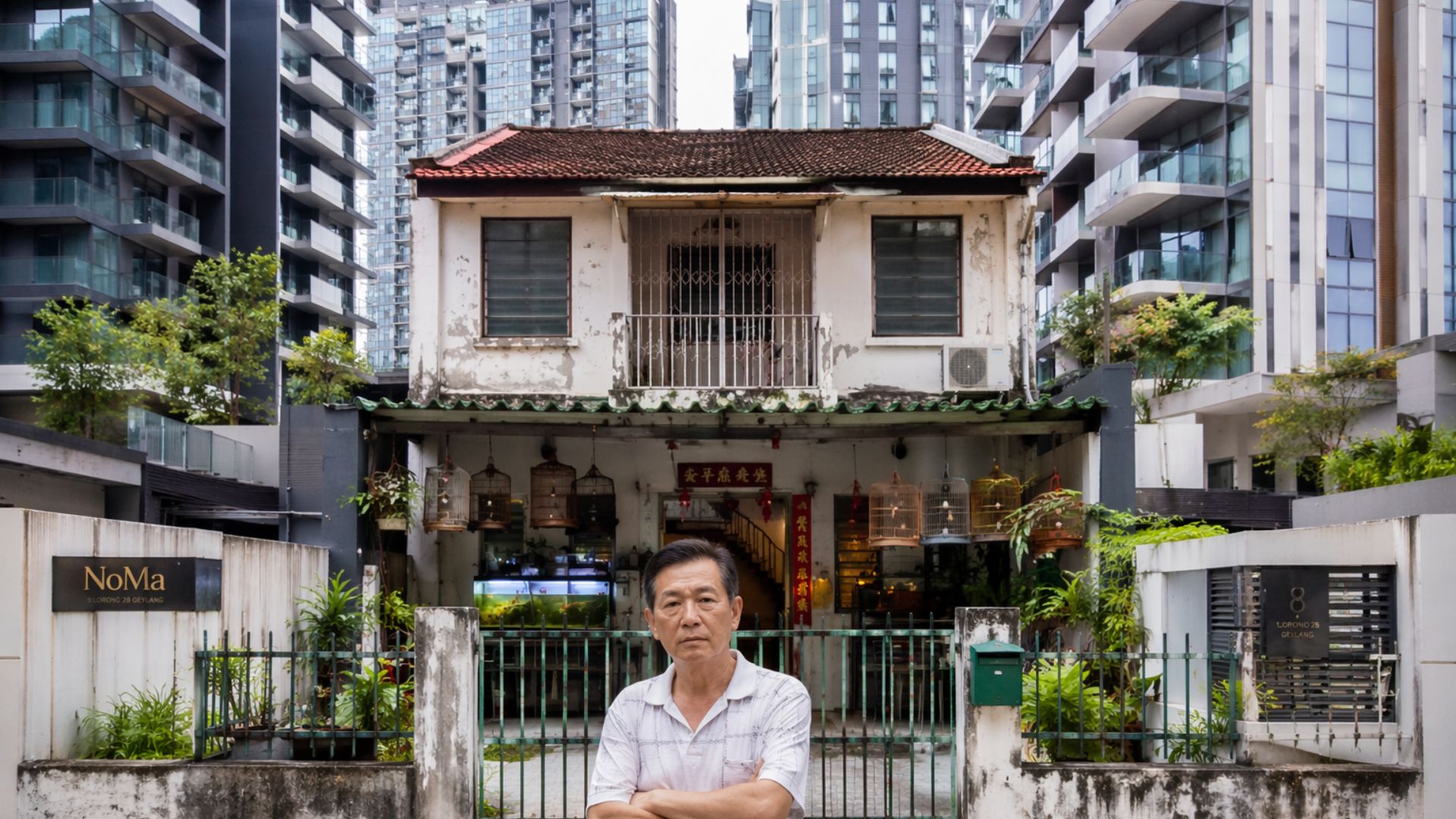

Real estate resistance in valued area of Singapore transforms old house into urban symbol surrounded by luxury condominium, after owner refuses million-dollar offer and forces adaptation of residential project in one of the most competitive markets in Asia.
The decision of a resident to keep his own house in Geylang, a traditional neighborhood in Singapore, led to a high-end condominium being built around the property and transformed the residence into a rare case of resistance to real estate consolidation in one of the most vertical cities in Asia.
Valued at around S$ 4 million, approximately R$ 15.2 million, the property was left out of the agreement closed by the developer to enable the NoMa project, a freehold residential development, a type in which the property is not subject to a lease term.
The property is located at Lorong 28 Geylang, in an area that has begun to concentrate new residential buildings amid older houses.
-
Company Offering “Stones to Diamonds” Scheme Sells Ruined Italian Homes to Brazilians for 1 Euro, Disappears with Promised Renovations, Leaving Buyers in Debt to Italian Tax Authorities Until 2028 Without Property

-
Plastic Packaging Drives Santa Catarina Industry to 230% Growth, Aiming for R$ 500 Million by 2030 Amid Sector Crisis, with New Gearless Line Expanding in Southern Brazil to Compete in South America

-
Flamengo Star Invests in Brazilian Coastal Luxury Real Estate as Itapema Surpasses Balneário Camboriú in High-End Market Growth
-
Brazil to Issue “Panda Bonds” in China, Aiming to Raise Up to 5 Billion Yuan at Lower Interest Rates Than Dollar Debt


To bring the project to fruition, the developer managed to purchase five neighboring residences, located at 56 Lorong 28 Geylang and at the numbers 331, 333, 335, and 339 Guillemard Road.
As two owners refused the offer, the design of the condominium had to be altered to navigate around the lots that remained outside the transaction.
As a result, the house that remained standing ceased to be just another old building in the neighborhood and began to stand out visually among larger blocks, high walls, and the new architectural language of the surroundings.
The contrast became even more evident with the completion of NoMa, which has 50 residential units and appears in the local real estate market as a boutique condominium in District 14, near Dakota and Aljunied.
Refusal to sell changes real estate project in Singapore

The story gained attention in Singapore because it brings together factors that rarely appear so clearly in the same case: a valued area, a million-dollar asset, the refusal of owners to sell, and the complete adaptation of a development to move forward without absorbing all the planned lots.
Instead of incorporating the entire block, the builder had to work with a fragmented lot, which resulted in an unusual layout for the condominium.
This type of impasse is known in the market as a holdout, a term used when an owner refuses to sell the property even in the face of a broader movement of land consolidation.
In Geylang, the concept has ceased to be just a term in the industry and has become a concrete image: the old house remained surrounded by new buildings, without the construction being interrupted.
The result was both urbanistic and symbolic, as it exposed the limits of negotiation in a market pressured by intensive land use.
Personal motivations behind the resident’s decision
Reports from the local press indicate that the decision not to sell was not presented as a public dispute with the developer nor as an attempt to raise the negotiation price.
What came to light was a motivation linked to the emotional weight of the house.
According to these reports, the property had been purchased by the resident’s mother, now deceased, and continued to be used as a residence by him and an older sister.
In this context, the house ceased to be treated merely as a real estate asset and appeared as a space associated with routine, family memory, and permanence in a region close to the city center.
Reports published in Singapore also describe the entrance of the residence with birdcages and aquariums, elements that reinforce the image of a lived-in address, rather than a property kept vacant while awaiting appreciation.

The valuation around S$ 4 million, mentioned in reports from 2020 and later picked up by local outlets, helps explain why the episode attracted so much attention.
This was not a devalued property or one without a market, but a plot located in a coveted area for developers and surrounded by projects with clear commercial potential.
Still, the owner preferred to stay, defying the prevailing logic of financial maximization in one of the most competitive markets in the region.
Luxury condominium built around the house
NoMa was launched as a high-standard freehold project, with a proposal for few units and located in the so-called city fringe of Singapore.
Local real estate market sources describe the condominium as a three-block development, situated precisely in the space that remained after the partial purchase of the neighboring houses.
The need to navigate around the two preserved lots gave the project an unusual configuration, noticeable to those passing through the area.
On one side, the house on Lorong 28 Geylang remained.
At another point in the complex, a property on Guillemard Road also remained outside the negotiation, described by the local press as a Buddhist prayer hall with restricted use to the family and acquaintances of the owner.
The continuity of the works, even without the purchase of all the lots initially desired, led to the two addresses coexisting with tall facades, new structures, and controlled condominium circulation.

The uniqueness of the case lies less in the fact that an old house has survived and more in the way this permanence occurred.
In many similar episodes, disputes of this kind end in prolonged legal battles, project revisions, or work suspensions.
In Geylang, the development was completed and the residence remained in the same place, now inserted into a landscape completely redesigned by verticalization.
Urban transformations in Geylang and architectural contrast
The coexistence between old buildings and recent constructions is not exactly new in Geylang, a region that has been undergoing gradual changes in its urban profile for years.
What made this episode more emblematic was the scale of the contrast.
The preserved house was not only next to a new building but practically encapsulated by a real estate complex conceived from its absence in the business.
Therefore, the address ended up gaining relevance beyond visual curiosity.
The case began to illustrate, in a very concrete way, how individual decisions can interfere with the logic of urban renewal even in cities with rigid planning and a heated market.
By remaining where it has always been, the house became an involuntary landmark about the weight that belonging, memory, and everyday use can still have when confronted with million-dollar offers and large-scale redevelopment projects.