Portuguese
  Spanish


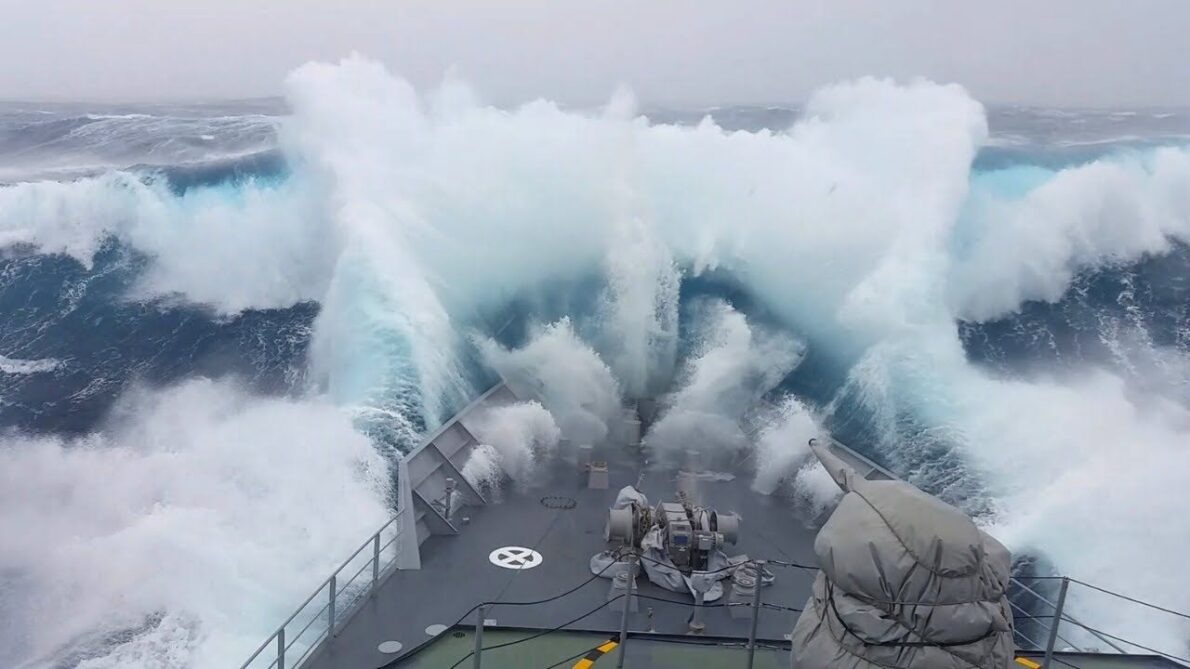

Understand How Advanced Engineering and State-of-the-Art Stabilization Systems Allow Large Ships to Withstand Monster Waves and Remain Afloat Even in the Most Violent Storms.
Have you ever wondered how large ships manage to withstand monstrous waves during storms? These colossi of the sea, which carry tons of cargo, face forces of nature that could easily sink smaller vessels. The answer lies in the combination of advanced engineering and cutting-edge technologies that make these maritime giants nearly indestructible.
In the middle of the ocean, where the forces of nature dominate, ships need to become islands of stability. To achieve this, they are equipped with various stabilization devices. Bilge keels, for example, act like invisible anchors that help keep the ship stable even when waves hit it hard.
Active Stabilization Systems Are Even More Sophisticated on Large Ships
Another crucial device is the anti-roll tanks. These water-filled tanks act as dynamic counterweights that move to balance the ship. When the ship rolls to one side, the water inside the tank moves in the opposite direction, neutralizing the motion and keeping the ship stable.
-
They exchanged the idea of a large house for a 35 m² warehouse, spent US$ 12,000 on the structure, and created a tiny house in Colorado with space to live and work.

-
While modern cities rely on pumps and electricity, in Iran, ancient tunnels carried water through the desert using only slope and gravity.
-
Instead of sending families far from the city, a project in Chile intentionally created incomplete houses on expensive urban land and left technical space for each to grow.
-
General Motors Replaces Over a Thousand Workers with 50 Cobots at Electric Vehicle Plant, UAW Union Criticizes Move Amid Industry’s Automation Push


Active stabilization systems are even more sophisticated. They use sensors and smart algorithms to detect changes in sea conditions and automatically adjust the ship’s movement. This includes active fin stabilizers, which are fins mounted on the sides of the ship’s hull. These fins can move in various directions, controlled by gyroscopic systems, to counterbalance the ship’s movement and keep it stable.
New Companies Are Exploring the Use of Artificial Intelligence and Machine Learning to Predict Sea Conditions
In addition to withstanding waves, ships are designed to prevent capsizing even in extreme conditions. Self-righting boats, for example, are equipped with pendulum systems that allow them to flip 180 degrees and return to their original position if turned upside down. These safety systems are developed by leading maritime technology institutions, such as the Royal National Lifeboat Institution in the United Kingdom.
Maritime technology companies are continuously innovating to improve safety and stability on ships. New companies are exploring the use of artificial intelligence and machine learning to predict sea conditions and adjust stabilization systems in real-time. Others are developing lighter and more resilient materials to build more efficient anti-roll tanks.
Large Ships Are Testaments to Human Ingenuity
In addition to stabilization systems, modern ships are equipped with a variety of safety measures. Advanced communication and location systems allow the crew to request help swiftly in case of an emergency. Personal safety equipment, such as life jackets and inflatable boats, is essential for crew safety.
The next time you see a large ship sailing calmly on the horizon, remember the incredible technology that makes this possible. These sea giants are testaments to human ingenuity and the ability to face and overcome nature’s most severe challenges.