






 Portuguese
  Spanish


Rome Crumbled Under Corruption and Abuse of Power. The Warning Echoes Even Today in the Fragilities of Modern Democracies.
Sometimes, systems do not break due to external blows. They wear out silently from within, gradually corroded. Rome did not lose its Republic overnight. It was not a single enemy or a war that brought it down.
What destroyed Rome was a slow process, built vote by bought vote, general by general disobeying the Senate, and senator by senator preferring to enrich themselves rather than protect the institutions. Corruption became routine. It was not an accident, but an accepted practice by many.
Power Became an Investment
In the 2nd century BC, holding a magistracy in Rome ceased to be prestigious. It became an economic opportunity.
-
Artesian Well Becomes Lifeline for Small Brazilian Farm: Drilling Reaches 60 Meters, Finds Marble, Navigates Rock Fissures, and Strikes Fresh Water

-
Street Cleaner in Brazil Finds Discarded Books That Helped His Wife Pass Civil Service Exam and Become Police Captain
-
July’s Night Sky to Feature Planetary Alignments, New Moon, Venus at Sunset, Buck Moon, and Two Meteor Showers

-
Fisherman Catches 18kg Catfish Near Brazil’s Itaipu Lake, Among Largest Recorded in Recent Years




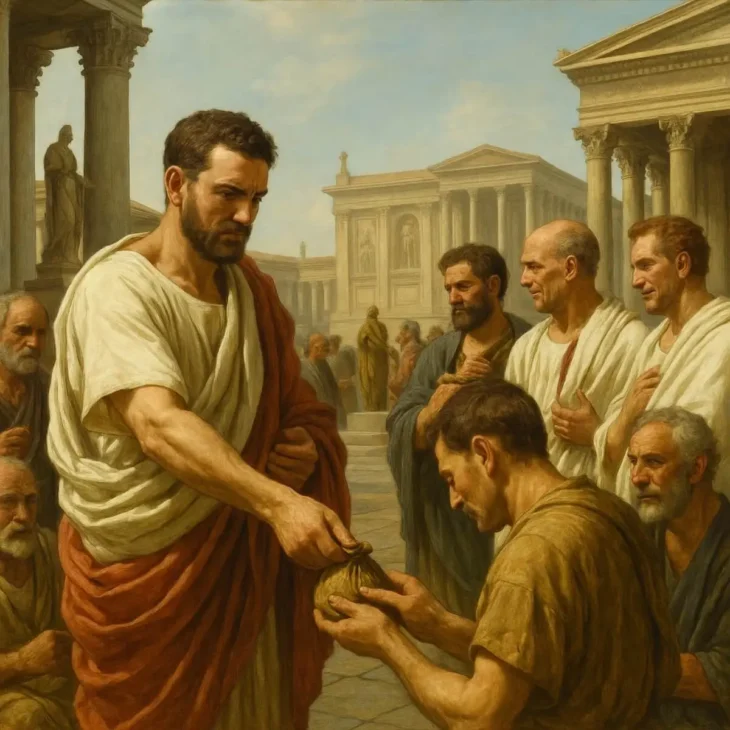
Election campaigns required enormous spending. One had to fund public spectacles, provide meals, and make costly promises. Many candidates went into debt, confident they would recover everything, and more, once in office.
The buying of votes became normal. Networks of clientelism exchanged coins, favors, and advantages. Not participating in this game became stranger than joining it.
Politics turned into a high-risk business. Only the powerful or the desperate dared to compete.
This behavior also contaminated the provinces. Governors acted like viceroys, pressuring local inhabitants.
Taxes were inflated, lawsuits were sold, and abuses were ignored. Corruption ceased to be an exception and became the rule.
An Isolated Senate
The Senate, once the center of deliberative power, became an exclusive club. Great patrician families controlled the most influential positions. New voices were blocked. It was not enough to be wealthy: one had to have a surname and private alliances.
Many senators did not even attend sessions. They claimed health issues or delegated votes to allies.
Important decisions were no longer public but made at banquets. Laws ceased to be debated and became negotiated. The ideal of participation turned into an empty routine.
There were attempts at reform. Limits on re-election, harsher penalties for bribery, and oversight of public accounts were proposed.
But they stalled. Those who should implement them were the ones benefiting from the system. The result: nothing progressed beyond paper.
Justice for the Few
The Roman Republic prided itself on having written laws. But access to justice became unequal. Judges were, for the most part, from the same elites that dominated politics. Impartiality was just talk.
Corruption trials became spectacles. Many times the verdict was already known even before the first hearing. One of the most emblematic cases was that of Verres, governor of Sicily.
Accused of extortion and pillaging, he was only convicted because Cicero prevented, with great oratory and popular support, the postponement of the trial.
Most of the time, corrupt individuals were acquitted and rewarded with new positions. In addition, the courts served as a political weapon.
Accusing a rival was more effective than debating. Without strong allies or money to defend themselves, a convicted person was ruined. Justice became a tool for personal ambition.
Empty Values
The Republic was founded on values such as virtus (courage), fides (loyalty), and mos maiorum (tradition of the elders).
By the end of the 2nd century BC, these words were still spoken, but they were no longer lived. Young aristocrats learned to dissimulate, to manipulate, not to serve.
The imported luxury of Greek culture also had an impact. What was once considered excess became a symbol of power.
Extravagant villas, endless banquets, jewelry, and exotic slaves became signs of prestige. Austerity began to be seen as weakness.
Economic ostentation was not just personal taste. It served to establish hierarchies, gain political support, and humiliate adversaries.
The republican simplicity was replaced by cynicism. The notion of a community of equal citizens was corroded by inequality and corruption.
On the Brink of Collapse
Corruption was not just a symptom. It was an active force in the destruction of the Republic. As institutions lost credibility, violence appeared as a solution.
The agrarian reforms of the Gracchi brothers were blocked by interests in the Senate. The response was assassination. Dialogue was replaced by bloodshed.
Generals began to replace magistrates as leaders. Men like Marius and Sulla, with personal armies, blackmailed the State. The Senate, weak and divided, depended on them. Rome learned to live in a state of emergency.
When Julius Caesar crossed the Rubicon, he did not face a strong Republic. He faced a political corpse. Corruption was not the sole reason for the fall, but it left it vulnerable to authoritarianism.
Brazil, and the Price of Cynicism
The end of the Republic was not an accident. Nor a simple consequence of territorial growth. It was the result of conscious decisions. It was the fruit of the abdication of duty, the normalization of abuse, and the conversion of power into personal privilege.
Rome did not fall into the hands of barbarians. It fell into the hands of the Romans themselves. Men who, believing themselves above the law, made corruption the norm and justice a weapon. Their legacy is a warning. The story of the Roman Republic is not just a past chapter: it is a caution.
And What About Brazil?
Is it possible to see, in our days, some movements that deserve attention? There are those who observe practices of buying political support, exchanging favors, staffing institutions, and episodes of corruption that, from time to time, shake the trust of the population. Are we gradually getting used to this?
In certain situations, is there not a lingering doubt about the real impartiality of justice? Are all treated the same way? Or are there cases where some are spared while others are pursued more rigorously?
If the Roman experience serves as a lesson, perhaps the greatest risk is not in the large isolated scandals, but in the accumulation of small daily concessions. In the normalization of practices that, little by little, weaken what should be solid.
When personal interest overrides the public interest, would it not be natural for the functioning of institutions to begin to weaken?
The path of decay is usually slow, made up of small choices, negotiated votes, adapted laws, and relativized values.
Rome did not fall suddenly. It emptied slowly. A little each day, vote by bought vote, law by negotiated law, value by forgotten value.
Perhaps the point is precisely there: how far can we perceive when we begin to tread this same path?


