






 Portuguese
  Spanish


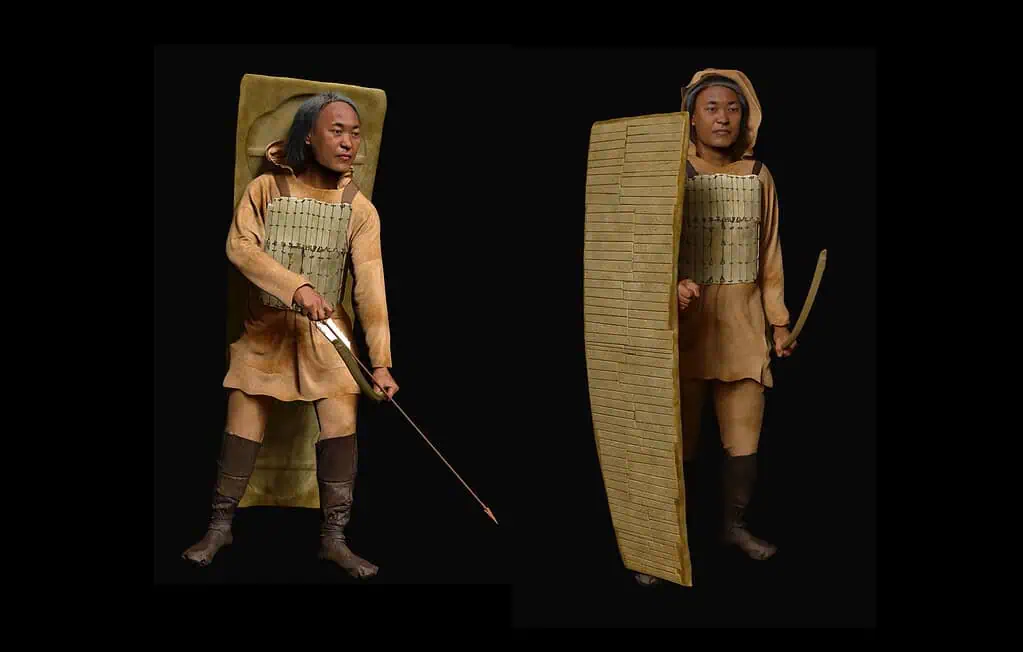

4,000-Year-Old Warrior Buried Under Bone Shield Has Face Reconstructed. Discovery Reveals Impressive Details of Ancient Culture Preserved in Ice
In the beginning, there were only bone plates emerging on the frozen surface of Siberia. But what appeared to be a common find revealed something much larger. A Stone Age warrior, buried with a shield made of bones and a past marked by battles, had his face reconstructed after four millennia.
The discovery took place in 2004 during excavations in the Kerdugen region of the Republic of Sakha, Russia. Alexander Stepanov, one of the most experienced excavators on the team, found precisely arranged bone fragments just seven centimeters deep. The excavation quickly gained importance.
The site hid an unusual tomb, preserved in permafrost. There lay the remains of a man from the Ymyyakhtakh culture, a nomadic group of hunter-gatherers.
-
Xiaomi Unveils Ultra-Slim Washer-Dryer with Over 30 Programs, Hygienic Steam, Smart Drying, 15-Minute Quick Wash, App Control, and Space-Saving Design

-
Brazilian Researchers Develop Ultrasound-Based Breast Scanner Using Warm Water, Currently Undergoing Clinical Validation

-
Brazil Develops Its First Locally-Made 5G Radio Unit, Achieves Over 1.5 Gbps in Lab Tests, Paving the Way for Interoperable Equipment
-
El Niño Intensifies: Over 90% Chance of Persisting Until 2027, Raising Ocean Temperatures and Increasing Severe Weather Risks in Southern Brazil, Warns Federal Report




He was wrapped in armor made of over 100 bone plates. And beside him, signs that this body concealed a violent, ritualistic, and mysterious story.
Archery Warrior Buried with Wapiti Shield
The analysis by archaeologists revealed that the man was buried with a shield made of wapiti bones, a large elk from the region. Six of the plates had arrowheads embedded in them.
This indicated that he had participated in confrontations. The body showed several fractures, healed wounds on the skull, and damaged joints.
Experts pointed out that he was likely a right-handed, experienced archer. “He could have been a warrior-archer,” said Liliya Alekseeva, director of the Archaeology and Ethnography Museum at NEFU and responsible for the reconstruction project. “There is such a term — war dogs. It seems to me that this is exactly about our hero.”
Based on radiocarbon dating, the burial took place about 3,800 years ago, at the end of the Neolithic period. The man’s height was 1.65 meters. He was between 40 and 50 years old at the time of death — an advanced age for that period. His tomb was shallow, only 35 centimeters deep, but well-preserved.
In addition to the armor and weapons, the burial contained personal items. There was a hoe made of slate and a small pouch, possibly used as a tool kit.
The presence of these objects, along with the way the body was buried, indicates that he held a high status within his community.
Signs of Ritual and Fire under the Warrior’s Head
During the excavation, archaeologists found fragments of a second skeleton, stacked beside the warrior. This finding raised hypotheses about the possibility of a ritual sacrifice.
In similar sites in Siberia, signs of this type have already been recorded. But, to this day, there is no confirmation of exactly what occurred in that burial.
Another detail caught attention. The warrior’s skull showed signs of burning. According to researchers, the fire may have been intentionally lit as part of a rite of passage.
“The burning of the head obviously indicates that the soul of a person is in the head or the hair,” explained Alekseeva. This type of practice combined spiritual symbolism with practical functions of purification.
Despite the shallow depth, the tomb withstood the passage of time thanks to the region’s permafrost. This allowed scientists to preserve and analyze the remains in great detail. With advances in technology, it was possible to go further.
Digital Reconstruction and Encounter with the Past
The warrior’s face was reconstructed by scientists from the North-Eastern Federal University (NEFU) in Yakutsk. The project, called “Face to Face with the Past,” utilized digital scans of the skeleton and burial artifacts.
Techniques such as photogrammetry and the craniofacial reconstruction method developed by Mikhail Gerasimov were key in the process.
The specialists gathered hundreds of images to create 3D models. From the data, they produced a realistic sculpture of the man’s face. The bust is now displayed at the NEFU Museum of Archaeology and Ethnography, allowing visitors to see what the warrior who lived nearly four millennia ago looked like.
The result is striking. The face shows a man with strong features, a pronounced jaw, and an aged expression. According to researchers, he resembles modern populations of Arctic Siberia. After thousands of years, he has regained an identity.
Four Decades of Archaeological Dedication
The reconstruction was only possible thanks to years of work in the field. Liliya Alekseeva, who led the project, has been involved in excavations for over 40 years. “The field season becomes not just a job,” she shared. “Without it, like without a breath of air, it becomes impossible to live.”
Since 2004, researchers have followed every step: from the first contact with the bones to the three-dimensional reconstruction. The project highlights how science, technology, and dedication can unite the past with the present.
Today, the warrior rests in the museum, but his reconstructed face gazes at visitors with serenity. He has traversed centuries of ice, silence, and mystery — and now, he gains voice and memory. After four thousand years, the man buried under a bone shield is once again recognized.
With information from ZME Science.


