Portuguese
  Spanish


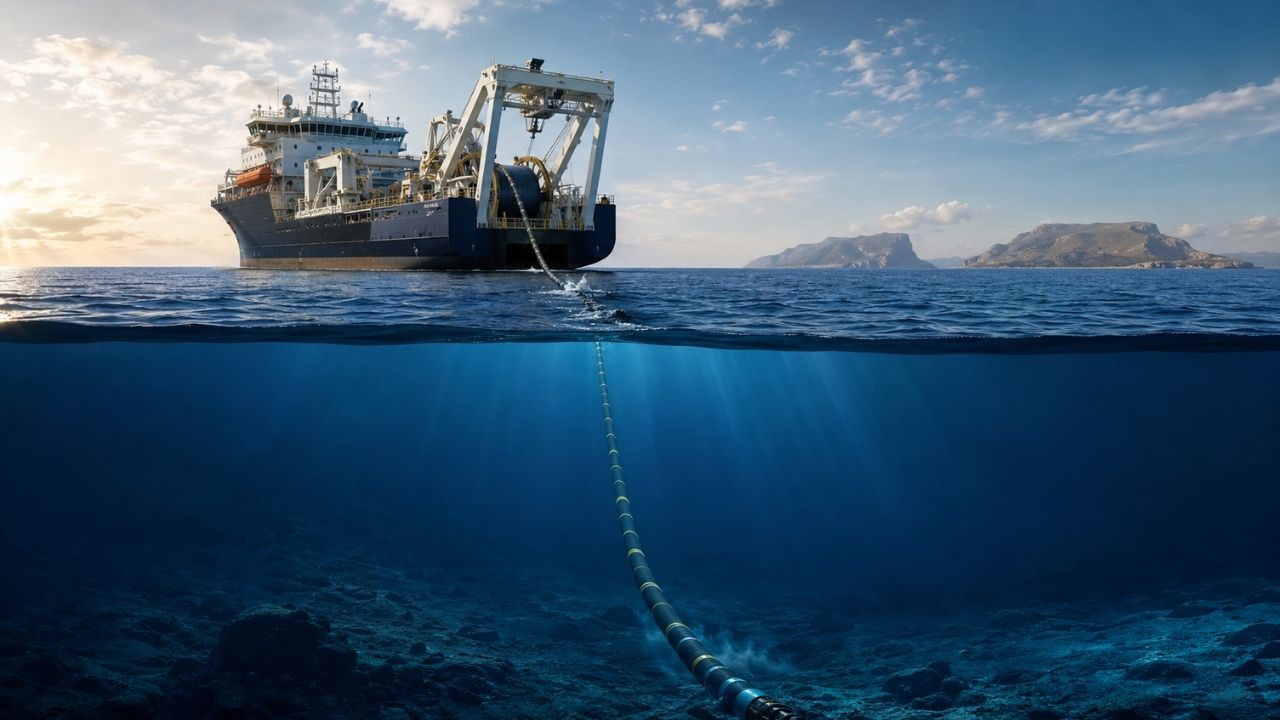


The submarine cable installed by Nexans in the Tyrrhenian Sea led Italy to a new world record in deep waters, consolidated a decisive stage of the Tyrrhenian Link, and reinforced electricity transmission between Sardinia and Sicily with 500 kV HVDC technology.
The submarine cable was the protagonist of an operation that placed Italy at the center of an unprecedented milestone in submarine engineering. Nexans completed the installation of a high-voltage system in the Tyrrhenian Strait and confirmed a world depth record of 2,150 meters, achieved during the offshore campaign carried out in December 2025 for the Tyrrhenian Link project, developed for Terna, the Italian transmission system operator.
According to the Nexans portal, more than a technical feat, the operation drew attention due to the degree of precision required in an extreme environment. It was not just about laying a structure on the seabed, but about installing a 500 kV HVDC cable in deep waters and, at the same time, closing the physical connection between Terra Mala, in Sardinia, and Fiumetorto, in Sicily, concluding the submarine phase of one of Italy’s most strategic energy projects.
The record in the Tyrrhenian Sea marked the final stretch of a decisive work

Nexans announced on January 7, 2026, that it had successfully completed the installation of the high-voltage submarine cable for the Tyrrhenian Link project. The record was reached the previous month, in December 2025, and the final stage of offshore execution ended on January 1, 2026, the date on which the second submarine section installation operation was concluded.
-
A Japanese governor single-handedly stalled the construction of the world’s fastest train for nine years, and only now has he agreed to allow a tunnel excavated at a depth of 1,400 meters.

-
Almost 1 billion euros, two gigafactories, and a million-dollar public investment, Chinese company aims to turn Spanish city into Europe’s new battery hub.

-
Advancement in the industry: Brazilian company creates ultralight material comparable to steel and paves the way for hydrogen cylinders up to 70% lighter, with a direct impact on logistics, the energy industry, and national competitiveness – learn about Forza Composites

-
In Brazil’s backyard: Tesla, by Elon Musk, announces official operations in Uruguay, where electric vehicles already make up 20% of new cars but still leaves out the largest market in the region.





This moment held special significance because it represented the completion of all high-voltage cable installation activities for which the company was responsible in the western section of the project. In practice, the operation sealed a concrete advance for an infrastructure designed to reinforce the Italian national electricity grid and increase the robustness of transmission between strategic areas of the country.
The numbers behind the operation help to gauge the scale of the project
The most striking data was the depth of 2,150 meters, a level that set a new world record for a high-voltage direct current submarine power cable. In projects of this magnitude, depth is not just an impressive number. It defines the degree of difficulty of the entire operation, from route preparation to the cable’s behavior on the seabed.
The western section of the Tyrrhenian Link, under Nexans’ responsibility, comprises approximately 480 kilometers of deep-water submarine cable, installed in two offshore campaigns, one of approximately 200 kilometers and another of about 280 kilometers. Considering the complete project, the Tyrrhenian Link consists of two 500 kV HVDC submarine connections, each about 970 kilometers long, with a total transmission capacity of 1,000 MW.
The most impressive part was not just the depth, but the precision required on the seabed
The most curious aspect of the work lies in the contrast between scale and delicacy. Installing a submarine cable more than two thousand meters deep requires a rare combination of engineering, route planning, specialized manufacturing, and operational control of the vessel responsible for the mission, the Nexans Aurora.
According to the company itself, achieving this result in a 500 kV HVDC system required extreme discipline in each phase of the process. Instead of a simple laying operation, the project involved a highly controlled technical sequence to ensure that the cable was installed safely, stably, and precisely in a scenario where any deviation could compromise the entire infrastructure.
Why this connection between Sardinia and Sicily matters to Italy
The Tyrrhenian Link was not conceived merely as a high-level engineering feat. It has a strategic function for Italian electricity transmission. By connecting anchoring points in Terra Mala, Sardinia, and Fiumetorto, Sicily, the system strengthens the national energy grid and expands the capacity for electricity transfer between relevant regions of the country.
According to Terna’s assessment, the milestone demonstrates the ability to face highly complex technological challenges and deliver infrastructure aimed at the stability, security, and adequacy of the Italian electrical system. In a scenario where national grids need to be more resilient and efficient, this type of interconnection gains not only technical but also economic and strategic importance.
The project expands the global dispute for increasingly complex energy infrastructure
The record achieved by Nexans also reveals a larger movement in the energy sector: the race for more robust, deeper, and more sophisticated submarine projects. High-voltage direct current interconnections have become central pieces for countries seeking to reinforce national grids, integrate territories, and increase supply reliability in increasingly demanding electrical systems.
In this context, Italy emerges as the stage for a project that combines extreme depth, long distance, and high transmission capacity. For Nexans, the result reinforces its position in complex HVDC deep-water projects. For the market, the case shows that the electrical infrastructure of the future increasingly relies on large-scale submarine solutions, executed with operational rigor and a high degree of specialization.
What this milestone reveals about the future of submarine power cables
The completion of the Tyrrhenian Link’s submarine installation phase leaves a clear message: the submarine cable has ceased to be merely a connection element and has taken on a central role in the expansion and modernization strategies of electrical grids. When an operation of this type reaches 2,150 meters in depth and completes a 500 kV connection between strategic islands, the impact goes beyond the record.
The case of the Tyrrhenian Sea deserves attention because it shows how far submarine engineering can go and indicates the direction of new investments in energy transmission. In an era where infrastructure, electrical security, and integration capacity are gaining increasing value, projects like this tend to become a benchmark for what is to come in the next few years.