Portuguese
  Spanish


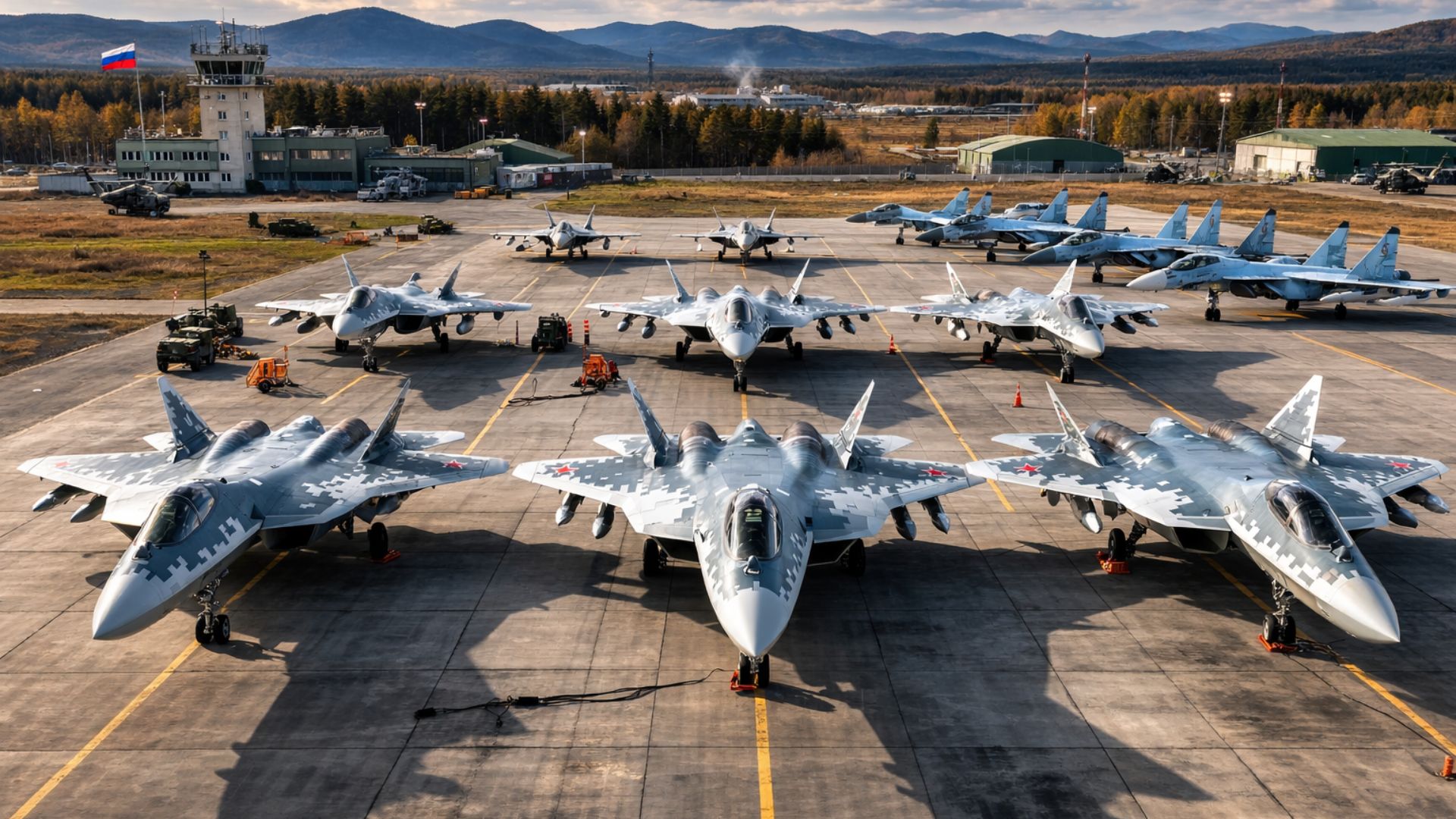

Unprecedented Concentration of Su-57 Fighters in the Russian Far East Rekindles Debate on Protecting Strategic Assets After Drone Attacks and Reveals, Through Satellite Images, the Simultaneous Presence of Fifth-Generation Aircraft and Advanced Vectors at a Base Near China.
Satellite images recorded on February 9, 2026, show Russia concentrating at least 15 stealth Su-57 fighters at Dzyomgi airbase in Khabarovsk, in the Far East, about 280 km from the Chinese border.
The same images, released by the AviVector project, also indicate the presence of 18 Su-35S, three MiG-31BM interceptors, and two Mi-8 helicopters in the yard, in an unusual grouping of high-performance aircraft.
Satellite Images Expose Concentration of Su-57 at Dzyomgi
According to the publication from AviVector, the aircraft are shown parked outdoors in ramp areas, providing rare visibility of the number of vectors at the site and the occupancy pattern observed on that day.
-
NASA Plans Telescope That Can Be Repaired by Robots 1.5 Million Kilometers from Earth

-
China Launches First Oceanic Medical Rescue Ship with Advanced Facilities to Serve Remote Regions

-
Midea Unveils Portable PortaSplit Air Conditioner: 12,000 BTUs, Quiet Mode, Heating, Dehumidification, App Control, and AI Efficiency Without Professional Installation
-
Singapore Turns Incinerated Waste Ash into Construction “Sand” in Ambitious Project to Revolutionize Megacity Waste Management


Reports following the images emphasize that Dzyomgi is in the Komsomolsk-on-Amur area, associated with the industrial infrastructure of the program, an aspect cited as a backdrop for the movements and concentration.
Su-57 Fleet and Numbers Still Unclear
The concentration draws attention because the Su-57 program operates under low public transparency, and open-source estimates vary depending on the criteria used, as Russian authorities do not provide a detailed total of units in service.
Recent news mentions the delivery of a “batch” of Su-57s to the Aerospace Forces on February 9, 2026, but does not specify how many units were transferred, keeping the count dependent on announcements and independent verification.
In this context, analysts compiling prototypes and production aircraft often speak of a fleet of several dozen, and it was in this context that specialized outlets regarded the number of 15 jets at Dzyomgi as a significant portion.
Attack in Akhtubinsk Entered Consideration After June 2024
The movement occurs after a drone attack attributed to Ukraine that hit the Akhtubinsk base in Astrakhan on June 8, 2024, when commercial images displayed explosion marks near a parked Su-57.

At the time, Ukrainian military intelligence claimed to have hit two aircraft, and specialized publications analyzed comparative images while independent outlets reported recognition of the incident by Russian sources.
Airbase Security Under Pressure from Drone Warfare
The Akhtubinsk case reinforced the debate on the vulnerability of advanced aircraft when left in open areas, and observers began tracking possible adjustments in dispersal and protection at various Russian bases.
In Dzyomgi, the AviVector description itself notes Su-57, Su-35S, and MiG-31BM in the same complex, allowing satellite observation of how these assets were gathered in a specific point of the territory.
Base Near China and Distance from the Ukrainian Theater
Reports on the case highlight that the choice of the Far East places Dzyomgi a great distance from the main theater of war, an argument used by outlets that describe the base as less exposed to similar attacks.
Nonetheless, the same sources do not publicly detail which air defense measures would be directly associated with the airfield, nor if there has been recent reinforcement, limiting what can be stated based only on the released material.

The mention of China arises because part of the reports places Dzyomgi about 280 kilometers from the border, a data repeated in the follow-ups to gauge the base’s location on the regional map.
What the Images Do Not Reveal About Operational Readiness
In the images from February 9, there are also 18 Su-35S and three MiG-31BM, along with two Mi-8, a set described as a simultaneous record of aircraft with different profiles in the same yard.
Even with the visibility provided by satellites, it remains impossible to determine if all the planes were operational, under maintenance, or in transit, because photographs from a single day do not clarify readiness cycles or internal routines.
Therefore, the public reading of the episode has relied on the objective data of the record of 15 Su-57 at Dzyomgi and the reference to the 2024 attack, without official confirmation of permanent redistribution.
So far, there is no public statement from the Russian Ministry of Defense detailing the movement to Dzyomgi, and the absence of consolidated official numbers regarding the Su-57 fleet keeps the topic subject to revisions as new announcements emerge.
With the drone warfare pressing airbase security and with the unprecedented presence of so many Su-57 concentrated in the Far East, to what extent can new satellite images change the perception of where Russia can protect its most valuable assets?