Portuguese
  Spanish


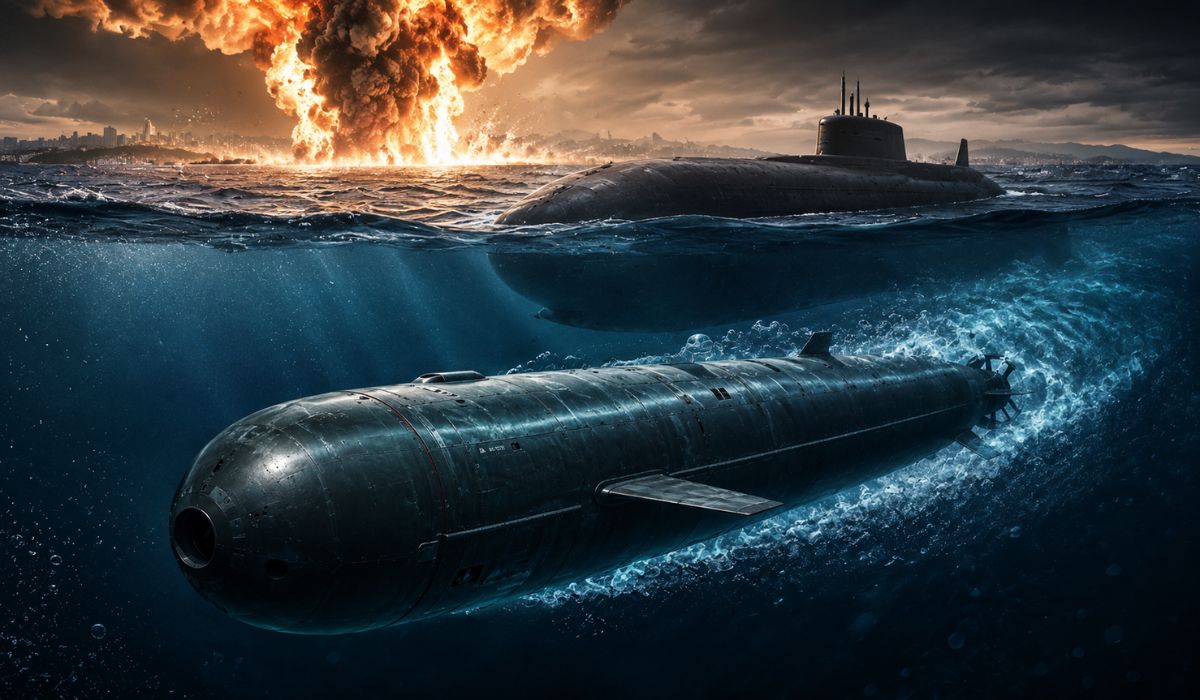

The Poseidon combines torpedo, submarine drone, and nuclear propulsion in a Russian system designed to operate underwater, reigniting debates about deterrence, military technology, and coastal risks.
The Poseidon has entered the nuclear weapons debate by bringing together uncommon characteristics in a single system.
Instead of following the logic of an air-launched missile, the Russian weapon was designed to move underwater, unmanned, with nuclear propulsion and the capability to carry a nuclear payload.
The equipment returned to the spotlight after President Vladimir Putin announced on October 29, 2025, that Russia had conducted a test of the system.
-
Brazilian Innovator Converts Old Car into Electric Vehicle Using Laptop Batteries and Forklift Motor, Achieves Nearly 90 km/h in Urban Settings

-
Samsung Unveils Smart Oven with Built-In Camera, AI Food Recognition, and Real-Time Monitoring via Smartphone.
-
Ocean Transformed into Sci-Fi Lab: 87-Meter Structure with Submarines, Deep-Sea Robots, Helicopter, Genetic Labs, and 8K Cameras Unveils Rare Creatures
-
11-Year-Old Develops Solar Water Purifier to Aid Communities in Kenya and Gambia





According to him, the operation took place the day before and included the launch from a submarine and the activation of the nuclear propulsion unit.
According to Reuters, Putin stated that, for the first time, Russia managed to launch the Poseidon from a carrier submarine and activate the nuclear power unit during the journey.
The statement confirms the version presented by the Kremlin but does not allow independent verification of all the equipment’s technical data.
The curiosity surrounding the Poseidon lies in the combination of functions.
Military analysts describe it as a mix of torpedo, submarine drone, and nuclear reactor, created to travel long distances at sea and expand Russia’s nuclear deterrence methods.
What is the Poseidon
The Poseidon is an unmanned underwater vehicle powered by nuclear energy.
In practice, it functions as a strategic-range torpedo, but with a different proposal from conventional submarine weapons.
In NATO, the system is also known as Kanyon.
The weapon was publicly presented by Putin in 2018, as part of a set of new Russian strategic systems announced in response to U.S. missile defenses and the expansion of Western military presence in Eastern Europe.
Information cited by analysts and Russian outlets indicates that the Poseidon would be about 20 meters long, 1.8 meters in diameter, and weigh approximately 100 tons.
Estimates mentioned by Reuters suggest a range of 10,000 kilometers and a speed close to 185 km/h.
Why it is not a common torpedo
The main difference lies in propulsion.
Traditional torpedoes have limited range and are usually used in combat against ships or submarines, while the Poseidon has been presented by Russia as a system capable of crossing great oceanic distances.
This characteristic changes how the weapon is classified.
The equipment does not rely on a ballistic trajectory, like an intercontinental missile, nor does it follow the launch pattern of a bomb carried by an airplane.
By operating below the surface, the Poseidon could make detection and tracking more difficult, according to defense analysts.
Submarine detection depends on factors such as depth, noise, sensors, routes, water temperature, oceanic relief, and the capabilities of the navies involved.
Therefore, there is no public consensus that any system of this type is absolutely immune to interception.


How the Poseidon Threatens Coastal Cities
The Poseidon gained international attention for being associated with the capability to hit coastal regions.
Military analysts state that a nuclear warhead detonated at sea, near coastal areas, could cause widespread destruction and radioactive contamination.
The expression “radioactive waves” appears in descriptions of the possible effect of the system.
The actual scale, however, would depend on variables such as the warhead’s power, explosion depth, distance from the coast, underwater relief, and ocean conditions.
For this reason, the most accurate way to present the topic is to say that the Poseidon is designed to threaten coastal targets and naval bases, according to military assessments, without turning all estimated effects into proven facts in a real scenario.
The central point is strategic.
By developing a weapon that would approach by sea, Moscow attempts to show that it could circumvent part of the defenses aimed at missiles and expand its nuclear retaliation options.
A Submarine Nuclear Drone
The expression torpedo-drone helps explain the concept to the general public.
The Poseidon does not carry a pilot and does not operate like a conventional vessel.
It would be launched by adapted submarines and would follow a route defined by navigation and control systems.
This logic is similar to autonomous underwater vehicles used in research, mapping, and military operations.
The difference is that, in the Russian case, the equipment was designed as a strategic weapon with nuclear capability.
Nuclear propulsion is another element that differentiates the system.
In theory, it would allow the equipment to travel long distances without relying on the same fuel limitations as conventional torpedoes.
At the same time, any nuclear-powered weapon raises environmental and safety concerns.
Test failures, propulsion accidents, loss of control, or incidents during transport could pose additional risks, although there is no public confirmation of an accident related to the test announced in October 2025.

Submarines associated with Poseidon
The Poseidon was developed to be transported by special submarines.
The Belgorod, delivered to the Russian Navy in 2022, is often cited by experts as one of the platforms associated with the program.
Another submarine related to the system is the Khabarovsk, also linked to special missions and strategic underwater armaments.
The existence of these platforms indicates that the Poseidon is part of a broader naval project, not an isolated piece of equipment.
Even with these indications, there is no independent confirmation that the Poseidon is in full operational service.
The test announced by Putin indicates a declared advancement in development, but does not prove serial production, definitive deployment, or full military readiness.
Caution is necessary because announcements of strategic weapons also serve a political function.
In times of tension, demonstrating military capability can have diplomatic and internal weight, in addition to the technical aspect.
Nuclear race helps explain the project
The Poseidon appears during a period of modernization of the nuclear arsenals of major powers.
Russia, the United States, and China are investing in new systems, while arms control agreements have lost strength in recent years.
In 2026, an analysis by the Bulletin of the Atomic Scientists, signed by experts linked to the Federation of American Scientists, estimated that Russia had about 4,400 nuclear warheads in its military stockpile.
The same survey indicated that Moscow continued replacing systems inherited from the Soviet era with more recent equipment.
In this scenario, weapons like Poseidon and Burevestnik appear as symbols of the Russian attempt to preserve strategic capability.
The Burevestnik, a nuclear-powered cruise missile, also had a test announced by Russia in October 2025.
For the Kremlin, these systems demonstrate the ability to overcome defenses and maintain deterrence power.
For Western governments and security experts, they add uncertainty to an international environment marked by the war in Ukraine and the competition among nuclear powers.