Portuguese
  Spanish


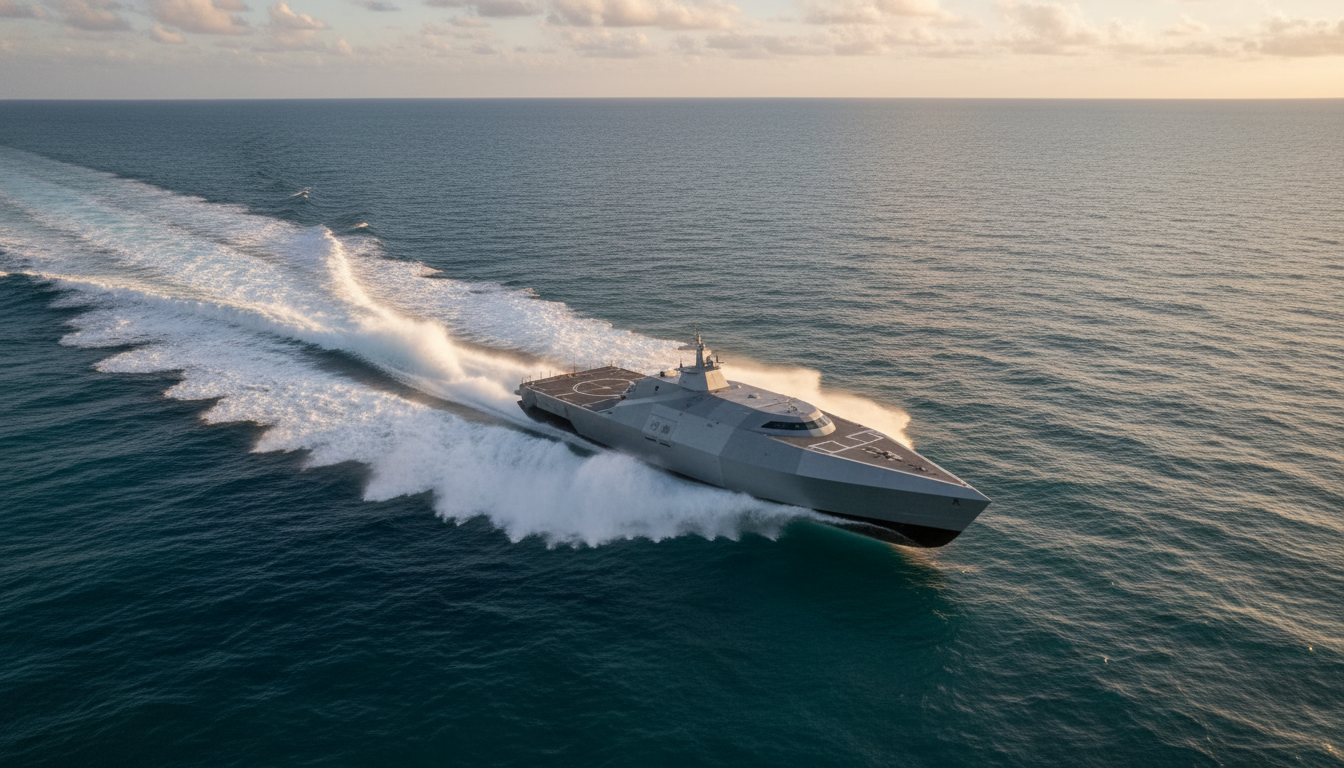

With 52 meters in length, a speed of 30 knots, and the capacity to carry vertical launch missiles, the Saildrone Spectre is the largest and most armed drone ship ever revealed by the American company that started by making autonomous sailboats to monitor oceans — and now wants to hunt submarines for the US Navy
According to a Breaking Defense report from April 2026, Saildrone officially unveiled the Spectre during the Sea-Air-Space 2026 exhibition, held from April 20-22 in Washington, D.C.
Thus, the Spectre marks a radical shift for the Californian company.
Therefore, Saildrone — known for its solar-powered drone sailboats that map oceans — now enters the naval warfare market with an autonomous ship capable of hunting submarines and firing missiles without any crew on board.
-
A 13-foot robot nicknamed Godzilla is assembling the world’s largest nuclear fusion reactor piece by piece.

-
Experts Warn: Aging NASA Launch Facilities Could Hinder Artemis Moon Mission Progress
-
Self-Driving Harvester Now Operating in Brazil’s Vast Farmlands
-
Astronomers Discover Two Giant Exoplanets as Light as Cotton Candy, Challenging Current Scientific Models 1,110 Light-Years from Earth


Two versions of the same predator: deadly silence or stealth attack
As detailed by Saildrone on its official website, the Spectre will be offered in two variants.
The first is the Spectre Silent Endurance, designed for anti-submarine warfare (ASW).
This version carries Thales’ TB29 and CAPTAS-4 towed sonars, which passively listen to the ocean for acoustic signatures of submarines.
Furthermore, its ultra-low acoustic signature allows it to patrol areas for months without being detected.
Consequently, the second variant — the Spectre Stealth Strike — is more offensive.
It sacrifices some autonomy in favor of speed and firepower, carrying two Mk70 VLS (Vertical Launch System) launchers.
Each Mk70 accommodates 4 Mk-41 VLS cells, the same system used in the US Navy’s Arleigh Burke-class destroyers. In total, the Spectre can carry 8 missiles ready for launch.

52 meters, 30 knots, and 70 tons of payload
According to Navy Times, the Spectre has the following specifications:
- Length: 52 meters (170 feet)
- Maximum speed: 30 knots (~55 km/h)
- Payload: up to 70 tons of modular equipment
- Cost per unit: approximately US$ 40 million
- Production: 5 units per year at the Fincantieri shipyard in Green Bay, Wisconsin
- First sea trial: early 2027
- Armament partnership: US$ 50 million with Lockheed Martin (signed in October 2025)
In this regard, Richard Jenkins, founder and CEO of Saildrone, told the press: “It’s the first time we’ve sold a Saildrone vessel without a wing.”
However, the reference is significant. Saildrone’s previous drones — used for ocean mapping, climate monitoring, and tracking illegal fishing — relied on rigid sails for solar propulsion.
Similarly, the Spectre dispenses with the sail in favor of conventional engines, prioritizing speed and combat capability over energy autonomy.

The US Navy has already opened the marketplace — and Saildrone wants in
The timing of the launch is no coincidence.
In March 2026, the US Navy announced a new “MUSV marketplace” — a rapid acquisition platform to purchase production-ready medium unmanned surface vessels.
As reported by Inside Unmanned Systems, Saildrone submitted its Spectre proposal to the marketplace during Sea-Air-Space 2026 itself.
Likewise, the US$ 50 million partnership with Lockheed Martin, signed in October 2025, ensures that the Spectre is already integrated with Navy weapon systems from its inception.
Furthermore, a live-fire test with the Mk70 launcher is scheduled for the RIMPAC 2026 exercise — the world’s largest multinational naval exercise.
Paul Lemo, from Lockheed Martin, confirmed that the test will demonstrate the Mk70’s ability to fire from autonomous platforms in a simulated combat scenario.
The future of naval warfare: ships without sailors
On the other hand, the Spectre represents something greater than a commercial product.
Admiral Daryl Caudle, Chief of Naval Operations for the US, has publicly advocated for the concept of “containerized capabilities” — modular weapon systems that can be installed on any platform.
The Spectre embodies precisely this vision: an autonomous hull that receives containers with sonars, missiles, or surveillance equipment as the mission requires.
However, the strategic implication goes beyond modularity. A crewless ship can operate in contested waters where the risk to sailors would be unacceptable.
It can patrol sea lanes for months without stops. It can be lost in combat without human cost.
And at US$ 40 million per unit, it is much cheaper than a US$ 2 billion destroyer.
Thus, a fleet of 20 Spectres would cost US$ 800 million — less than half the price of a single Arleigh Burke-class destroyer. And it would cover an ocean patrol area impossible to reach with conventional crewed ships.
Likewise, the loss of a Spectre in combat would represent a significant financial cost, but zero human casualties. This equation fundamentally changes the risk calculation in naval operations.
Saildrone, which started with submersible drones like the Lamprey being integrated into its platforms, now leads a transformation that could redefine how navies fight in the 21st century.

What’s still needed for the Spectre to truly exist
Despite this, the Spectre is still a project on paper.
The first unit will be built at the Fincantieri shipyard in Green Bay, Wisconsin, with a capacity of five ships per year.
However, sea trials are only scheduled for early 2027.
Still, the US Navy has not yet confirmed the purchase. Saildrone’s proposal is being evaluated alongside competitors in the MUSV marketplace.
Furthermore, there is no real operational data — everything known comes from design specifications and simulations.
Thus, between revealing a concept at Sea-Air-Space and having a drone ship hunting submarines in the Pacific, there is a long road of tests, certifications, and political decisions.
However, if the Spectre performs as promised, the era of crewless warships will have officially begun — not as science fiction, but as a commercial product with a defined price, timeline, and shipyard.