






 Portuguese
  Spanish
  3 min of reading
  2 comments


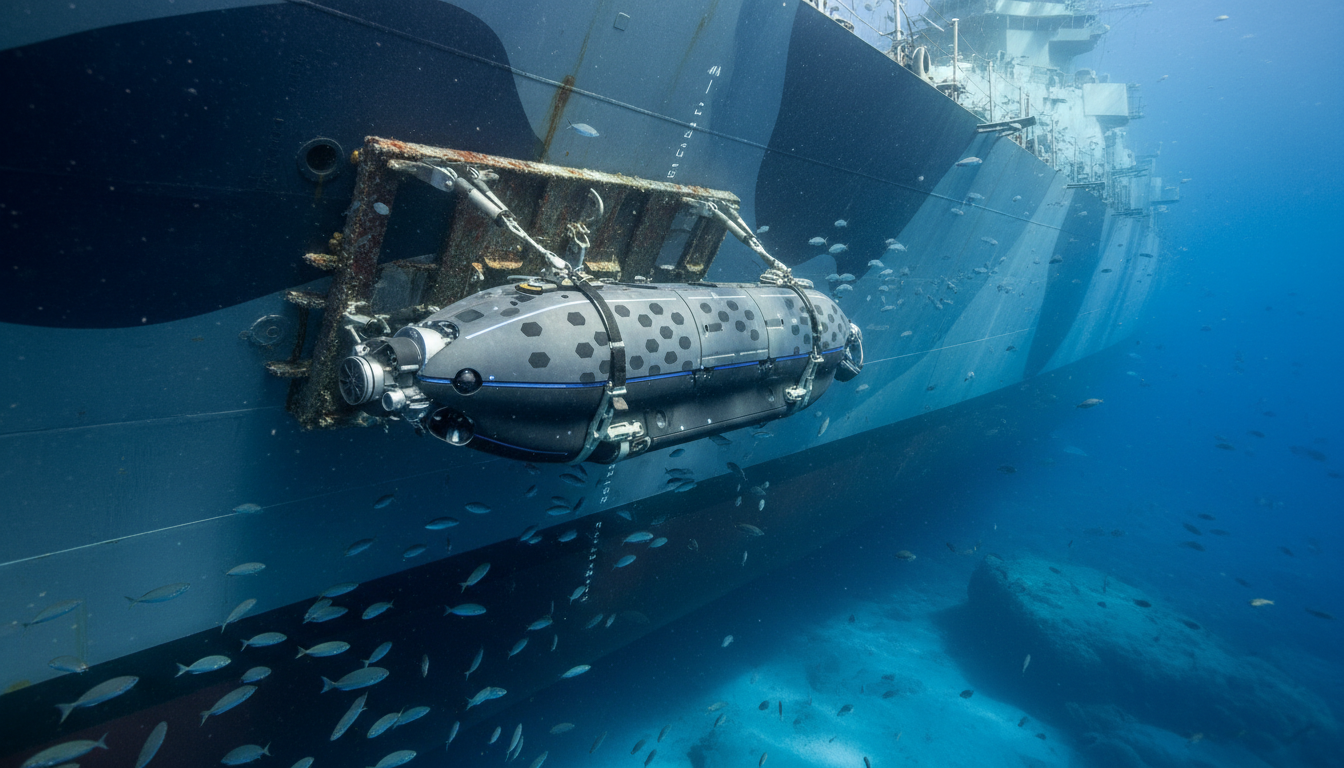


Lockheed Martin presents autonomous underwater vehicle that attaches to the hulls of allied ships, recharges batteries with currents, and conducts attacks without human intervention — all with a 24 cubic foot compartment
Lockheed Martin unveiled on February 9, 2026, in Palm Beach, Florida, a submarine drone that changes the rules of naval warfare. The Lamprey MMAUV attaches to the hulls of allied ships and submarines like a lamprey.
Unlike any underwater vehicle ever created, it does not require modifications to the host ship. It simply attaches and travels along.
When it arrives at the theater of operations, it detaches and dives. It can rest on the ocean floor indefinitely, awaiting orders.
-
Helicopter Drops 180 Tons of Sand and Gravel on Swedish River to Revive Ecosystem Damaged by Decades of Exploitation

-
Brazilian Company Launches Retro Smartphone with 48 MP Camera, T9 Keyboard, and Privacy Features for Social Media-Free Use

-
Self-Taught Chinese Farmer Builds 5-Ton Submarine from Scrap, Launches It in Anhui River
-
Invisible Induction Technology Enables Wireless Power for Blenders, Coffee Makers, and Air Fryers, Reducing Countertop Cables




Its name comes from the lamprey, the parasitic fish that attaches to larger hosts to feed and move.
“The modern battlefield demands platforms that can hide, adapt, and dominate,” said Paul Lemmo, vice president of Lockheed Martin.

How a parasitic drone operates on the ocean floor
The Lamprey travels attached to the hull of the host ship. During transit, it recharges its batteries with integrated hydro generators.
Upon reaching its destination, it is at 100% charge. It does not require a nearby base or additional logistical support.
It has four thrusters for autonomous maneuvers. It moves silently underwater without leaving a trace.
It can rest on the seabed collecting intelligence data. It functions as an invisible underwater sentinel.
When it receives the order, it can attack. Or simply continue observing, transmitting information to command.
Those following military innovations know that China is already testing machines that cut underwater cables at 3,500 meters. The race for underwater dominance is accelerating.
Torpedoes, aerial drones, and electronic warfare in 24 cubic feet
The Lamprey’s cargo compartment has 24 cubic feet — approximately 0.68 cubic meters. It is modular and configurable.
Inside it can hold light anti-submarine torpedoes. It is the first autonomous underwater weapon with this capability.
It can also carry up to three retractable aerial drone launchers. Yes — a submarine drone that launches flying drones.
- Light anti-submarine torpedoes for direct engagement
- Up to 3 aerial drone launchers with double tubes
- Acoustic decoys to confuse enemy sensors
- Electronic warfare systems
- Deployable sensors for continuous surveillance
- Open architecture for future customizations
The open architecture allows new weapons and sensors to be integrated as the mission requires.

Why this changes naval warfare
The U.S. Navy’s strategy for distributed naval warfare prioritizes low-cost autonomous systems.
Instead of concentrating power in a few expensive ships, the idea is to spread capability across dozens of smaller platforms.
The Lamprey embodies this philosophy. Entire groups can be launched and remain dormant on the ocean floor.
When needed, they wake up simultaneously. They can attack, confuse, or simply monitor the enemy.
The operational cost is significantly lower than that of manned submarines. Lockheed has not disclosed exact figures.
The Indo-Pacific scenario is pointed out as the main theater for this type of weapon. Tensions with China drive development.
Brazil, which recently tested the Tamandaré Frigate with a 76 mm gun, is closely observing these naval innovations.

Innovative, but still in demonstration phase
Despite the progress, the Lamprey has been internally funded by Lockheed Martin. There is no formal contract with the U.S. Navy.
Sea tests have confirmed autonomous maneuvers and surveillance. But depth and autonomy details have not been disclosed.
The hull attachment is innovative. However, if detected, it can compromise the host ship’s stealth.
There are no public comparisons with equivalent Chinese or Russian systems. The submarine race is secretive by nature.
The information was compiled from statements by Lockheed Martin and reports from New Atlas. The system is in the demonstration phase and may undergo changes before mass production.





Very nice technology great job
Thanks, Anthony! The lamprey concept is fascinating — a drone that attaches itself to enemy ships and waits silently on the seabed is straight out of science fiction, yet Lockheed Martin is actually building it. Glad you enjoyed the article!