






 Portuguese
  Spanish
  5 min of reading
  0 comments


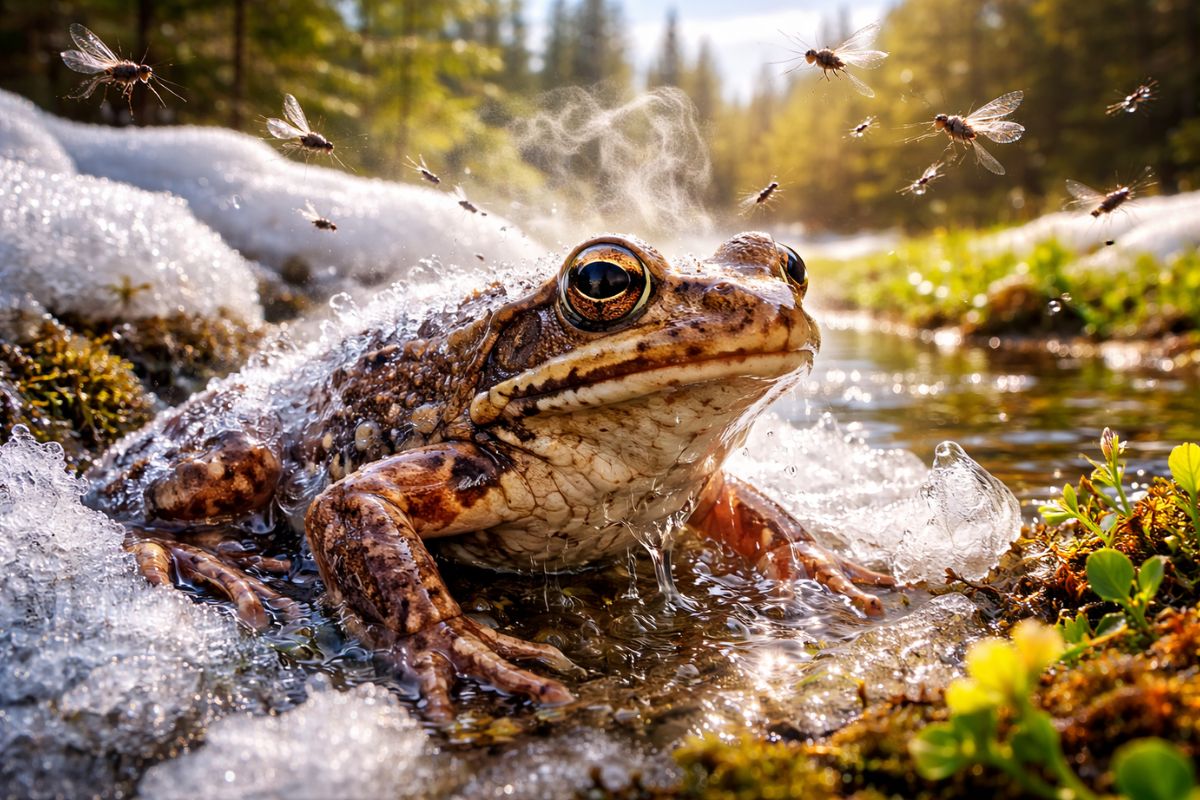
In The Nature Documentary, The Wood Frog Becomes A Frozen Frog In Winter In Alaska, Uses Natural Antifreeze And Wakes Up Surrounded By Mosquitoes In Alaska.
As rivers and ponds begin to melt in spring, the ground is still hard as stone. Beneath a layer of dead leaves and ice, the Wood Frog appears dead. It is completely frozen, including the eyes. There is no pulse, no breathing, no movement. However, inside, something invisible is ensuring that this animal has a second chance when the cold finally recedes.
Slowly, heat returns to the ground, and the frog’s body begins to thaw from the inside out. The heart starts to beat again, the brain “lights up,” and the animal resumes movement, as if someone had pressed a power button. After eight months frozen, the Wood Frog is whole, functional, and ready to leap straight into the water. However, as soon as life inside restarts, another challenge arrives from the outside: the largest clouds of mosquitoes on the planet, which awaken at the same time and are already out for blood, including the frog’s.
The Brutal Winter That Freezes The Wood Frog

In Alaska, winter is unforgiving. Rivers and ponds freeze, the surface turns to ice, and the ground remains hardened for months.
-
Roblox changes the rules for children and teenagers in Brazil and promises a safer platform with selfies and parental control.

-
Water can carry pesticides invisible to common treatment, but nanosensors developed by Brazilian researchers promise to speed up the alert before the risk reaches the tap.

-
Gases created to save the ozone layer have become a new global warning: substitutes for CFCs have already released more than 335,000 tons of a “forever chemical” onto the Earth as invisible rain, contaminating everything from tap water to Arctic ice.
-
Researchers present a hydrogen ion battery capable of storing energy in two different forms, an innovative solution that promises to increase the autonomy of renewable systems and simplify energy transportation.




For most animals, the only way to survive is to hide, migrate, or rely on protected shelters. The Wood Frog takes a different approach.
Instead of completely fleeing the cold, it buries itself under dead leaves, near the frozen ground, and accepts being literally frozen for the season.
It is not just intense cold; it is a state in which the body seems to shut down: no pulse, no breathing, no obvious signs of life.
What distinguishes it from a body beyond recovery is what is happening, silently, within each cell.
The Invisible Antifreeze That Comes From The Liver
The secret to this “miracle” begins before winter presses down. In autumn, the animal’s liver kicks into gear and pumps a natural, viscous antifreeze directly into the cells. This antifreeze prevents the interior of the cells from freezing and breaking their internal structures.
What ends up freezing is only the water between the cells, in the surrounding space. This makes all the difference: with the internal liquid protected by the antifreeze, the organs are not destroyed by ice.
The Wood Frog does not avoid freezing; it manages it, controlling where the ice can form without causing irreversible damage.
When the extreme cold arrives, the body is prepared. The essential organs remain chemically protected, even if, on the surface, the animal looks merely like a block of ice lost under the leaves.
The Awakening Of The Wood Frog In Spring

With the arrival of spring, the scene changes. Rivers and ponds start to melt again, the temperature rises, and the ice around the Wood Frog begins to give way.
But the thawing is not just external. Its body starts to thaw from the inside out, in a gradual process that reconnects all vital functions.
The heart begins to beat again, the brain starts processing information again, and muscles regain the ability to contract.
In no time, that “frozen body” transforms back into an active frog, capable of jumping, swimming, and reacting to the environment.
It is hard not to view this as a biological miracle: after eight months frozen, the Wood Frog is completely intact and ready to return to normal life.
The first destination is clear: the nearest lake. Liquid water becomes the ideal environment for feeding, locomotion, and reproduction. But spring brings not only advantages.
From Returning To Life To The Mosquito Attack
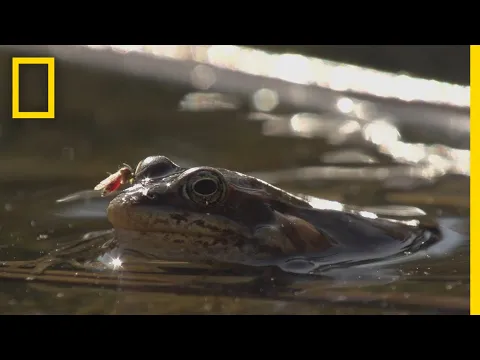

As the waters thaw, another protagonist enters the scene: the mosquito. In Alaska, with the thawing, gigantic swarms of mosquitoes erupt from aquatic habitats, all at once, in search of blood to complete their life cycles.
The number of mosquitoes in the region exceeds that of many tropical rainforests. This is not something the Wood Frog can ignore.
Not even a cold-blooded animal escapes this cloud of hungry insects, which attack everything they find, from large mammals to small amphibians.
The frog wakes up from one extreme — months frozen — straight into another: a season where it must live, feed, reproduce, and still deal with a rain of bites.
The scene is almost ironic: surviving a winter that freezes everything and, upon waking, facing one of the largest concentrations of mosquitoes on the planet. But this is exactly how this life cycle repeats, year after year.
A “Miracle” Biological That Redefines Our Limits
All of this makes the Wood Frog an impressive example of resilience. It shows that life can find solutions where logic says nothing should survive.
Freezing the body, suspending vital signs, and then resuming everything with minimal damage is something far beyond what we are used to seeing in animals.
In practice, this frog proves that surviving is not just about enduring the cold; it is knowing how to use its own body as a laboratory, producing antifreeze in the liver, choosing where ice can form, and coordinating the return to activity in tune with the season’s change.
At the same time, it reminds us that nature offers no rest: it barely escapes the ice and must already deal with swarms of mosquitoes in one of the planet’s most intense environments.
And you, after learning the story of the Wood Frog, what do you find more impressive: surviving eight months frozen or waking up directly in a world full of mosquitoes?





Be the first to react!