





 Portuguese
  English
  Spanish
  4 min of reading
  1 comment


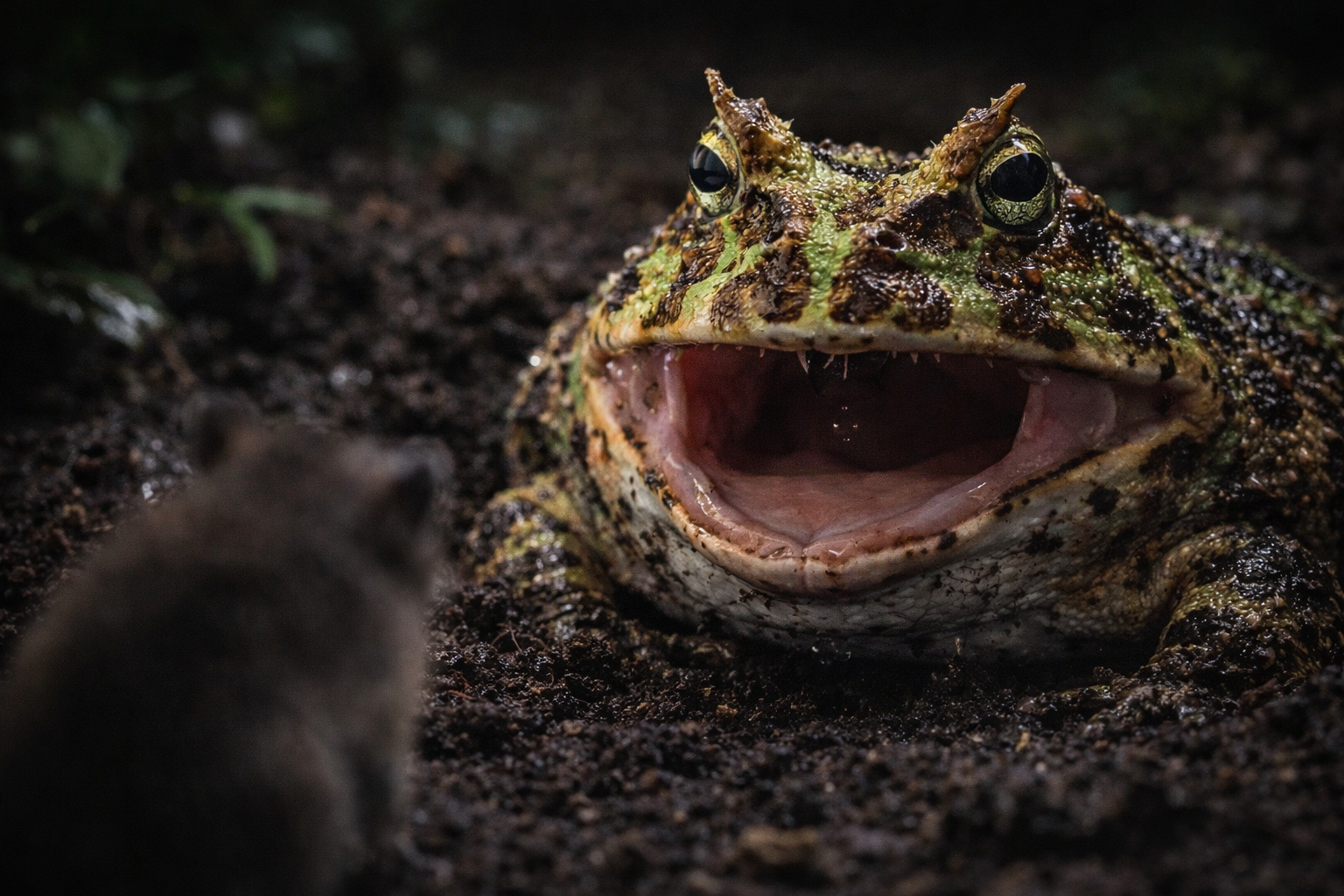


Horned Frog Swallows Birds, Ambushes Rodents, and Bites Like a Feline. South American Predator Challenges Amphibian Limits, According to Scientific Studies.
Among amphibians, most people imagine small, discreet animals that feed on insects and avoid confrontation. The Ceratophrys ornata, known as the horned frog or Argentine horned frog, completely dismantles this image. Native to regions of Argentina, Uruguay, Paraguay, and southern Brazil, it occupies such an aggressive predatory niche that researchers have already compared it to a mini apex predator in its ecosystems.
With a rounded body and a gigantic mouth that occupies nearly half of its cranial structure, this amphibian is equipped for hunting vertebrates, a behavior considered atypical and rare among frogs. Instead of seeking small invertebrates, it ambushes birds, rodents, lizards, and even other frog species, swallowing prey that is proportionally large.
A Giant Mouth and a Bite That Surprised Scientists
The ferocity of the horned frog comes not only from its diet but also from its bite. In 2017, a study published in Scientific Reports analyzed the mandibular force of these amphibians and compared it to patterns found in carnivorous mammals. The results caught attention:
-
Russia wants to build new nuclear plants in Brazil and is negotiating an agreement with the Lula government to expand Rosatom’s presence in atomic energy projects, small reactors, and peaceful nuclear technology.

-
Microscopic fossils 1.7 billion years old found in rocks in Australia reveal complex cells living at the bottom of an ancient sea and may change what scientists know about the evolution of life on Earth.
-
Seen from space, an underwater volcano erupts in the Pacific, spewing smoke directly from the sea, spreading floating pumice, and may be creating a new island in a region so poorly mapped that scientists still do not know exactly which structure is erupting.
-
Researchers identify marks of Ice Age megafloods in the United States, a phenomenon that crossed Montana, Idaho, Washington, and Oregon, sculpted rolling hills like waves, and left giant scars that still challenge the landscape.


Researchers determined that the bite force of the horned frog could be comparable to that of small felines, such as some wild cats. Technically, the “bite force” was measured in Newtons, and when scaled up for the larger species of the genus Ceratophrys, the extrapolated value indicated a force sufficient to hold and puncture small vertebrates.

This bite reinforces another striking trait: the frog does not try to kill quickly. Instead, it holds the prey in its mouth and swallows it whole, relying on its jaw musculature and digestive secretions.
The Ambush-Based Hunting Strategy
The Ceratophrys ornata does not chase its prey. Instead, it employs a strategy based on immobility, camouflage, and muscle explosion. With coloration that blends shades of green, brown, and yellow, it hides among the vegetation, partially buried in the ground.
When the prey approaches, the attack is instant and violent. The technique is simple and efficient: suddenly open the mouth, bite, lock, and swallow. The body shape facilitates this tactic since the animal possesses:
- Wide skull
- Extremely articulated jaw
- Robust flexor muscles
- Quick reflexes
This combination allows it to capture prey larger than expected for an amphibian. Field records show individuals consuming small birds, juvenile rats, small tegus, and even other frogs of the same size.
An Opportunistic Metabolism
Another interesting trait is that the horned frog does not need to feed every day. Like other amphibians, it has a lower metabolic rate than mammals and birds. This allows for long fasting periods, broken by large meals.
Researchers studying the species have noted that many individuals spend a large part of the day motionless, conserving energy while waiting for the next opportunity. From an ecological standpoint, this creates a predator specialized in abundance peaks, benefiting from seasonal cycles and climate variations.
Growing Quickly and Living Aggressively
In nature, the life of the Ceratophrys ornata begins intensely. The tadpole stage, unlike what occurs with many species, can involve cannibalism when food is scarce. This characteristic helps reduce competition and increases the average size of the survivors.
Upon reaching adulthood, the horned frog reaches about 10 to 15 centimeters, placing it among the largest terrestrial amphibians in South America. Its robust body is accompanied by a disproportionate mouth, responsible for its fame and ecological impact.
Scientists note that few amphibians combine rapid growth, vertebrate diet, and aggression, making this species a compelling case study in herpetology.
The Ecological Risk and the Impact of the Exotic Animal Trade
The aggression and vertebrate diet have made the Ceratophrys ornata one of the most sought-after frogs in the exotic pet trade. Although popular among breeders, experts warn of two main issues:
- Risk of abandonment and environmental invasion if released into unsuitable ecosystems
- Illegal capture in native areas, contributing to population pressure
Additionally, habitat alterations, wildfires, urbanization, and water contamination have been reducing the number of individuals in some regions. Monitoring data published in the Journal of Zoology point to local population declines associated with environmental degradation.
An Amphibian That Redefines What We Expect from the Class Amphibia
The horned frog surprises because it accumulates characteristics that combine different animal groups:
- The ambush typical of snakes
- The powerful bite similar to small felines
- The camouflage common in lizards
- The metabolism characteristic of amphibians
When scientists discovered that the bite was strong enough to be compared to carnivorous mammals, the discussion began to involve functional evolution, environmental pressures, and cranial mechanics.
Evolutively speaking, the Ceratophrys ornata shows that amphibians can occupy more aggressive niches than the public imagines, challenging the notion that frogs are merely fragile, passive insectivores.
A Compact and Underestimated Predator
The Ceratophrys ornata is a reminder that biodiversity hides unexpected forms of biological power, even in groups considered simple. An amphibian capable of swallowing birds, ambushing mammals, and biting like a feline redefines what we think about frogs and shows that nature possesses extremely varied predatory models.
Anyone interested in zoology, evolution, and animal behavior finds in the horned frog one of the best examples of extreme predation compacted into a small body.





Tenía que ser Argentina……