Portuguese
  Spanish


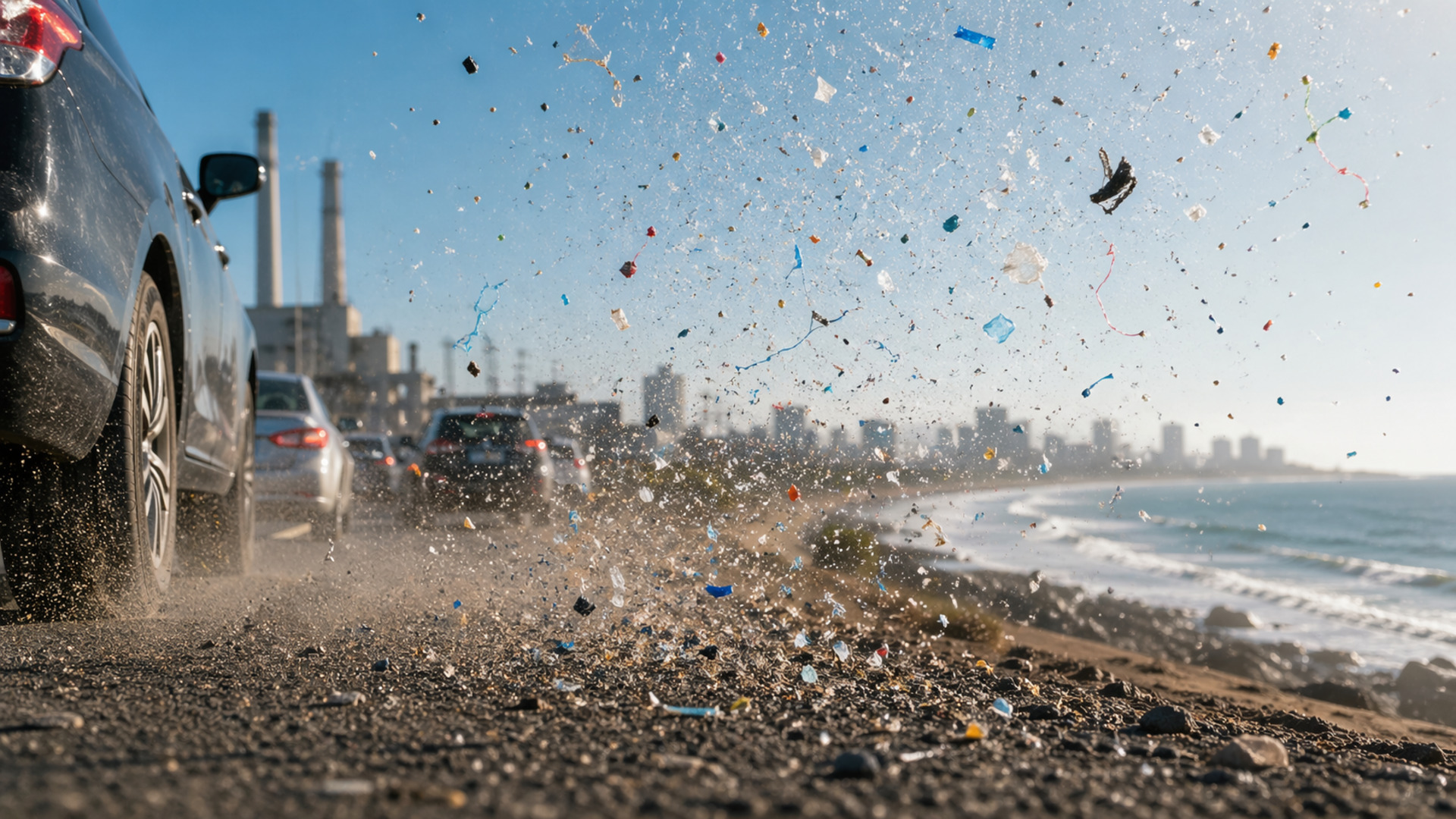

Airborne microplastics circulate through the atmosphere, reach remote regions, and can return to the surface, but new measurements indicate that terrestrial sources release more than 20 times more particles than the ocean, despite uncertainties about the total mass transported.
Airborne microplastics primarily come from terrestrial sources, not the ocean, as some previous estimates suggested. A study by the Department of Meteorology and Geophysics at the University of Vienna shows that land releases more than 20 times more microplastic particles into the atmosphere than the oceanic environment, although the true extent of the problem still has significant uncertainties.
The research was published in the journal Nature and combined global measurements with computational models to revise the origin of these particles. The work also identified that previous models significantly overestimated the amount of microplastics present in the air and deposited on the Earth’s surface.
Airborne microplastics predominantly originate from land
The atmosphere plays a central role in the dispersion of airborne microplastics across the planet. These particles can be transported to remote regions, inhaled by people and animals, and then fall back onto the surface, increasing pollution in oceans and soils.
-
Spain Launches World’s Largest Floating Dry Dock: 56-Meter Giant Produces Massive Concrete Structures in A Coruña Using Technology Proven in Brazil

-
AI-powered toys that talk, recognize faces, and collect data face scrutiny from Brazilian government over children’s privacy concerns

-
4,000-Year-Old Child’s Skull Unveils Ancient Burial in 7,500-Year-Old Norwegian Rock Shelter, Impressing Archaeologists

-
Norway Defeats Brazil in World Cup but Invests Billions to Preserve the Amazon, Strengthens Amazon Fund, and Joins Brazil in Leading Global Effort Against Tropical Deforestation



Particles present in the atmosphere originate from direct sources, such as tire wear and textile fibers. They can also come from already contaminated terrestrial and oceanic surfaces, which release microplastics back into the air.
Until now, the scale of these emissions and the contribution of each source were not well understood. Previous studies often pointed to the ocean as the main emitter, but new data changes this interpretation by indicating the predominance of land-based sources.
Study compared 2,782 measurements worldwide
To refine the estimates, Ioanna Evangelou, Silvia Bucci, and Andreas Stohl compiled 2,782 individual measurements of atmospheric microplastics from research conducted in different parts of the world. These real data were then compared with results from a transport model that incorporated three previously published emission estimates.
The comparison revealed a wide difference between simulations and observations. The model predicted far more microplastic particles in the air and deposited on the Earth’s surface than the observed volume, in some cases by several orders of magnitude.
This difference allowed for adjusting the model and separately recalibrating emission estimates from land and ocean. As a result, the research provided a more precise understanding of the circulation of airborne microplastics and the relative contribution of each origin.
Previous models overestimated emissions
After recalibration, terrestrial emissions remained far above oceanic ones in terms of particle count. Even with the downward correction, land remained the primary source of airborne microplastics by quantity.
The adjusted data show that more than 20 times more microplastic particles are emitted from land than from the ocean. This conclusion challenges the idea that the marine environment would be primarily responsible for emitting these particles into the atmosphere.
The research also indicates that the estimates used until now were too high, especially for terrestrial emissions. Nevertheless, the revision did not eliminate the importance of land-based sources, which remained dominant after the adjustments.
Ocean emits fewer particles, but with greater mass
The analysis separates two important aspects: particle count and emitted mass. Although land releases more particles, the mass emitted by the ocean is greater because oceanic particles have a larger average size.
This contrast helps explain why the origin of airborne microplastics still requires more detailed measurements. Particle count and total mass transported can indicate different dimensions of the same environmental problem.
The difference also shows the need to improve understanding of the size of these particles. Size distribution is still one of the main uncertainties for calculating the total amount of plastic transported by the atmosphere.
Uncertainties still limit global calculation
The study represents an advance in understanding how airborne microplastics spread globally. Even so, researchers indicate that the available database still does not allow closing all gaps regarding the actual amount of plastic in atmospheric circulation.
Andreas Stohl points out that more measurements are needed to separate how much comes from traffic and how much originates from other sources. The particle size distribution also remains uncertain and has not yet been recorded with sufficient precision in the available data.
The conclusions reinforce the need to expand global measurements and improve the models used to estimate emissions. With more precise data, it will be possible to better dimension the role of traffic, textile fibers, contaminated surfaces, and the ocean in the presence of airborne microplastics.