






 Portuguese
  Spanish
  5 min of reading
  0 comments


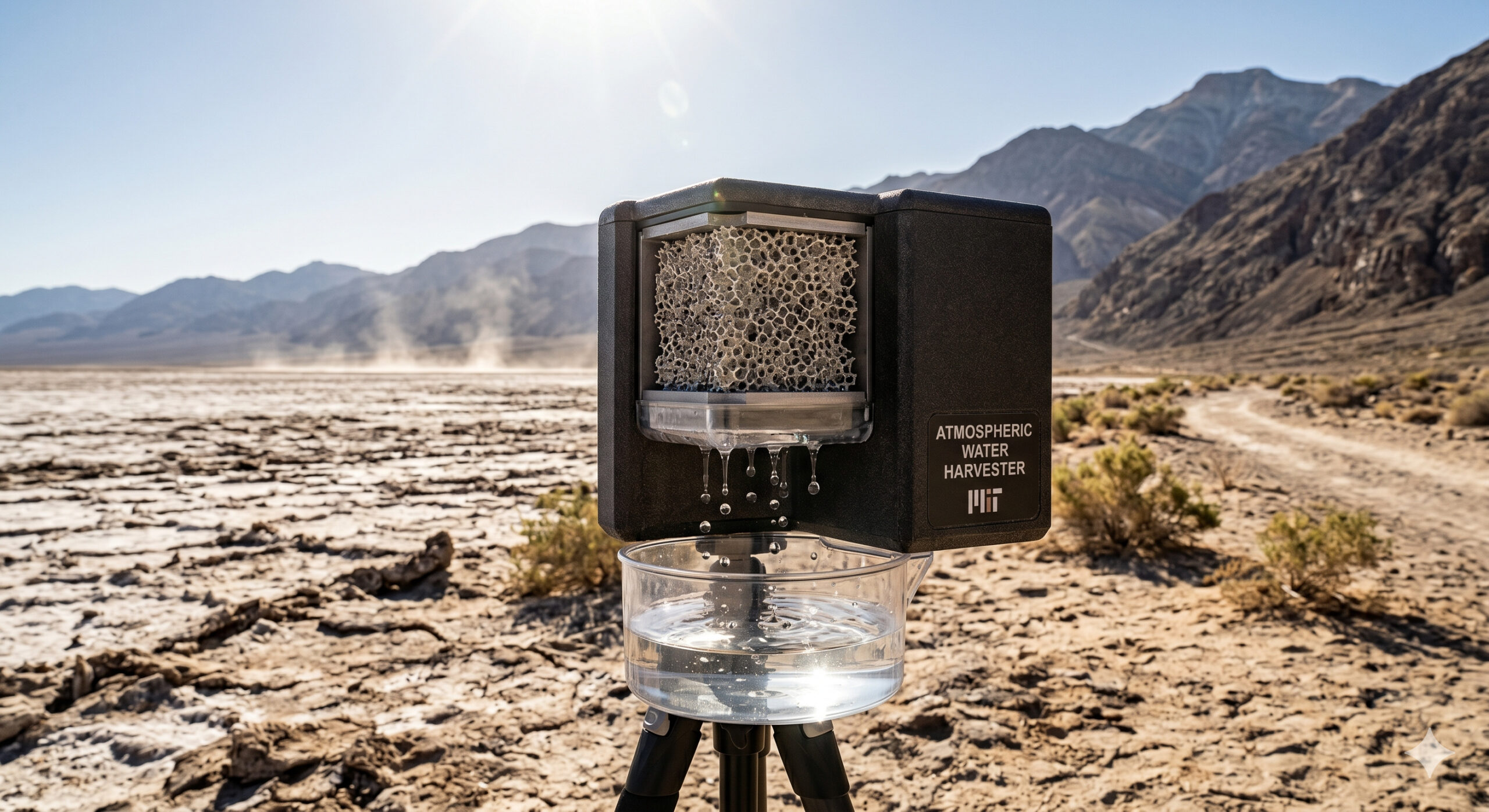
MIT develops origami-inspired vertical hydrogel panel capable of extracting drinking water from air without electricity or solar power.
In June 2025, researchers at the Massachusetts Institute of Technology (MIT) presented a technology that attempts to transform atmospheric air itself into a direct source of drinking water using only natural temperature changes. The project, described in the scientific article “A Meter-scale Vertical Origami Hydrogel Panel for Atmospheric Water Harvesting in Death Valley”, published in the journal Nature Water, uses an origami-inspired vertical hydrogel panel capable of absorbing atmospheric vapor during the night and releasing liquid water at dawn without relying on electricity, batteries, filters, or solar panels.
The device was tested for seven days in one of the driest and hottest regions of North America, Death Valley, California. Even under relative humidity varying between only 21% and 88%, the system managed to produce between 57 ml and 161.5 ml of drinking water per day. The number is still small for complete residential supply, but it drew attention because the equipment operates entirely passively, exploiting only the natural cycle between cold nights and hot days.
Vertical panel uses hydrogel to “capture” invisible water from the air
The core of the technology is a highly absorbent hydrogel developed by the laboratory led by Professor Xuanhe Zhao. Hydrogels are soft, porous materials capable of storing large amounts of water without dissolving.
-
A discarded microwave may contain 22-carat gold in internal components; study recovered a 450 mg nugget from electronic boards.

-
Who has the highest IQ: the oldest child, the middle child, or the youngest? A study with 240,000 people published in Science reveals a difference of up to 3.2 points and indicates which position in the family tends to have an advantage.
-
A YouTuber spent almost a year transforming the failed invention into an autonomous flying umbrella: the drone uses a camera and Raspberry Pi to follow the person and protect them from the rain on its own.
-
The first trillionaire in history, Elon Musk notices Brazil and its internet, Starlink, which works even in the middle of nowhere, emerges for just R$ 600, fits in a backpack, operates via satellites, and offers dual-band Wi-Fi with WPA3 security.


In the MIT project, researchers created a special version molded into small, rounded structures similar to bubble wrap.

These structures expand when absorbing atmospheric vapor and contract when releasing water. The panel functions almost like an artificial skin capable of “breathing” moisture directly from the atmosphere.
Origami-inspired structure changes shape on its own
The group used geometric principles inspired by origami to increase the material’s efficiency. During the night, the hydrogel absorbs water vapor and its small domes swell.
When the temperature rises at dawn, the material begins to shrink in a transformation similar to the folding of an origami.
This contraction releases the accumulated vapor inside the device’s glass chamber. The material’s physical change itself functions as an automatic atmospheric water pumping mechanism.
System works without electricity, battery, or solar panels
The point that most caught the researchers’ attention was precisely the total absence of external energy. Other atmospheric capture technologies typically rely on electrons, compressors, condensers, or solar energy. The MIT system operates solely on the natural thermal differences between night and day.

At night, lower temperatures favor moisture absorption. During the day, natural heating releases the captured vapor. All the energy used by the system comes directly from the surrounding environment.
Panel tested in one of North America’s driest environments
The tests took place in Death Valley, a region famous for extreme temperatures and low atmospheric humidity. The location was chosen precisely to demonstrate operation under conditions considered extremely hostile.
Even under these circumstances, the system managed to continuously produce drinking water for an entire week.
According to MIT, the device achieved a maximum production of about 160 ml per day. The team wanted to prove that the system works even where there is virtually no conventional access to water.
Glass chamber has special cooling layer
The hydrogel sits inside a vertical glass chamber coated with a special cooling film. When the hydrogel releases vapor during daytime heating, this vapor condenses on the inner glass.
The water then flows by gravity into small collection tubes. The design eliminates the need for fans, motors, or mechanical pumps.
The device transforms a complex condensation process into a virtually silent and autonomous system.
Hydrogel uses hygroscopic salt stabilized with glycerol
One of the biggest challenges for atmospheric water systems involves the leakage of salts used to absorb moisture.
In the MIT project, researchers used lithium chloride incorporated into the hydrogel. This salt has an enormous capacity to attract water molecules.
The problem is that, in many previous projects, the salt contaminated the produced water. To prevent this, the team added glycerol to the hydrogel. Glycerol stabilizes the salt and prevents it from escaping with the collected water.
According to the researchers, tests showed that the produced water remained below salinity limits considered safe for human consumption. This allowed the system to operate without additional filters.
The microscopic structure of the hydrogel was also designed to reduce salt leakage. The goal was to create an atmospheric water system that already produced potable water directly upon collection.
Technology tries to solve water crisis in regions without infrastructure
MIT states that the project was designed especially for poor, isolated areas or those without reliable access to electricity.
According to Xuanhe Zhao, the idea is to develop systems usable even in places where solar panels are still difficult to obtain.
This expands the potential for use in deserts, arid regions, isolated villages, and emergency scenarios. The central proposal is to transform the air itself into an accessible distributed source of potable water.
The team believes that larger versions could operate together, forming modular panels. As the system has a vertical, window-like shape, researchers see potential for integration into facades, walls, and urban structures.
In theory, entire buildings could eventually participate in atmospheric water harvesting. The technology attempts to transform urban surfaces into passive collectors of atmospheric moisture.
Project is part of the global race for “water from air”
In recent years, universities and companies have begun to compete in Atmospheric Water Harvesting technologies. There are projects using MOFs, electrical condensers, special metallic materials, and biomaterials.
MIT’s differentiator lies precisely in its entirely passive operation. Without electricity and without moving parts, the system drastically reduces operational complexity.
The research shows how smart materials are beginning to replace traditional machines in some of the most critical areas of modern engineering.
Earth’s atmosphere holds billions of liters of invisible water
Researchers highlight that the Earth’s atmosphere contains enormous quantities of water in vapor form. The challenge has always been to transform this invisible moisture into liquid water efficiently and cheaply.
The MIT panel aims precisely to explore this gigantic atmospheric reserve using only basic thermal physics and advanced materials.
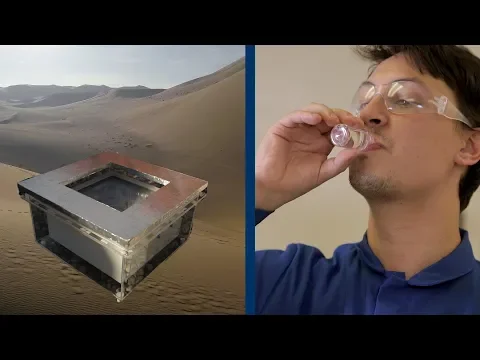

The experiment shows that even extremely dry environments still carry enough water to be captured when the right materials come into play.
Given this technology, do you believe that systems capable of capturing water directly from the air could become common in homes and cities of the future, or will traditional solutions like reservoirs and desalination still dominate the world’s water supply in the coming decades?


Be the first to react!