






 Portuguese
  Spanish


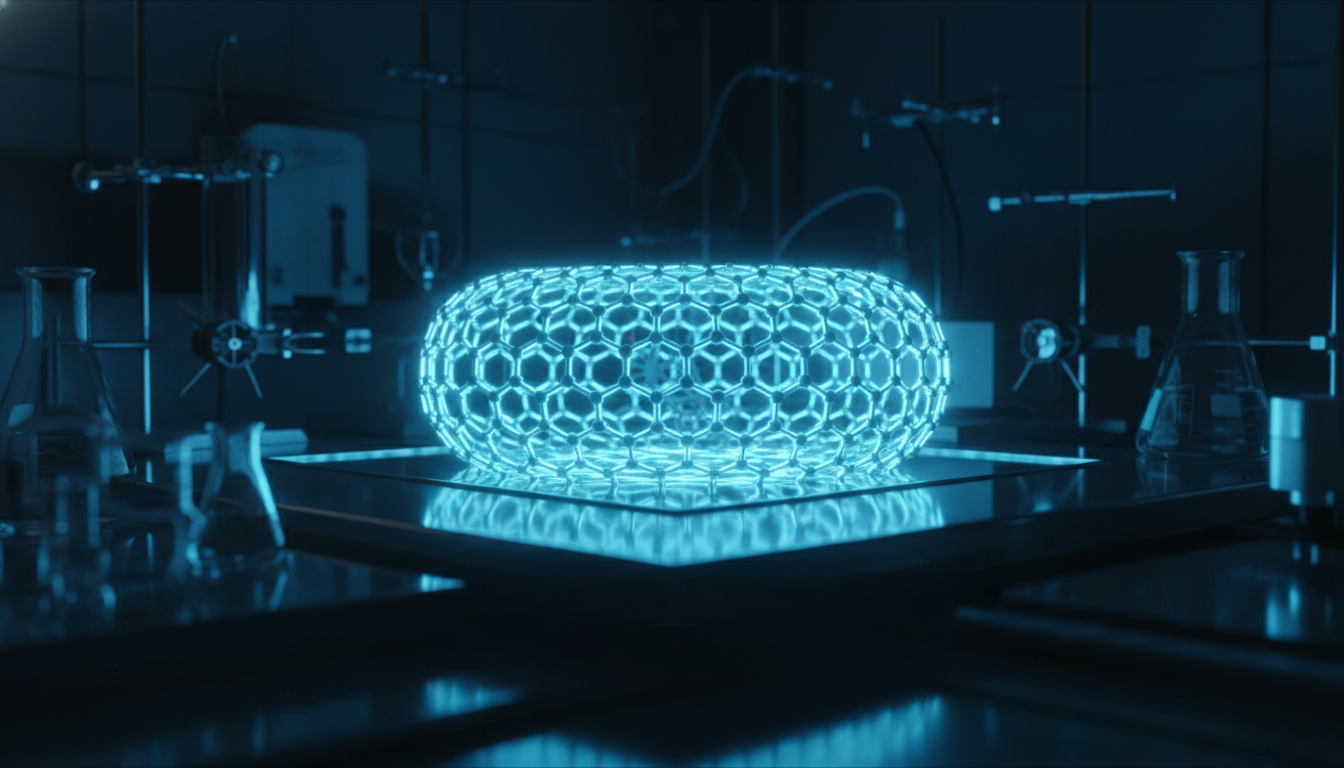

Researchers from India and Japan created ultraclean graphene samples and observed electrons flowing like a frictionless liquid — violating a law of physics that had been in effect since the 19th century by more than 200 times
Scientists from the Indian Institute of Science (IISc) and Japan’s National Institute for Materials Science announced on April 15, 2026, the observation of a phenomenon that physics considered impossible in common materials.
In ultraclean graphene samples, electrons stopped behaving as individual particles.
Instead, they began to flow collectively, like a virtually frictionless liquid.
-
The World’s First Smartphone, Released in 1994, Would Cost the Equivalent of an iPhone 16 Plus Today

-
Robot Explores Atlantic Ocean Depths, Captures Unprecedented High-Definition Footage of Rare Giant Squid

-
São Paulo to Host Brazil’s Largest Military Aviation Museum, Aiming for Global Top Five by 2027 with 100 Aircraft Displayed
-
Entrepreneur Leaves Job After 20 Years, Invests Under $200 to Launch Sustainable Craft Store Inspired by Beeswax Wraps, Now Earning $7,000 Monthly


The result violated the Wiedemann-Franz law by more than 200 times at low temperatures. This law, established in the 19th century, states that in any metal, heat conduction and electrical conduction must be proportional.
In graphene, they completely decoupled.
What is the Dirac fluid found in graphene
The observed phenomenon has a specific name in quantum physics: Dirac fluid.
It is an exotic state of matter in which electrons stop acting individually and begin to move together, as if they were a single fluid.
Aniket Majumdar, a PhD student at IISc and first author of the study published in the Nature Physics journal, explained: “Since this water-like behaviour is found near the Dirac point, it is called a Dirac fluid — an exotic state of matter which mimics the quark-gluon plasma, a soup of highly energetic subatomic particles observed in particle accelerators at CERN”.
In a free translation: the Dirac fluid mimics the quark-gluon plasma — a soup of highly energetic subatomic particles that had only been observed in accelerators like CERN, in Switzerland.
Now, for the first time, this behavior has been reproduced on a laboratory bench, using only graphene.

A fluid 100 times less viscous than water
Researchers measured that the viscosity of the Dirac fluid is 100 times lower than that of water.
This means that electrons in graphene flow with almost zero resistance — close to what physicists call a perfect fluid.
In conventional metals, when electrical conductivity increases, thermal conductivity rises along with it. The two are always coupled.
In ultraclean graphene, however, they inverted.
Electrical conductivity and thermal conductivity began to move in opposite directions.
This decoupling directly violates the Wiedemann-Franz law — and not by a small margin, but by a factor of more than 200.

The secret lies in the Dirac point
The phenomenon occurs under a very specific condition: the Dirac point.
This point is the exact boundary between graphene behaving as a metal or as an insulator.
By adjusting the number of electrons in the sample, researchers were able to bring the material to this point.
There, electrons stop behaving as particles that collide with each other and begin to move as a coordinated fluid.
The challenge was that, for decades, impurities and defects in materials prevented the observation of this state.
The Indian-Japanese team solved the problem by manufacturing exceptionally clean graphene samples, eliminating the impurities that masked the effect.
Applications in ultrasensitive quantum sensors
Beyond its impact on fundamental physics, the discovery has practical implications.
The presence of Dirac fluid in graphene could enable quantum sensors capable of detecting extremely weak electrical signals and faint magnetic fields.
These devices would be useful in ultra-low noise applications, such as advanced scientific instrumentation and precision medical diagnostics.
Graphene, discovered in 2004 by physicists Andre Geim and Konstantin Novoselov — who received the Nobel Prize in Physics in 2010 for the discovery — continues to reveal properties that challenge established knowledge.
In a previous article by Click Petróleo e Gás, we showed how **graphene can be 200 times stronger than steel in civil construction**, reaching over 13 thousand views.

Caveats: still laboratory research
The study is a demonstration of fundamental physics, not a ready product.
The samples require ultra-low noise conditions and very low temperatures, difficult to replicate outside advanced laboratories.
However, the fact that a phenomenon previously restricted to CERN particle accelerators has been reproduced on a laboratory bench **opens a door that didn’t even exist before**.
The collaboration between India and Japan demonstrates that graphene still holds surprises — even two decades after its discovery.
If a single-layer carbon atom material can violate a law of physics by 200 times, what else can it do that we don’t yet know?


