Portuguese
  Spanish


Scientists simulated what would happen if all Earth’s oceans evaporated — and found the same mark on Mars, suggesting one-third of the planet was once covered by water
If you empty a bathtub, the water leaves a mark on the rim — a line that shows exactly how high the level reached. Scientists from the University of Texas at Austin and Caltech have just found that same mark on Mars.
Using data from NASA’s Mars Orbiter Laser Altimeter (MOLA), the team led by researcher Abdallah Zaki identified a distinct, flat band of terrain that stretches across the entire northern hemisphere of the red planet.
This band — which scientists called a “bathtub ring” — is between 200 and 400 meters wide and is positioned between 1,800 and 3,800 meters below what would have been the ancient sea level.
-
Berries, Strawberries, and Blueberries Could Transform Agriculture in Northeastern Brazil, New Tests Reveal

-
Danish Resident Discovers Six Viking Gold Bracelets Weighing 762.5 Grams, Third Largest Gold Treasure in Denmark

-
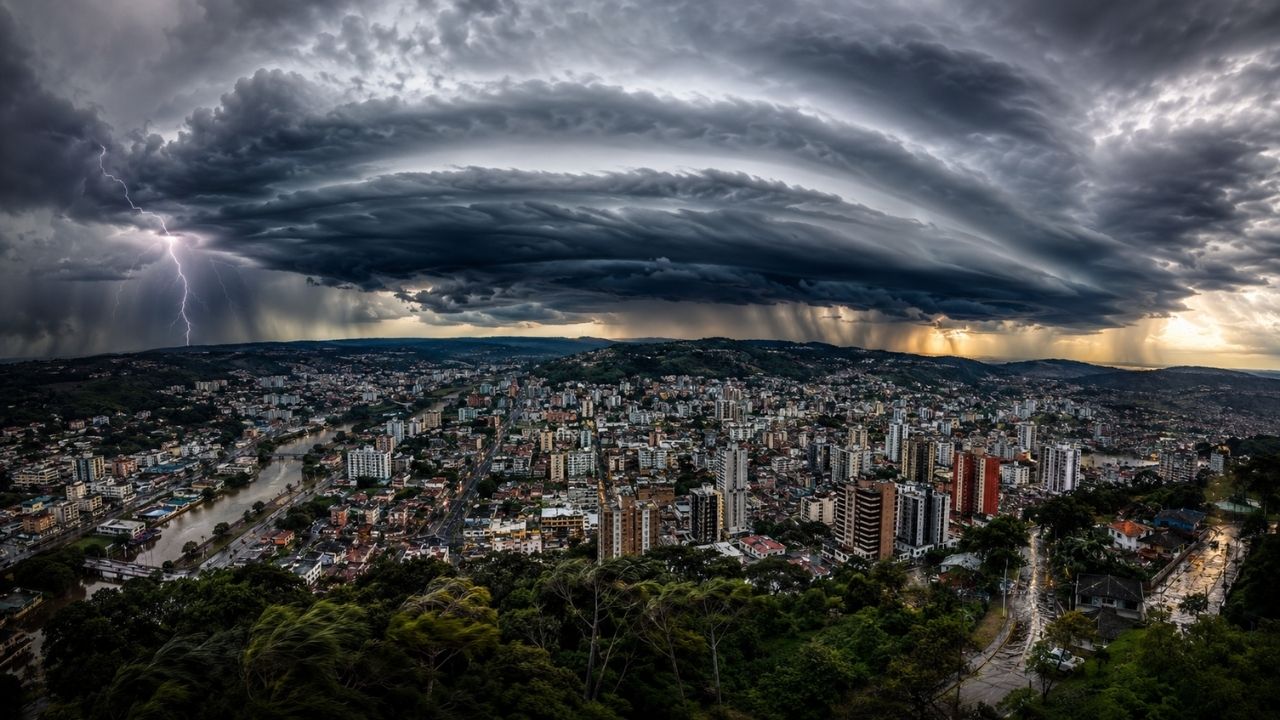
Over 200 Cities in Southern Brazil on Storm Alert as Cyclone Near Uruguay Brings Heavy Rain, Hail, and Winds Up to 100 km/h

-
Archaeologists Discover 2,300-Year-Old Beer in Sealed Bronze Vessel from Ancient Chinese Tomb



It is the strongest evidence yet found that an ocean covered approximately one-third of Mars billions of years ago.
The ingenious trick: imagining Earth without water
The idea arose from a simple question. What would happen if Earth’s oceans completely disappeared?
Researchers ran computer simulations to find out. The result was revealing: the most enduring geological mark water would leave on Earth would be the continental shelf — that sloping band where the continent gently dips into the ocean floor.
Even after millions of years of erosion, the continental shelf would remain visible. It’s a stable topographic signature.
So they looked for the same signature on Mars. And they found it.
“If there’s an ocean, there must be a shelf. That’s a more stable topographic signature,” Zaki stated.

It’s not isolated evidence — several pieces are converging
The coastal shelf is not the only clue. Scientists had already identified other independent pieces of evidence pointing to the same conclusion.
Thousands of layered sediment deposits, some hundreds of meters thick, have been found in the region. These are the type of formations expected at the bottom of a large, long-lasting body of water.
Ancient river deltas have been identified precisely at the boundary where the shelf begins — at the point where water would have met land.
Clay minerals and rocks altered by prolonged exposure to water are scattered throughout the region. These are chemical signatures that water leaves when interacting with rock for millions of years.
Each piece of evidence alone could be explained in another way. But all of them together, converging in the same location, form a picture difficult to ignore.
The Chinese rover that found ancient underground beaches
In 2021, China landed its Zhurong rover on the Utopia Planitia plain in Mars’ northern hemisphere — precisely in the region where the ocean would have existed.
Zhurong detected evidence of ancient beaches in underground sedimentary layers. These are formations resembling coastal deposits on Earth, where sand and gravel accumulate at the water’s edge.
This discovery is important because it comes from direct ground observation — not from satellites. The rover literally drove over what may have been an ocean floor.
And most fascinating: the beaches found by Zhurong are in the same region where Zaki and his team identified the coastal shelf.

What happened to the water? Where did Mars’ ocean go?
Mars once had an atmosphere dense enough to sustain liquid water on its surface. But over billions of years, the planet lost its global magnetic field.
Without this protection, the solar wind gradually stripped water molecules from the atmosphere. The water literally escaped into space.
Recent estimates suggest that Mars may have retained surface water until about 2 billion years ago — much longer than previously thought.
Some of this water may have migrated underground. In 2026, a separate study detected evidence of liquid water still trapped beneath the Martian crust, in deep reservoirs.
In other words, the ocean didn’t completely disappear. Part of it might be hidden down there, waiting.
Perseverance is already investigating the “bathtub ring” deposits
NASA’s Perseverance rover operates in Jezero crater, a location chosen precisely because it has an ancient river delta — exactly the type of formation associated with an ocean’s edge.
The crater contains deposits rich in carbonates on the margin of the ancient lake/ocean. Carbonates form when water interacts with carbon dioxide — a process identical to what occurs in Earth’s seas.
Perseverance is collecting samples of these rocks for future return to Earth. If the carbonates contain signs of biological activity, it would be the first direct evidence of life outside Earth.
The next mission will dig directly into the coastal shelf
The European Space Agency plans to launch the Rosalind Franklin rover in 2028, with a Mars landing scheduled for 2030.
The rover is equipped with a drill capable of penetrating up to 2 meters below the surface — deeper than any previous mission.
Its destination: to investigate the mineralogy and geology of the proposed coastal shelf, verifying if it truly sustained an ancient ocean.

What it means to find a “bathtub ring” on another planet
If Mars truly had an ocean covering one-third of its surface for billions of years, the implications are enormous.
Liquid water is the most basic ingredient for life as we know it. A stable, long-lasting ocean would offer conditions for the emergence of simple organisms.
This doesn’t mean there was life on Mars. It means the conditions were there.
The question is no longer “Did Mars have water?” — that seems confirmed. The question now is: “Did Mars have life?”
The samples Perseverance is collecting may provide an answer. But they won’t arrive on Earth until the 2030s. Until then, Mars’ “bathtub ring” remains the quietest and most powerful mark of a world that was once blue.