Portuguese
  Spanish


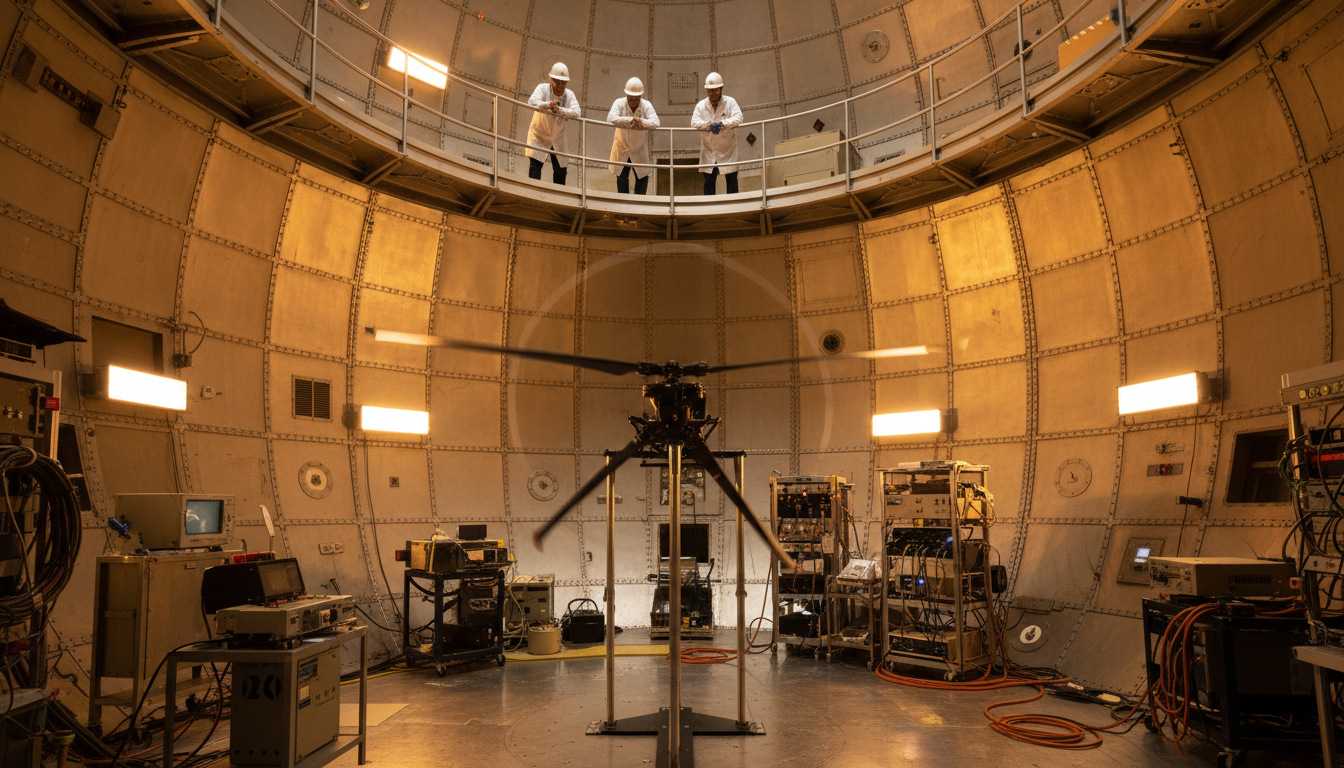


In a chamber that simulates Mars’ atmosphere, JPL engineers spun carbon fiber blades until the tips broke the sound barrier at Mach 1.08.
In March 2026, inside the 25-Foot Space Simulator chamber at the Jet Propulsion Laboratory in Pasadena, California, NASA engineers achieved for the first time a supersonic Mars rotor capable of operating without breaking apart.
According to the official statement released by JPL on May 7, the tips of the carbon fiber blades spun at Mach 1.08. The reproduced atmosphere had the same thinness as the red planet.
The feat, announced on May 14 in a report by Earth.com, concludes a campaign of 137 runs. The test marks the transition of Martian aviation to something much more ambitious.
-
Extreme Heat of 41.3°C Warps Roads in Germany, Causes Autobahn Asphalt to Crack, Injures People, and Forces Snowplows to Cool Down Highways

-
AI Security System in Brazil Aims to Cut False Alarms by Differentiating Pets from Intruders, Enhancing 24/7 Monitoring for Homes and Businesses

-
Archaeologists Discover 1,500-Year-Old Byzantine Mosaic with Greek Biblical Inscription in Israel, Uncover Ruins of 10 Buildings Near Kiryat Gat
-
Ohio Carpenter Finds 308-Gram Meteorite the Size of a Baseball After Dreaming of Its Location





The rotor designed by teams from JPL and the Ames Research Center in Silicon Valley opens a new class of Martian helicopters. They will be able to carry instruments, larger batteries, and soil samples.
For Brazil, which is studying scientific missions in partnership with NASA through the Brazilian Space Agency, the test indicates that aviation beyond Earth is beginning to transform into real planetary logistics.
The experiment behind the supersonic Mars rotor

According to NASA, the achievement was not born from just more rotation. The team combined rotations of up to 3,750 rpm with a headwind generated by auxiliary vertical rotors.
Before this opposing wind, the three-blade tips reached Mach 0.98 inside the chamber. Then, with the auxiliary on, the tips surpassed the sound barrier and stabilized at Mach 1.08.
Aerodynamicist Shannah Withrow-Maser from the Ames Research Center was quoted in the official NASA release. “We thought we would be lucky to reach Mach 1.05, and we reached Mach 1.08,” she stated.
As detailed by JPL, the 25-Foot Space Simulator chamber was configured to reproduce low pressure, cold temperatures, and a carbon dioxide-dominated atmosphere. The scenario replicates the Martian surface.
Additionally, the test showed a 30% gain in lift compared to the current design. In practice, this means longer and thinner blades carrying more weight per spin.
From Ingenuity to the new helicopter

To understand why the achievement is so important, we need to go back to April 19, 2021. On that day, in Jezero crater, the Ingenuity made the first powered flight on another planet.
Originally planned as a 30-day demonstration with five flights, the small helicopter ended up making 72 flights until January 2024. It covered more than 2.8 kilometers and completed almost three Martian years.
On January 25, 2024, according to the official note released by NASA, the vehicle remained upright. However, images from the last flight showed irreparable damage to one of the blades.
On the other hand, success came with hard limits. The Ingenuity weighed 1.8 kilograms, did not carry scientific instruments, and had lithium batteries totaling 44.4 watt-hours.
This was only enough for 187 seconds of high-power flight. In practice, autonomy to serve as an aerial scout for the Perseverance rover, but not to carry complete instruments.
Helicopters to collect samples

According to the official page of the Mars Sample Return, the most advanced concept is the Sample Recovery Helicopter.
This is a vehicle derived from the Ingenuity, but with greater mass, three small wheels for ground mobility, and a robotic claw capable of picking up titanium tubes.
In turn, these tubes would be delivered to a lander equipped with a small rocket called the Mars Ascent Vehicle. Then, an orbiter from the European Space Agency would bring the cargo to Earth.
Still, the Mars Sample Return program went through political turbulence. In January 2026, the US Congress decided to cut the mission’s “as conceived” version.
About 110 million dollars were redirected to the Mars Future Missions line. Therefore, the advancement of the supersonic Mars rotor is not left orphaned.
It becomes a strategic asset that can be reused in other leaner and modular robotic exploration architectures.
Why it is so difficult

Compared to terrestrial helicopters, those on Mars face a physics problem. The Martian atmosphere is a hundred times thinner than ours.
Therefore, to generate the same lift, the blades need to spin much faster. At such high rotations, the tips approach the speed of sound.
Indeed, they risk entering the transonic regime, where shock waves emerge and lift can drop sharply without warning.
On Earth, traditional helicopters avoid this regime by keeping the tips around Mach 0.7 to 0.85. The Ingenuity has already operated at Mach 0.87.
The leap to Mach 1.08, according to NASA, shows that carbon fiber blades with optimized aerodynamic profiles can withstand the Martian air in the supersonic regime.
Where Brazil fits in
Although the experiment took place in California, the development reaches Brazil. Brazilian institutions monitor and participate in scientific instrumentation stages in NASA missions.
As the portal has already shown in coverage about the Psyche probe, Brazilian scientists have a growing presence in interplanetary missions.
Secondly, the technical leap in Martian aviation paves the way for autonomous drones in hostile environments here on Earth. Similarly, composite blades can be adapted for offshore platforms in the pre-salt.
As documented by Click Petróleo e Gás in a recent report on Mars, this type of advancement fuels public interest in space science.
What comes next
According to NASA, the Mach 1.08 data is still under analysis. Engineers suspect there is extra thrust margin to be explored.
Next, the team plans to run prolonged fatigue tests to verify if the blades withstand repeated cycles without losing rigidity over months.
According to the agency’s disclosed schedule, the next Mars mission with a helicopter still depends on budget approval in the US Congress.
At that time, if the next launch window is seized, a Martian drone with supersonic blades could reach the surface later this decade.
- Speed achieved: Mach 1.08 in simulated Mars air
- Location: 25-Foot Space Simulator chamber, JPL, Pasadena, California
- Runs: 137 tests in March 2026
- Lift gain vs. Ingenuity: +30% per spin
- Maximum rotor rotation: 3,750 rpm with headwind
- Reference mass of Ingenuity: 1.8 kg, without instruments
Limits of the supersonic Mars rotor
According to NASA itself, the test was conducted on Earth, inside a chamber. Therefore, there is no proof yet that the assembly will withstand real vibration and radiation.
According to the Ames Research Center study, there are unmeasured long-term variables, such as the aging of carbon fiber resin in ultra-freezing cycles.
Despite this, the mission schedule depends on political decisions in Washington. Recent cuts to the Mars Sample Return show that funding for Martian exploration is volatile.
Finally, the question remains: if the Mach 1.08 advancement can multiply the payload of planetary drones, does Brazil have the capacity to embark with its own instruments?