






 Portuguese
  Spanish


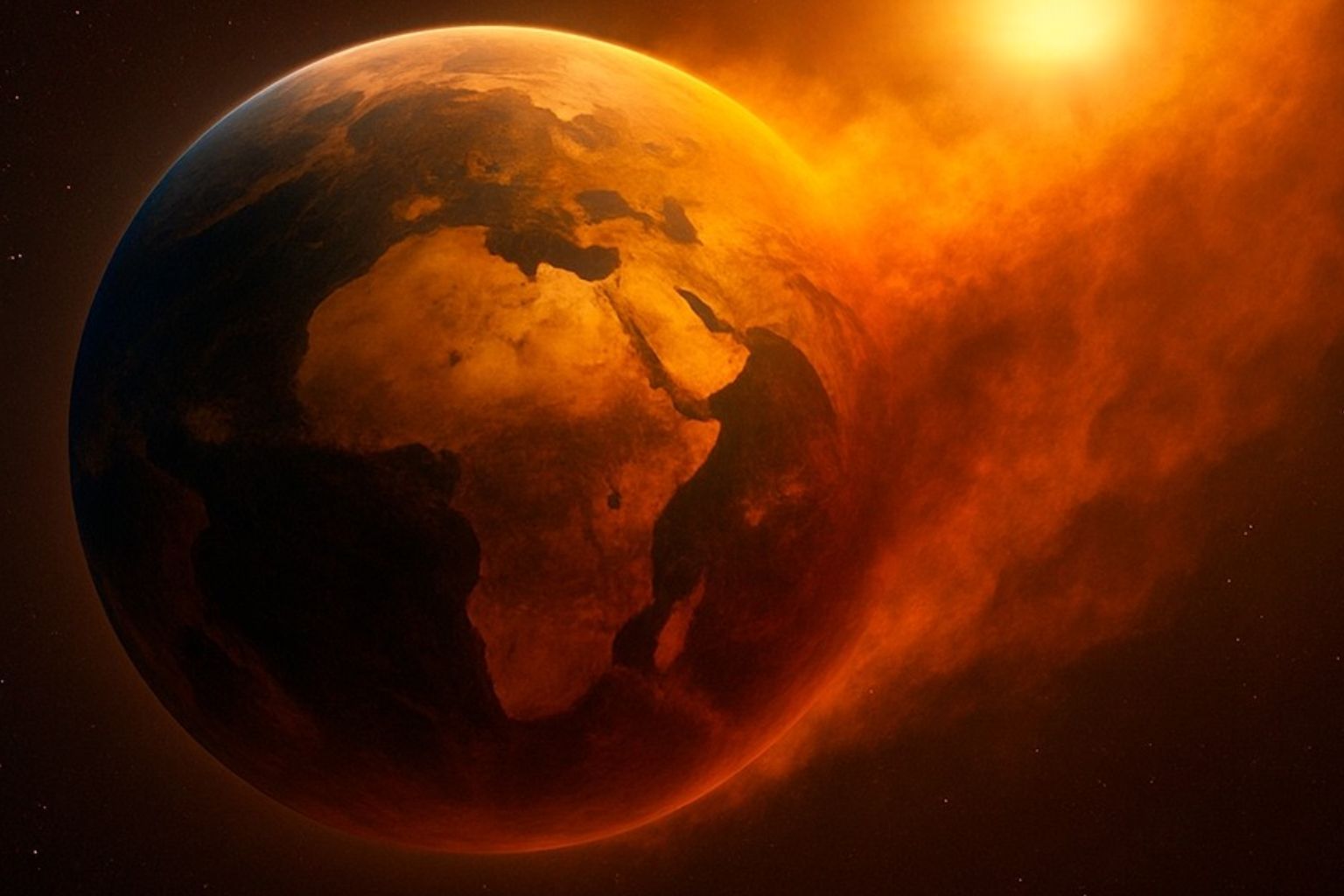


Earth’s oxygen is not eternal. Climate and geochemical models indicate that the gradual increase in the Sun’s luminosity will remove CO₂ from the atmosphere, make photosynthesis unfeasible, and cause a catastrophic drop in oxygen levels in about a billion years. The atmosphere will return to a state similar to that which existed before the emergence of complex life.
The Earth’s oxygen seems as permanent as the ground beneath our feet, but science shows it has an expiration date. Studies in astrobiology and planetary sciences indicate that the amount of oxygen available in the air depends on a fragile balance between production and consumption that has been maintained for hundreds of millions of years, but is not guaranteed forever. Photosynthesis, carried out mainly by plants and microorganisms, releases oxygen, while processes such as respiration, decomposition, and chemical reactions with rocks and gases continuously consume it. If this balance is disrupted, the atmosphere that supports all complex life on the planet will cease to exist.
And the agent responsible for this disruption will not be an asteroid, a volcanic eruption, or human action. It will be the Sun itself, which is becoming more luminous every billion years and which, by intensifying its radiation, will trigger a series of chemical reactions that will remove CO₂ from the atmosphere and make photosynthesis impossible. Without photosynthesis, there is no oxygen production. Without production, Earth’s oxygen will be gradually consumed by geological and chemical processes until the atmosphere returns to an anoxic state, similar to what existed before the emergence of multicellular life over two billion years ago.
Why Earth’s oxygen is not permanent
According to information from the portal Revista Oeste, the idea that Earth’s oxygen is a natural constant is intuitive but wrong. On geological time scales, the composition of the atmosphere has changed drastically throughout the planet’s history. During the first two billion years of Earth’s existence, there was virtually no free oxygen in the air. It was only with the emergence of cyanobacteria, capable of performing photosynthesis, that oxygen began to accumulate in the atmosphere, in an event known as the Great Oxidation, about 2.4 billion years ago.
-
Robots Clean Solar Panels in Desert Power Plants Without Water, Preventing Energy Losses

-
AI Radar Built with Old Camera and $20 Gains Attention After Alleged $317,000 Sale to Chinese Government, But Lack of Documentation and Official Confirmation Raises Questions

-
Amateur Detectorist Discovers 3,400-Year-Old Bronze Age Gold Treasure with 121 Pieces in Transylvania, Including a Unique Ring

-
Italian Designer Develops Solar-Powered Terracotta Water Purifier Producing Up to 5 Liters of Drinking Water Daily Without Electricity


What scientists are now demonstrating is that this cycle can close. The Earth’s oxygen exists because there is a dynamic balance between production by photosynthesis and consumption by chemical and biological processes, and any significant alteration on one side of this equation can destabilize the system. Production depends on CO₂ and sunlight to fuel photosynthesis. Consumption depends on volcanism, mineral oxidation, and respiration of living organisms. When production can no longer compensate for consumption, the Earth’s oxygen begins to decline.
How the Sun Will Destroy the Earth’s Oxygen

The mechanism is indirect but inevitable. The Sun is becoming approximately 10% more luminous every billion years, a natural process of stellar evolution that occurs as the hydrogen in the star’s core is consumed and nuclear fusion intensifies. More luminosity means more energy reaching the Earth’s surface, which accelerates the so-called chemical weathering, the process by which rainwater reacts with minerals in rocks and removes CO₂ from the atmosphere.
With less carbon dioxide available in the air, photosynthesis becomes progressively less efficient, reducing the amount of oxygen produced on Earth each year. Meanwhile, geological processes such as volcanism and tectonic plate movement continue to release gases that react with oxygen and consume it. The result is a slowly closing scissors: less production on one side, constant consumption on the other. In about a billion years, according to models, photosynthesis will become unviable and the Earth’s oxygen will enter irreversible decline.
What Happens When the Earth’s Oxygen Begins to Fall
The scenario of extreme reduction of Earth’s oxygen would not be a sudden drop, but a gradual process with cascading consequences. With less CO₂ in the atmosphere, plants and photosynthesizing microorganisms would lose efficiency and eventually be unable to survive, eliminating the planet’s main source of oxygen. Without the constant replenishment by photosynthesis, the remaining oxygen would be consumed by reactions with volcanic gases, oxidation of minerals on the surface, and other geochemical processes.
The consequences for life would be devastating. All complex life that depends on oxygen, from insects to mammals, would be eliminated as levels fall below the minimum necessary to sustain aerobic respiration. The planet would not become sterile: anaerobic microorganisms, which do not depend on oxygen, would likely survive and become the dominant form of life, just as they were in the first billion years of Earth’s history. The oxygen-rich atmosphere that allowed for the explosion of complex life would be remembered as a temporary episode on the geological scale.
The Uncertainties That Could Speed Up or Delay the End of Earth’s Oxygen

Although models indicate a timeframe of approximately one billion years for the great decline of Earth’s oxygen, researchers highlight important uncertainties that could alter this estimate. The future intensity of volcanism, the speed of tectonic plate movement, and how carbon will be stored in rocks or released into the atmosphere are variables that could accelerate or delay the process by hundreds of millions of years.
The evolution of life itself is another factor of uncertainty. New forms of organisms, changes in global vegetation, or adaptations in microbial communities could modify the way Earth’s oxygen is produced and consumed. On shorter timescales, human actions are already influencing climate and biogeochemical cycles, demonstrating the fragility of atmospheric balance. Although the timescale of Earth’s oxygen depletion is far beyond human experience, the research serves as a reminder that the habitability of the planet is not guaranteed by any physical law.
What research on Earth’s oxygen teaches about other planets
The discovery that Earth’s oxygen has an expiration date has direct implications for the search for life beyond the solar system. If the presence of oxygen in a planetary atmosphere is temporary and depends on a specific set of conditions, then detecting oxygen on an exoplanet does not guarantee that life exists there, only that the conditions for aerobic life exist at that moment. A planet may have had complex life in the past and lost its oxygen, or it may be in a pre-oxygenation phase where life exists but has not yet modified the atmosphere.
For astronomers scouring the cosmos for signs of life, understanding how and why Earth’s oxygen arose, was maintained, and will eventually disappear is crucial for interpreting the atmospheres of distant worlds. Earth is not a static model of habitability but an ongoing experiment that has already had phases without oxygen and will have them again. The difference is that this time, someone is here to document the process before it happens.
Scientists say that Earth’s oxygen has an expiration date and that the Sun will be responsible for the end of the air we breathe. Knowing that the planet will not be habitable forever changes the way you think about life? Share your thoughts in the comments.








This is only possible if Concrete pavements and Sand replace grass land, tress and forest