Portuguese
  Spanish


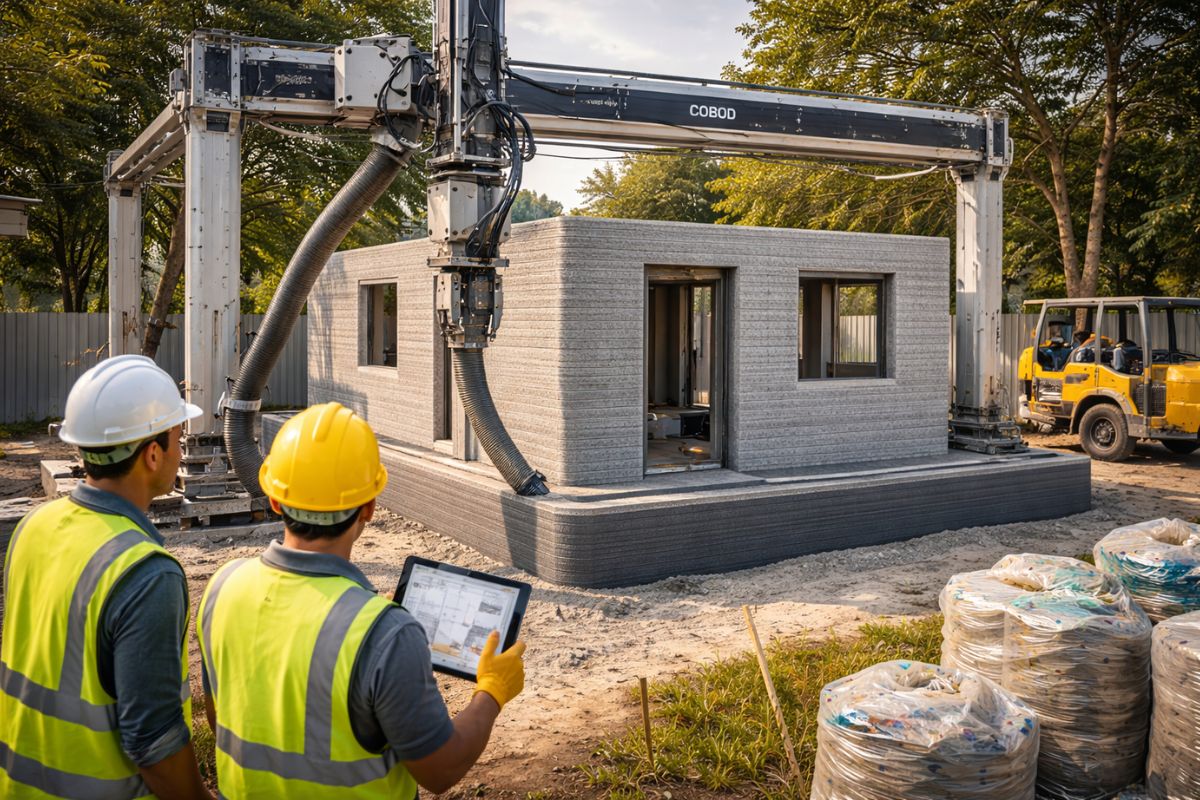


In Concepción, Chile, a University Team Claims to Have Built the First 3D Printed Concrete House in Latin America: Seven Concrete Walls Were Printed in the Laboratory in 29 Hours with the Atenea-UBB Printer and a KUKA KR120 Industrial Robot, and the Final Assembly Took Two Days in the Torreones Neighborhood
Concrete walls are no longer synonymous with bricks and rows in this Chilean prototype presented as a “seed house.” In Concepción, the team describes a process in which an industrial robot deposits layers of concrete guided by a computer-controlled digital design, printing structural elements instead of raising walls block by block at the traditional pace.
Concrete walls here appear as an industrialized product from the laboratory before becoming a house on the construction site. The prototype occupies about 30 square meters and has seven walls made of printed concrete, according to Professor Claudia Muñoz from the Faculty of Architecture at the University of Biobío. The detail that changes perception is the time: the walls would have been built in 29 hours, and the final assembly took two days.
Where It Was Made, Who Signed the Project, and Why Concepción Became a Showcase

The project was presented in Concepción, Chile, with the participation of a university team linked to the University of Biobío.
-
Brazilian Designer Turns Broken Umbrella Nylon into Jackets, Employs 101 Seamstresses to Create 19,500 Pieces and Earn R$ 240,000

-
“Dinosaur-Era ‘Zombie’ Tree Rediscovered Alive in Secret Australian Canyon, Astonishing Scientists”

-
Two Design Students from Brazil Turn Recycled Plastic into Fashionable Eyewear, Earning $10 Million in a Year
-
Self-Taught Brazilian Innovator Brings Solar Power to Shantytowns Using Scrap, Solar Panels, and Phone Batteries


The house was built in the Torreones neighborhood, on a plot owned by a private construction company that was involved in the project, indicating a bridge between research and the construction sector.
The nickname “seed house” is not just marketing; it signals a prototype, an initial model to test method and acceptance.
The ambition is to be the first construction of this type in Latin America, and this draws attention because the region has a demand for housing and, at the same time, tends to rely on the import of technologies and methods.
Rodrigo García himself from the construction manufacturing group raises the issue as a complex change that needs to be adapted to the Chilean reality.
How the Robot Prints, Which Machines Are Involved, and What “29 Hours” Really Means

The system used combines a printer called Atenea-UBB and a KUKA KR120 industrial robot.
The “robotic printer” pours layers of concrete based on a computer-controlled digital design.
Instead of raising walls with bricks, mortar, and human pace of rows, the robot deposits layer upon layer.
The 29 hours refer to the construction of the walls, not the complete cycle of work. After printing the seven concrete walls, the team reports that the final assembly took two days.
This separates two stages of the process: manufacturing of components (industrialization in the laboratory) and assembly on-site (installation and fitting of what was produced).
In practice, this design attempts to shift some of the construction time from the site to a more controlled environment.
Seven Walls, 30 m² and What the “Seed House” Aims to Prove
The “Seed House” occupies about 30 square meters and is described as consisting of seven walls made of printed concrete.
Professor Claudia Muñoz claims that these walls were printed entirely in the laboratory, which reinforces the idea of standardization and repeatability as a goal.
What the prototype aims to prove is that it is possible to build a compact house quickly and with shape control, reducing traditional steps such as masonry raising, alignment of rows, and reliance on purchasing a large number of elements before starting.
The gain reported is in logistics and time, because the traditional method involves plans, budgets, purchasing, site preparation, and time-consuming execution. 3D printing attempts to shorten the sequence, but without promising that the entire process disappears.
Why This Matters to Housing and Why It Is Not Yet a “Ready Solution”

Rodrigo García claims that the technology could help change the way construction is done, with flexible models, but he also states that there is still much to be proven in terms of costs and reliability.
This is the most important brake on the narrative: speed does not solve everything if cost and durability do not add up.
The interest lies in the Latin American context of housing demand and historical reliance on imports.
García mentions that the change needs to be adapted to the Chilean reality, marked by earthquakes, and to climate diversity.
This raises a central technical question: how do 3D printed concrete walls behave in seismic environments, and how does the system handle climate variations, material curing, and maintenance over time?
Traditional Construction Versus Digital Construction, What Changes on Site and What Does Not Change
García’s speech describes the “before” to justify the “after”: in the traditional model, plans are drawn up, budgets requested, a large number of elements purchased, and the site prepared, which consumes time. 3D printing attempts to replace part of the purchasing and assembly with direct manufacturing of components.
But the construction site does not disappear. The house was built on real land, with the partnership of a private construction company, and there was a final assembly of two days.
This indicates that printing solves a slice of the problem, the production of the walls, but still depends on logistics, preparation, installation, and integration with other parts, such as roofing, installations, finishes, and connections to the site.
Concrete walls were printed in 29 hours in Concepción by a university team with the Atenea-UBB printer and a KUKA KR120 industrial robot, forming seven walls of a “seed house” of about 30 m², assembled in two days in the Torreones neighborhood.
The prototype is presented as a regional milestone and an attempt to shorten construction time, but the team itself emphasizes that cost and reliability still need to be proven, in addition to adapting to earthquakes and climate.
I want specific answers: would you trust living in a house with 3D printed concrete walls if it reduced construction time, or what would weigh more for you, cost, durability, or safety in earthquakes? And in your city, where does construction lose time today, in wall raising, purchasing materials, or site preparation?