Portuguese
  Spanish


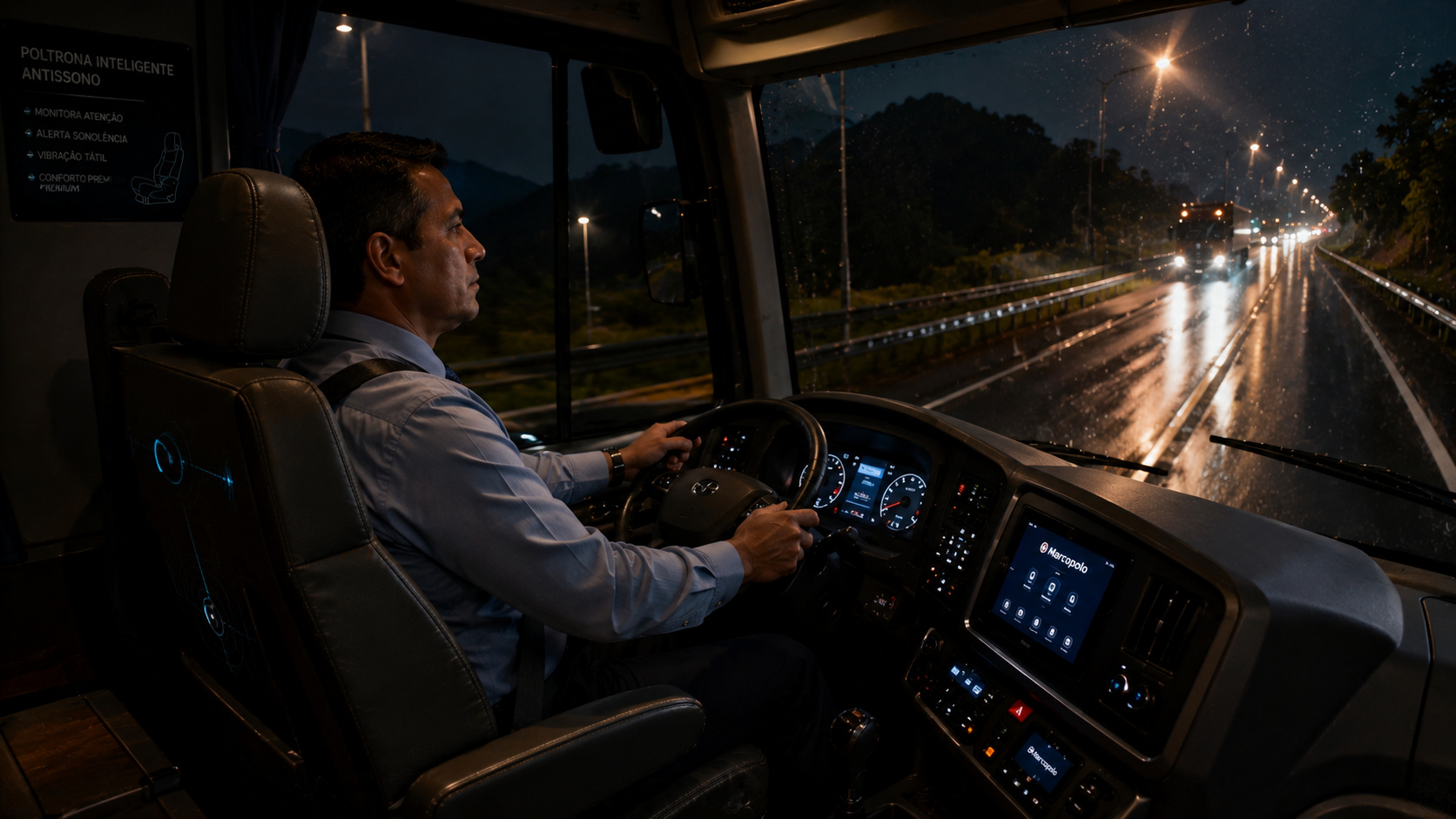

Unprecedented technology created by Marcopolo uses intelligent stimuli to combat fatigue at the wheel, increase drivers’ alertness, and reduce accidents on busy Brazilian highways
The advancement of technology in road transportation gained a new chapter in Brazil. Marcopolo introduced a solution created to combat drowsiness at the wheel. The innovation promises to increase road safety and reduce accidents involving heavy vehicles.
The information was released by “Canal Dana,” based on a report by Carpress. According to the published content, the manufacturer developed an intelligent seat equipped with mechanisms aimed at monitoring drivers’ fatigue.
The equipment was named Antisleep Seat. Furthermore, the project was born within Marcopolo’s Innovation Center. The company also partnered with the Multidisciplinary Center for Sleepiness and Accidents and Woodbridge.
-
Welder Discovers 16th-Century Diamond Ring in England After 7 Hours with Metal Detector; Gold Jewel Linked to Edward I Pattern Auctioned for £17,000

-
Former Merchant Marine Captain Invents Fuel-Free Barrier, Removes 20,000 Tons of Trash from Chennai Rivers
-
14-Year-Old Maxim Harris Turns School Project into Anti-Rage Gaming Accessory, Sells 1,000 Units Across 46 U.S. States, Donates 20% of Profits to Charity
-
Brazilian Health Agency Approves First Oral Medication for Cancer Patients




The proposal attracted attention because it combines technology, ergonomics, and safety in a single system. In this way, Marcopolo seeks to offer more protection for both drivers and passengers and transport companies.
Antisleep seat uses technology to keep driver alert
The new intelligent seat was not created just to offer comfort. In practice, it functions as an anti-fatigue system. The equipment uses mechanical and physiological stimuli capable of increasing the driver’s attention state.
According to the developers, the technology acts mainly in critical moments of drowsiness. Thus, the system tries to prevent dangerous situations during long trips.
The studies used by the team show that fatigue at the wheel has several causes. Among them are sleep deprivation, mental exhaustion, and excessive hours awake. Additionally, factors such as road monotony and reduced body temperature also directly influence the loss of attention.
The specialists involved in the project warn of another important point. Drivers who stay awake for more than 16 hours show a significant decrease in reaction capacity. Consequently, the risk of accidents increases worryingly.
Therefore, Marcopolo decided to invest in a preventive solution. Instead of acting only after a problem, the technology tries to identify signs of fatigue before the driver completely loses concentration.
System will be able to monitor driver fatigue and data in real time
Another important feature of the project involves technological integration. In the future, the Antisleep Seat will be able to connect to intelligent fleet management systems. Additionally, the equipment will be able to track drivers’ sleep patterns.
According to Petras Amaral, design and innovation manager at Marcopolo, the proposal goes beyond a simple seat. According to him, the goal is to transform the equipment into a complete preventive safety platform.
In practice, this will allow for real-time data cross-referencing. In this way, companies will be able to identify signs of accumulated fatigue, excessive work hours, and critical moments of tiredness.
Furthermore, transport operators will be able to use this information to improve work schedules. Thus, the trend is to increase safety and reduce risks on the roads.
This type of technology gains importance because road transport remains essential in Brazil. Thousands of truck drivers and bus drivers travel long distances daily. Therefore, physical and mental wear is part of these professionals’ routine.
Consequently, the search for intelligent systems capable of reducing accidents and improving working conditions on Brazilian roads is growing.
Marcopolo technology emerges as a bet to reduce highway accidents
Drowsiness at the wheel has been among the main causes of accidents involving heavy vehicles for years. Truck drivers and bus drivers face long shifts, irregular hours, and tiring routes.
In this scenario, the Antisleep Seat emerges as a promising bet. The system uses intelligent monitoring combined with stimuli provided by the seat itself. In this way, the equipment acts directly to keep the driver awake.
The project is still in the testing phase. Even so, it is already attracting interest in the automotive market and the public transport sector.
The initial expectation of Marcopolo was to complete the final tests and officially present the system between the end of the year and the beginning of 2017. Even so, the concept remains current and relevant to the transport market.
In recent years, companies have increasingly invested in safety technologies. Among them are fatigue monitoring systems, assisted driving, and embedded intelligence.
In the case of Marcopolo, the differential lies precisely in the direct action on the driver. The equipment combines ergonomics, engineering, and technology to increase the level of attention during driving.
Furthermore, the trend is that similar solutions will gain traction in the coming years. Especially in intercity buses, long-distance trucks, and large corporate fleets.
By combining innovation and safety, Marcopolo bets on a technology capable of transforming the routine of Brazilian road transport.
Do you believe that anti-fatigue technologies should become mandatory in buses and trucks on Brazilian roads?