Portuguese
  Spanish


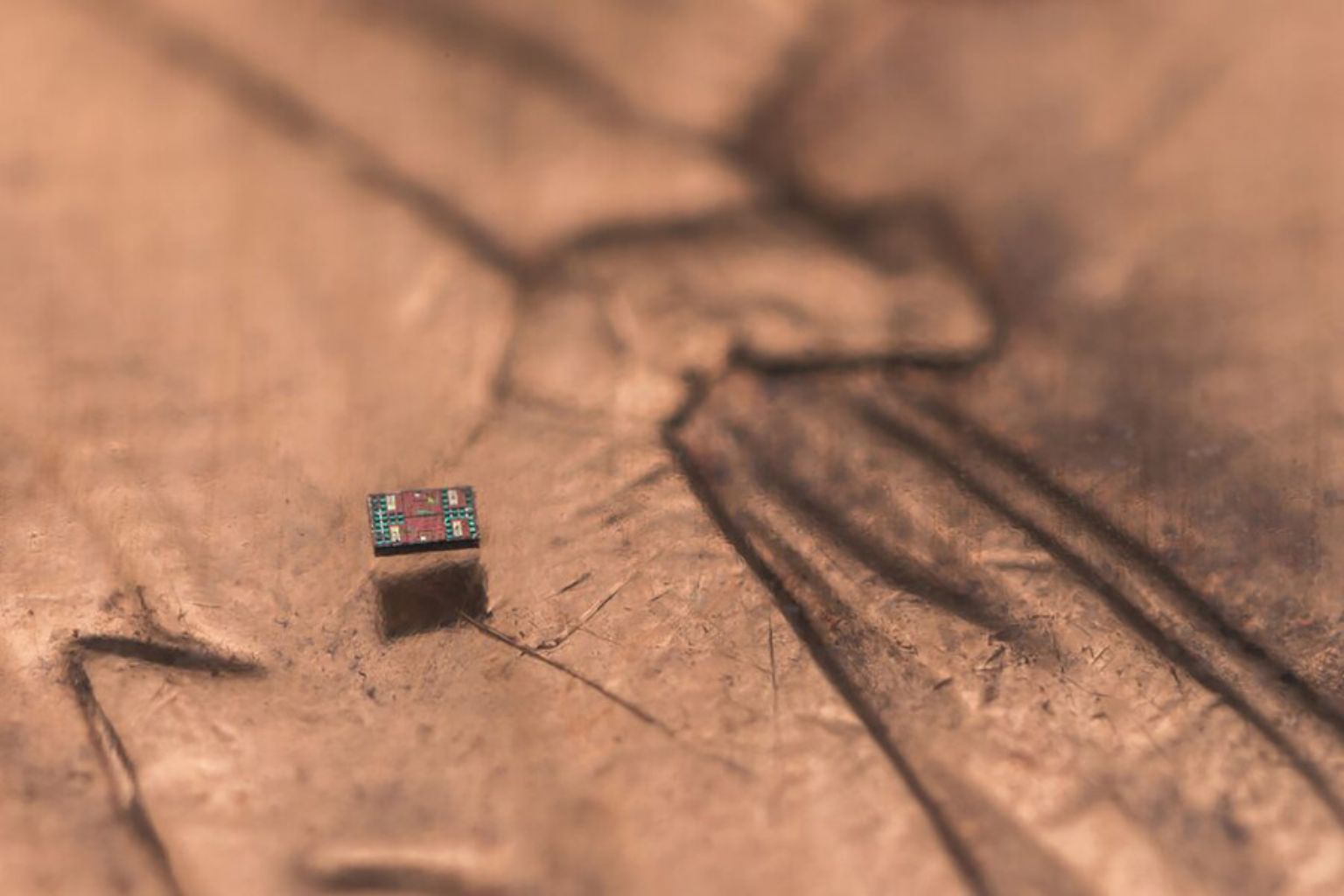


200 Micrometer Microscopic Robots Swim, Detect Temperature, and Make Decisions, Paving the Way for a New Era in Medical Robotics.
In 2025, researchers from the University of Pennsylvania, in collaboration with the University of Michigan, presented a new class of microscopic robots that pushes the limits of autonomous robotics. According to a statement released by Penn Engineering on December 15, 2025 and reported by Penn Today on December 17, 2025, the devices measure about 200 × 300 × 50 micrometers, are smaller than a grain of salt, and have been described as the smallest fully programmable and autonomous robots ever created, capable of swimming in liquids, detecting temperature changes, and adjusting their trajectory without wires, magnetic fields, or direct external control.
The advancement is not only in size but also in the level of functionality concentrated in a structure almost invisible to the naked eye. These light-powered microrobots carry microscopic computers, sensors, and propulsion systems capable of operating in liquid environments for months, in addition to executing programmed movements and acting in a coordinated manner in groups. In practice, the research opens a new scale for robots that can sense, compute, react, and move in dimensions close to those of microorganisms, with potential applications in cellular monitoring, medicine, and the manufacturing of microscopic devices.
This is one of the first documented examples of functional autonomous robots at the microscopic scale with sensory capability and programmed response.
-
NASA Rover Captures “Tired Face” on Mars, Highlighting Human Brain’s Tendency to See Faces in Rock Formations

-
Ancient Stone City in the Desert, Once Home to 30,000, Puzzles Scientists with Nabateans’ Water Mastery 2,000 Years Ago

-
Ancient Creature Thought Extinct Since Dinosaur Era Reappears, Baffling Scientists
-
India Deploys Giant Fabric Tubes Filled with Sand to Combat Coastal Erosion and Rebuild Disappearing Beaches





Architecture of Microrobots Integrates Sensors, Processing, and Propulsion in Structures Smaller than a Grain of Salt
The developed robots have a highly integrated architecture, combining elements that, in traditional systems, occupy much larger volumes. Each unit incorporates temperature sensors, basic electronic circuits for decision-making, and a propulsion system that allows movement in liquid environments.


The operation relies on light as an energy source. Small photosensitive cells convert light energy into electricity, powering the internal circuits. This approach eliminates the need for conventional batteries, which would be unfeasible at this scale.
Propulsion occurs through physical interactions with the surrounding fluid, allowing the robots to swim or move slowly. Although the speed is low, the goal of the system is not rapid movement but rather precision, control, and the ability to operate in confined and sensitive environments.
The integration of sensors, logic, and movement in a microscopic volume represents a significant technical leap in robotics.
Light-based operation allows energy autonomy without batteries in microscopic robots
One of the biggest challenges in micro-scale robotics is energy supply. Conventional batteries cannot be reduced indefinitely without loss of efficiency and safety. To circumvent this problem, researchers have adopted a light energy-based approach.
The robots use small photovoltaic structures that capture light and convert it into sufficient electrical energy to power the internal circuits. This model allows continuous operation as long as adequate lighting is available.
This solution also significantly reduces the weight and complexity of the system. Eliminating the need for internal energy storage is one of the factors that make it possible to achieve such small dimensions without compromising functionality.
However, this also imposes limitations, as performance directly depends on the intensity and availability of light in the environment.
Capacity to detect temperature and react to the environment shows the beginning of real autonomy in microscopic robots
The microrobots not only move but also manage to detect temperature variations in the environment. This sensory capability is fundamental, as it allows the device to respond to external stimuli in a programmed manner.

For example, upon detecting a temperature change, the robot can alter its trajectory or behavior. This type of simple response already constitutes a basic level of autonomy.
Although they do not yet possess advanced artificial intelligence, these systems demonstrate that even on a microscopic scale it is possible to integrate perception and action, which is essential for future applications.
This type of functionality paves the way for more complex systems, where multiple sensors and more sophisticated algorithms can be incorporated.
Coordinated group movement indicates potential for swarming robotics on a microscopic scale
Another important aspect of the project is the possibility of group operation. Instead of relying on a single robot to perform a complex task, multiple units can act in a coordinated manner.
This concept, known as swarm robotics, allows for the distribution of tasks among several simple agents. On a micro scale, this is particularly advantageous, as each individual unit has limitations in power and capacity.
By operating together, the robots can cover larger areas, increase redundancy, and improve the overall efficiency of the system. The coordination among multiple microscopic robots is one of the most promising pathways for future practical applications.
Potential medical applications include navigation within the human body and targeted drug delivery
One of the most discussed applications for this type of technology is in the medical field. Microscopic robots could be used to navigate within the human body, reaching hard-to-access areas.
In theory, these devices could transport medications directly to a specific point, reducing side effects and increasing treatment efficiency. They could also be used for internal monitoring, data collection, or even minimal interventions.

However, it is important to highlight that these applications are still in the experimental phase. The study does not demonstrate immediate clinical use, but rather the potential of the technology.
The possibility of operating within the human body with machines invisible to the naked eye represents a radical shift in medicine, but it still depends on significant advancements.
Comparison with conventional robots shows a paradigm shift in engineering and the concept of machine
The microrobots developed represent a paradigm shift compared to traditional robots. Instead of large, complex, and highly controlled systems, the new approach relies on extreme miniaturization and functional simplicity.
This shift requires a complete rethinking of control, energy, and interaction with the environment. At microscopic scales, physical forces behave differently, necessitating specific solutions.
Engineering is no longer just a matter of reducing size but requires new strategies adapted to the micro scale. This type of innovation can influence various fields, from electronics to biotechnology.
Current limitations show that technology is still in its initial phase and depends on advancements in control and energy
Despite the advancements, technology still faces significant limitations. Robot control is restricted, processing capacity is limited, and reliance on light as an energy source may restrict applications.
Moreover, large-scale manufacturing and standardization are still significant technical challenges. These factors indicate that technology is still in the early stages of development.
The experiment demonstrates feasibility, but does not represent a ready solution for immediate commercial or medical applications. Still, the observed progress suggests that these limitations may be overcome with the advancement of research.
Do you believe that invisible robots to the naked eye can become part of medicine and future technology?
The advancement presented by the researchers raises important questions about the future of technology. If robots smaller than a grain of salt can already detect, react, and move, the next step may take these machines into real applications within the human body or in critical environments.
The discussion involves not only engineering but also safety, ethics, and regulation. Still, the experiment makes it clear that the miniaturization of robotics is not just a trend, but an ongoing transformation.