






 Portuguese
  Spanish
  4 min of reading
  0 comments


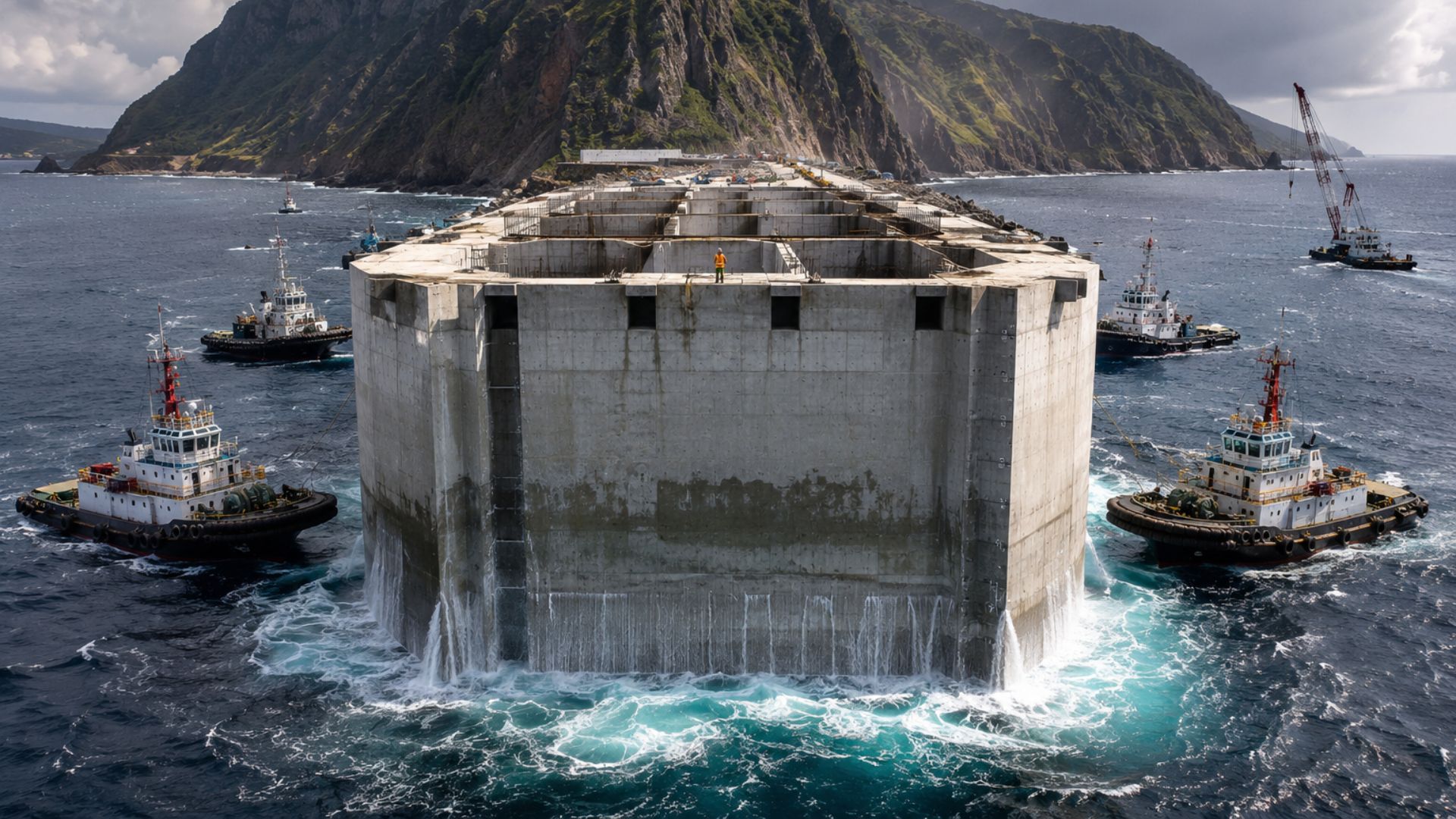
Ulleungdo Project mobilizes colossal concrete structures launched into the sea to create the foundation for an airport built on reclaimed land, in one of the most complex maritime operations ever carried out by South Korean engineering in deep waters subject to extreme waves.
The installation of 30 giant concrete caissons in the sea marked a new stage in the construction of Ulleung Airport, a project that transformed coastal engineering into a central piece to enable a runway on an island without sufficient flat areas to receive this type of structure.
Located in eastern South Korea, Ulleungdo has historically relied on maritime connections and features mountainous terrain, a condition that led engineers to advance over the sea to create a reclaimed area capable of accommodating a 1,200-meter runway.
According to DL E&C, responsible for the undertaking, the last caisson was installed on May 8, 2025, concluding a sequence of operations that began in May 2022, when the first structure started to be positioned in the construction area.
-
6-Year-Old Boy Finds 1,000-Year-Old Viking Sword During School Activity in Norway

-
Mother Who Orchestrated Her Daughter’s Genius Education Enters History After Crime That Still Mystifies Spain

-
Brazil to Allocate 3% of Affordable Housing Program in 38 Cities for Homeless, Paving Way for First Property Transfers to Formerly Unhoused Residents

-
Man Builds Handcrafted Wooden Cabin in Canadian Forest Using Only Trees and No Construction Crew



How South Korea created the airport base in the sea
Traditionally used in breakwaters and port structures, caissons function as enormous reinforced concrete blocks created to contain the advance of water and allow the reclamation of maritime areas intended for heavy construction.
In the Ulleung project, these structures began to form the base of the future airport runway, allowing for the internal filling of the reclaimed area in a region surrounded by deep waters and ocean conditions considered severe.
Among the models used in the work, the largest one reaches 28 meters in height, 32 meters in width, and 38 meters in length, in addition to reaching a maximum weight of 16,400 tons, an unusual dimension even for large South Korean maritime projects.
As the installation occurred in waters approximately 30 meters deep, each stage required precise alignment of the pieces and constant technical control to prevent displacements during definitive positioning on the seabed.
Before the controlled sinking of the caissons, the team responsible for the work prepared the seabed with about 60,000 tons of rocks, creating a stabilization layer capable of supporting the weight of the concrete structures.
As the stones had irregular shapes, divers worked on manually filling the empty spaces between the materials, a stage considered essential to increase the stability of the foundation and reduce risks of future settlement in the submerged terrain.
Caisson transport required unprecedented operation
Manufactured at Yeongilman port, in the city of Pohang, the caissons were transported individually by sea to Ulleungdo on a route of approximately 210 kilometers, considered the longest ever used for this type of operation in South Korea.
According to DL E&C, accumulated voyages reached about 6,300 kilometers, reflecting the logistical challenge of moving structures of this size in a region subject to frequent changes in maritime conditions.
In addition to the distance, transport depended on a rare combination of climatic stability and low sea agitation, as waves needed to remain below 1.5 meters for at least five consecutive days to ensure the safety of the operation.
Ulleungdo’s natural conditions also directly influenced the design of the structures used in the work, leading the company to develop a honeycomb-inspired model capable of dissipating part of the wave energy.
While the internal spaces help reduce the impact of maritime force, the curved shape adopted for the blocks increases resistance against the pressure exerted by the sea during periods of more intense climatic instability.
According to DL E&C, the system was designed to withstand waves of up to 22.6 meters, a figure associated with extreme scenarios considered rare for the region, but possible within the safety parameters used in the project.
Ulleung Airport expected to reduce travel time to one hour
With a total planned area of 430,455 square meters, Ulleung Airport was contracted under a turnkey model, a format in which the same company concentrates responsibilities related to project design, material supply, and construction execution.
Construction began in July 2020 and had already reached 61% completion when the installation of the last caisson was finished, paving the way for the next stages of maritime reclamation and runway consolidation.
DL E&C expects to complete the project in 2028, after the conclusion of the land reclamation phases, operational runway construction, and the implementation of other structures connected to the terminal.
When it becomes operational, the airport is expected to reduce travel time between Seoul and Ulleungdo from approximately seven hours to about one hour, significantly altering the logistics of access to the island.
The new infrastructure tends to impact resident transportation, tourist circulation, and regional access to services, especially since Ulleungdo historically relies on maritime connections subject to weather conditions.
Although regional impact is one of the project’s main objectives, the aspect that garnered the most international attention was precisely the use of gigantic maritime structures to create a runway in an area where there was practically no available space for construction.
Maritime engineering became an international highlight
Without resorting to expanding existing runways or occupying naturally flat areas, the South Korean project advanced over the sea to create its own structural base from a sequence of gigantic caissons installed on the ocean floor.
By bringing together techniques of coastal engineering, maritime foundations, and artificial land reclamation in a single operation, the work has come to be regarded as one of the most unusual examples of geographical adaptation applied to recent airport infrastructure.




-

-

-

-

-

-

109 people reacted to this.