






 Portuguese
  Spanish


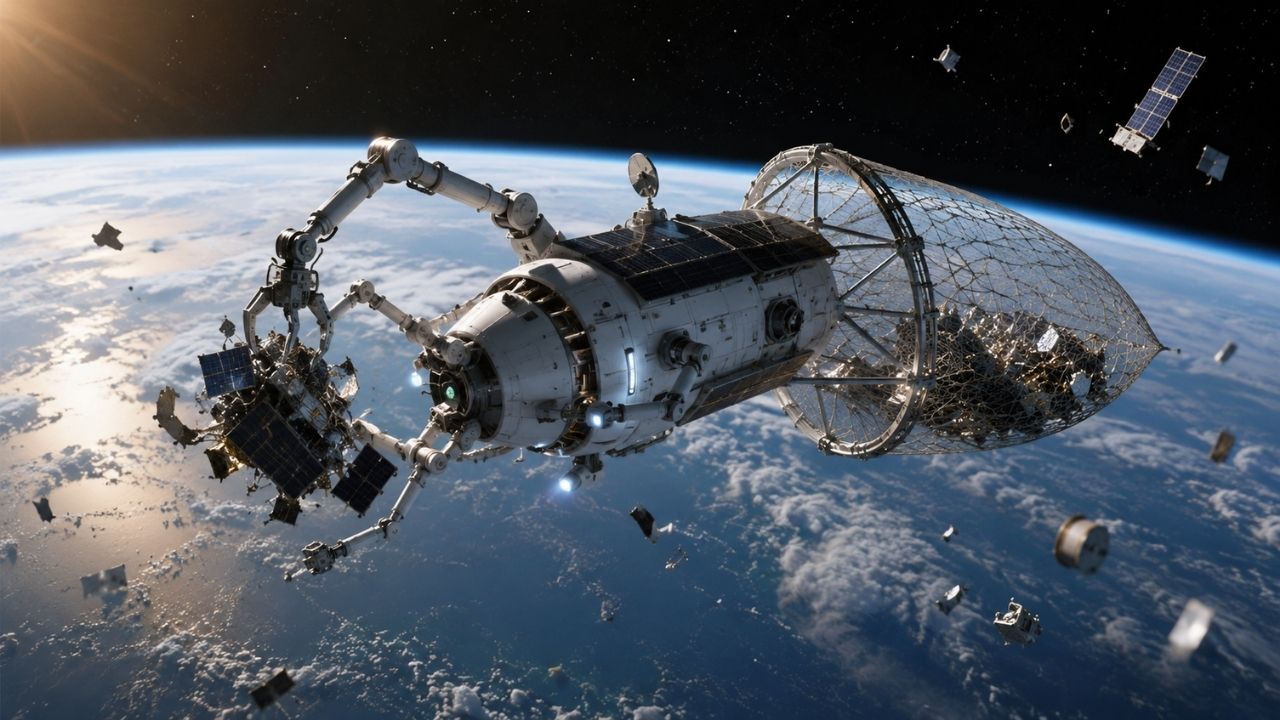


Space debris has become one of the biggest risks of the new orbital race, and the partnership between Portal Space Systems and Paladin Space aims to transform debris cleanup into a regular service, with the Starburst spacecraft and Triton payload operating as a repeatable collection system.
Space debris already totals an amount estimated at over 130 million fragments in low Earth orbit, while two private companies, the American Portal Space Systems and the Australian Paladin Space, are preparing a regular orbital debris collection service for 2027.
According to the Xataka portal, the idea is striking because it seems straight out of science fiction: a kind of maneuverable and refuelable space truck, combined with a payload capable of locating, classifying, and capturing pieces of objects circulating around the planet at high speed.
US and Australian companies want to transform orbital cleanup into a regular service
The proposal combines two complementary technologies. Portal Space Systems developed Starburst, a spacecraft designed to maneuver in orbit and be refueled. Paladin Space, on the other hand, provides Triton, a payload created to act as the operation’s “collector”.
-
No more TV stuck on the wall: Samsung The Freestyle+, the new projector with over 400 lumens projects on walls, floors, and ceilings, bringing cinema to any corner of the house.

-
A Japanese governor single-handedly stalled the construction of the world’s fastest train for nine years, and only now has he agreed to allow a tunnel excavated at a depth of 1,400 meters.

-
Almost 1 billion euros, two gigafactories, and a million-dollar public investment, Chinese company aims to turn Spanish city into Europe’s new battery hub.

-
Advancement in the industry: Brazilian company creates ultralight material comparable to steel and paves the way for hydrogen cylinders up to 70% lighter, with a direct impact on logistics, the energy industry, and national competitiveness – learn about Forza Composites



In practice, Starburst would function as the mission’s primary vehicle. Triton would be responsible for identifying debris, generating images, classifying objects, and performing collection.
The difference from previous experimental initiatives lies in the scale. Instead of removing just one or a few objects per mission, the partnership aims to create an operational and repeatable model capable of handling multiple fragments within a single operation.
If the schedule proceeds as planned, the first launch is expected to occur at the end of 2026, with more regular missions starting in 2027.
Over 130 million fragments show the scale of the problem in orbit
The accumulation of space debris has grown with the expansion of the orbital race. Deactivated satellites, rocket stages, loose parts, collision fragments, and spacecraft remnants have come to form a layer of risk around Earth.
The estimate of over 130 million fragments shows that the problem is no longer limited to large objects tracked by space agencies. Many pieces are small, but still dangerous, because they travel at extremely high speeds.
These fragments can hit satellites, communication equipment, Earth observation systems, and crewed structures. In more serious cases, they can also threaten missions with astronauts.
The concern grows because the number of objects in orbit tends to increase with the advancement of satellite constellations, commercial launches, and new private missions.
Starburst and Triton create a kind of space garbage truck

The strongest image of the proposal is the comparison to a garbage truck. On Earth, this type of service follows routes and repeats operations to keep cities functioning. In space, the ambition is similar, but on an orbital scale.
Starburst would be the vehicle capable of moving between different points in orbit. Triton, in turn, would perform the technical work of observing, recognizing, and capturing debris.
This detail changes the logic of orbital cleanup. The goal is not just to prove that it’s possible to remove an object, but to create a system with routine, repetition, and efficiency.
The Triton payload was designed to handle small, moving debris, including objects that spin or move irregularly. This is one of the biggest difficulties of the operation, as space debris does not sit still waiting to be collected.
Kessler Syndrome is concerning because collisions can create even more debris
One of the biggest risks associated with space debris is the so-called Kessler syndrome. The concept describes a chain effect: a fragment collides with a satellite or another object in orbit, generates new pieces, and these new debris then cause further collisions.
This domino effect can make certain orbital regions increasingly dangerous. The more objects circulating, the greater the chance of impact. The more impacts occur, the more fragments appear.
The consequence is an orbital environment that is more difficult to operate in, with increasing risk for communication, navigation, meteorology, internet, defense, and environmental monitoring satellites.
For this reason, orbital cleanup is no longer a distant idea. It has come to be treated as part of the necessary infrastructure to keep space usable in the coming decades.
Risk also involves astronauts, satellites, and the return of fragments to Earth
Most of the debris that re-enters the atmosphere disintegrates before reaching the surface. Even so, some fragments can withstand the fall and cause material damage or, in rare scenarios, injuries.
In orbit, the risk is more immediate. A small fragment can damage solar panels, sensors, antennas, and external parts of satellites. In crewed structures, the impact can pose a direct threat to astronaut safety.
Facilities like the International Space Station and future commercial stations depend on constant monitoring to avoid dangerous approaches. When there is a risk of collision, maneuvers may be necessary to change the structure’s position.
Each maneuver consumes resources, requires planning, and shows how space debris already interferes with the routine of operations outside Earth.
Private space race increases urgency for sustainable solutions
The proposal from Portal Space Systems and Paladin Space comes at a time of accelerated expansion in the space sector. Private companies launch satellites, develop orbital vehicles, and plan new stations, while governments expand scientific and strategic missions.
This growth creates opportunities but also increases pressure on low Earth orbit. Without control, the region could become more congested and more vulnerable to collisions.
A regular debris collection service, if it works as planned, could open a new market within the space economy. Instead of just launching objects, companies would also help keep the orbital environment safer.
Space cleanup, once seen as a distant challenge, is beginning to approach a planned commercial activity, with a vehicle, payload, schedule, and operational objective.
Space truck could mark a new phase of off-Earth infrastructure
The advancement of the so-called space garbage truck shows that orbital exploration has entered a more mature phase. It’s not enough to put satellites into operation. It will also be necessary to take care of the remnants left behind.
If regular missions begin in 2027, the initiative could test an orbital maintenance model similar to essential Earth services: repeatable, planned, and aimed at reducing long-term risks.
There are still significant technical challenges, especially in capturing small, irregular, and moving objects. But the proposal reveals a change in mindset in the space sector.
Space debris is no longer just an invisible problem above the planet. It has become a concrete threat to the infrastructure that supports communications, navigation, science, security, and Earth observation. And, for the first time, companies are trying to transform its collection into a regular operation.






They’d be blaming us for all the orbital litter – if we were allowed up there. Like they blame us for littering the oceans, and polluting the atmosphere.