Portuguese
  Spanish


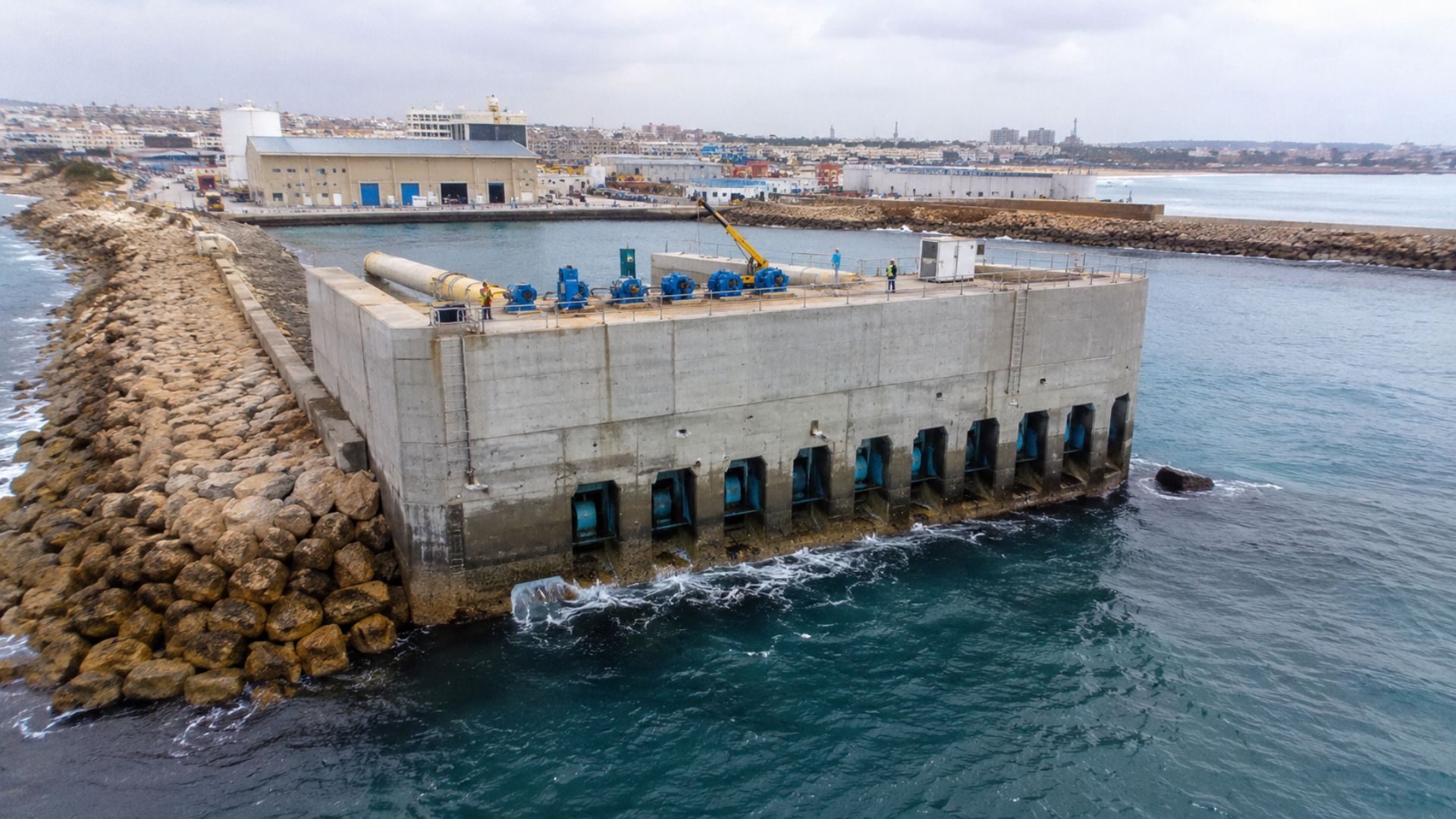


Submerged structure in the port of Torrevieja shows how Spain captures water from the Mediterranean to supply a large-scale desalination plant, with maritime intake, pumping, reverse osmosis, and distribution aimed at urban consumption and irrigation in the southeast of the country.
Spain operates in Torrevieja, in the province of Alicante, a reinforced concrete maritime structure weighing over 3,700 tons, used to capture water from the Mediterranean and supply the largest desalination plant in Europe, according to records from the Spanish government.
Installed next to the city’s port, the piece functions as an industrial-scale water intake, allowing the sea to enter the system before proceeding to the land-based plant, where it undergoes treatment for human supply and irrigation.
Largest desalination plant in Europe
Called in Spain cajón de toma, the block is over 50.7 meters long, 10.6 meters wide, and more than 13 meters high at its highest point, according to the technical documentation of the work.
-
Engineers Develop Fridge-Sized Machine to Produce 95-Octane Synthetic Fuel from Air and Water, Aiming to Sustain Combustion Engines Without Oil

-
Two-Armed Robot Uses AI to Reassemble Destroyed Pompeii Frescoes, Solving an “Impossible” Puzzle
-
New Law in Brazil Requires Breaks for Type 1 Diabetes Management at Work, School, and Public Exams

-
Scientists Confirm “Greening” of Antarctica: Ice on the World’s Coldest Continent Turns Green as Mosses Multiply Over Tenfold in Four Decades


The set was designed with 12 underwater windows to allow the continuous entry of saltwater, a solution associated with the need to maintain regular supply for a plant with large operational capacity.
The Torrevieja plant has a production capacity of 80 cubic hectometers per year, equivalent to about 240,000 cubic meters of desalinated water per day, according to data released by Spanish public agencies.
The operation is conducted by Acuamed, a public company linked to the Ministry for the Ecological Transition of Spain, responsible for hydraulic works of general interest in different regions of the country.
To achieve this final volume, the system needs to capture a larger amount of raw water, as the reverse osmosis process does not convert the entire captured flow into desalinated water.
The technical project foresees the intake of approximately 533,000 cubic meters of seawater per day, with a conversion factor of 45% in the desalination process, according to public information from the infrastructure.
This difference occurs because reverse osmosis separates part of the usable water and returns another flow to the environment as brine, with a higher saline concentration than the initially captured water.
For this reason, the Torrevieja infrastructure includes both the capture system and a specific network for the controlled disposal of the brine produced after the removal of salts.
How Mediterranean Water Reaches the Plant
From the port of Torrevieja, the captured water travels through a GRP pipeline, a plastic material reinforced with fiberglass, with a length of 2,120 meters and a diameter of 2,400 millimeters.
This conduit connects the maritime set to the unit installed on land, ensuring the transport of raw water to the initial treatment stages before passing through the reverse osmosis membranes.
Before this phase, the flow undergoes physico-chemical and physical pre-treatments, used to reduce particles and prepare the water for the high-pressure process used in salt separation.
The reverse osmosis stage concentrates the desalination operation, while subsequent systems adjust the quality of the treated water according to the parameters required for the intended uses.
The technical documentation also records the adoption of hyperbaric chambers for energy recovery, a resource used in high-pressure installations to reduce part of the energy consumption associated with pumping.
Concrete Block Was Towed by Sea
The concrete block was not built directly at the point where it operates, as the structure was manufactured at the Navantia shipyards in Cartagena before traveling by sea to Torrevieja.
Once floated, the piece was towed on a journey of about 43 nautical miles, an operation that required maritime planning and technical control during the movement.
During transport, part of the structure remained above the surface, while flotation systems and hermetic sealing of openings were employed to maintain the stability of the set.
The internal design of the caisson also integrates the movement and installation project, as the block was compartmentalized into 22 cells, with internal walls used as structural reinforcements.
This configuration was adopted to increase the rigidity of the piece and reduce risks during towing, approach to the port, and definitive positioning alongside the plant connections.
Underwater Windows and Large-Scale Pumping
At the intake point, the 12 windows allow water to enter the interior of the structure, where the equipment responsible for driving the flow towards the land unit is located.
The pumping station features six submersible pump groups and a reserve unit, a configuration designed to maintain the intake operation within the parameters defined by the project.
Integrated into the western breakwater of the port of Torrevieja, the set is protected by riprap and was positioned to operate in a port area with controlled interference on local circulation.
After the production of desalinated water, the brine generated in the process follows another system to a discharge area at the Levante dike, also in the port of Torrevieja.
Diffusers installed in the outfall help to dilute the flow in the marine environment, a step planned in desalination projects to reduce impacts associated with the return of water with a higher concentration of salts.
Desalinated water for supply and agriculture
The plant’s production serves both urban supply and irrigation linked to the Tajo-Segura system, one of the main water infrastructures used in southeastern Spain for water transfer and distribution.
Among the delivery points are the Cartagena Field Canal, the La Pedrera reservoir, and facilities associated with the Mancomunidad de los Canales del Taibilla, according to project records.
The plant’s relevance is related to the region’s water scenario, which includes intensive agriculture, urban expansion, tourism activity, and frequent pressure on rivers, reservoirs, and aquifers.
In this context, Spain has incorporated seawater as a large-scale complementary source through systems that combine maritime infrastructure, pumping, membranes, and distribution networks.
Desalination does not replace the management of conventional resources but adds an alternative source for areas subject to scarcity and variation in water availability throughout the year.
In Torrevieja, this strategy depends on a chain formed by maritime intake, large-diameter pipelines, submersible pumping, advanced treatment, and regional delivery of the produced water.
Expansion of the Torrevieja desalination plant
The plant’s capacity is expected to reach 120 cubic hectometers per year with the expansion authorized by the Spanish government, which plans to increase the unit’s production by 50%.
With this expansion, Torrevieja maintains a prominent position among European desalination projects by reverse osmosis, according to the classification released by Spanish authorities responsible for the project.
Part of the civil infrastructure had already been sized to support this future expansion, which includes elements associated with intake, water transport, and plant operation.
In this configuration, the intake box integrates a permanent base to expand the supply of desalinated water, without being limited to the initial capacity planned for the plant’s operation.
For those observing the port or the city, much of this system remains out of sight, because the intake, pumps, and main connections operate alongside the marine environment.
Even so, the connection with the Mediterranean is the stage that allows the system to function: without the concrete block, the underwater windows, the pumps, and the conduction to the plant, the saltwater would not reach the desalination process.