Portuguese
  Spanish




Dutch Startup Creates System That Simulates Uterine Environment and Could Transform High-Risk Neonatal Treatment
The startup AquaWomb, based in the Netherlands, unveiled an unprecedented technology that could redefine the boundaries of neonatal medicine.
The experimental system, developed throughout 2023 and detailed in a report by The Guardian in October 2024, simulates an artificial womb capable of keeping babies alive outside the mother’s body.
It creates an environment similar to the human womb with impressive accuracy.
Technology That Recreates the Uterine Environment with Precision
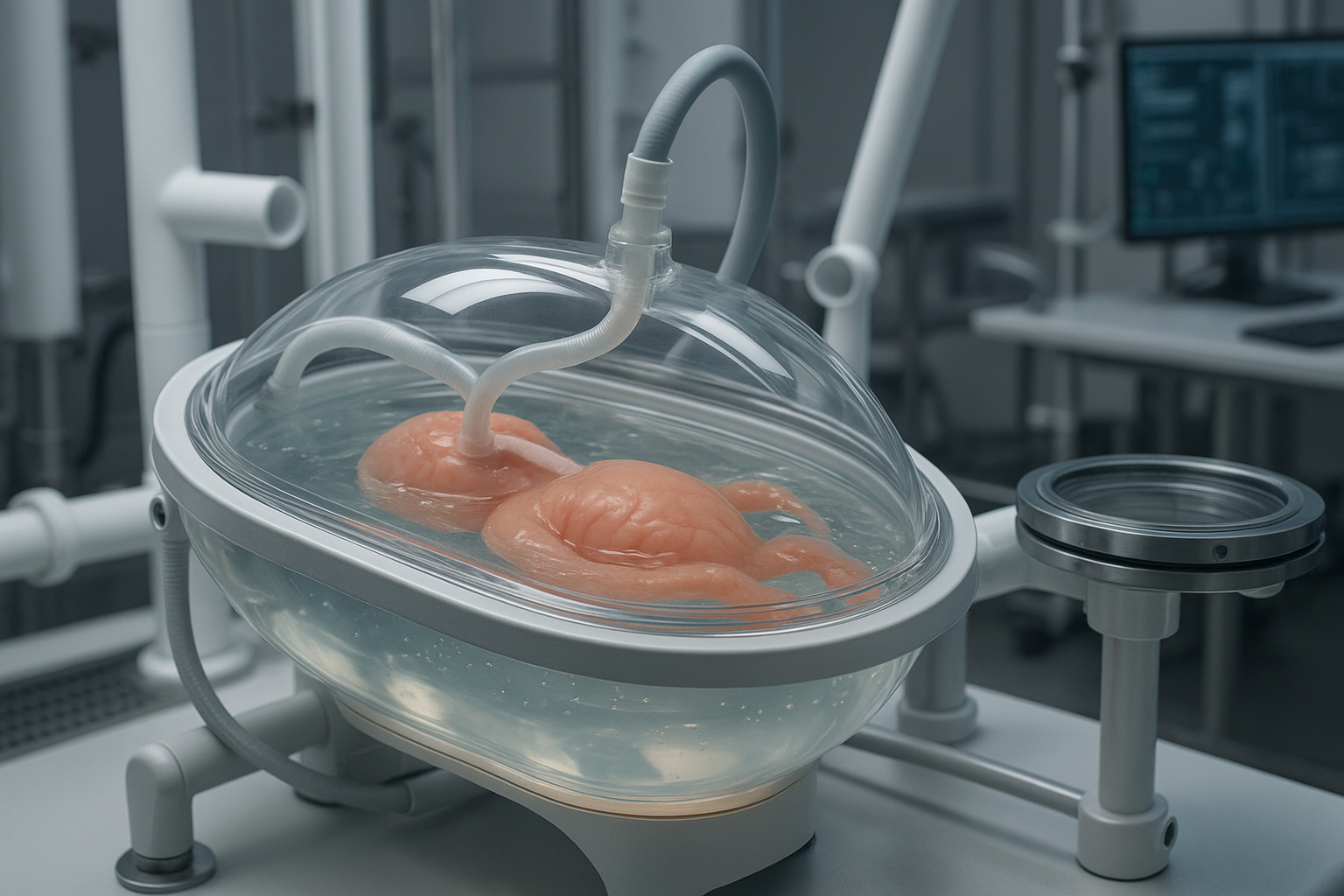
The device resembles a glass aquarium and contains synthetic amniotic fluid maintained at 37.6 °C.
This temperature ensures thermal stability and ideal conditions for fetal development.
The startup explains that the system was designed for extremely premature babies, born between 22 and 24 weeks of gestation.
During the process, after a cesarean section, doctors transfer the baby to the tank and reconnect the umbilical cord to an artificial placenta.
This placenta facilitates the exchange of oxygen and nutrients, allowing the baby to continue growing outside the womb without needing to breathe air.
-
Scientific Breakthrough: Bacteria Found in a Rio de Janeiro Lagoon Guide Mars Research After Scientists Identify Similarities to Extreme Environments, Expanding Understanding of Extraterrestrial Life Possibilities

-
Brazilian Mechanic Wins Indian Presidential Award for Inventing Fuel-Efficient Agricultural Machine

-
Brazilian Polilaminin Reaches 100 Spinal Cord Injury Patients Through Compassionate Use, Shows Progress After 6 Months, Highlighting UFRJ’s Role in Experimental Regeneration Research

-
Electrolux Unveils New Stove with Integrated Airfryer, PerfectCook360, VaporBake, Grill, Glass Top, and Oil-Free Large Portion Cooking



This stage is highly critical, as a system failure can cause irreversible brain damage in just two minutes.
As noted by Frans van de Vosse, professor of cardiovascular biomechanics at Eindhoven University of Technology, “it’s like juggling ten flaming balls; dropping one is not an option”.
The technology demands constant control and monitoring, which increases the complexity of the project.
Ethical Dilemmas and Social Impacts of the Innovation
Despite the optimism in the scientific community, the proposal raises deep ethical and emotional questions.
As explained by Elizabeth Chloe Romanis, a medical law expert at Durham University, the use of devices like this “creates a new stage of human development, something we have never had to regulate before”.
Questions arise about how medicine should intervene and how to ensure informed consent from parents in desperate situations.
There is also concern about the emotional bond between parents and children.
Many mothers experience feelings of guilt for not being able to carry their pregnancy to term.
The case of Beth Schafer, reported by The Guardian in 2024, illustrates this conflict well.
After losing her child at 23 weeks of gestation, Beth asked: “If this technology existed, would I be a bad mother for not using it?”.
The answer still divides experts and families today.
For many parents, the system represents hope and medical advancement.
However, for others, it could generate additional psychological pressure.
As stated by a participant in a support group mentioned in the report: “They already treat you as selfish if you don’t try all the interventions. This would be yet another pressure.”
Scientific Advances and Next Global Steps
Despite the progress, the AquaWomb technology has not yet been approved for clinical use.
However, it is expected that human trials will begin in 2026, after the approval of international safety protocols.
In the United States, the Food and Drug Administration (FDA) has been discussing, since 2023, the authorization for clinical trials with babies born before 24 weeks of gestation.
This is one of the most complex frontiers in modern medicine.
According to data from the National Institutes of Health (NIH), over 10,000 children are born annually in this critical window just in American territory.
Meanwhile, the Children’s Hospital of Philadelphia (CHOP) is conducting parallel studies on the topic.
In 2022, its team managed to keep lambs alive for 28 days in an artificial fluid environment, successfully simulating part of the uterine functions.
Even so, scientists avoid the term “artificial womb,” precisely to avoid associating the project with science fiction or the idea of complete ectogenesis, which would be birth entirely outside the human body.
A New Frontier in Neonatal Medicine
Experts believe that the AquaWomb technology could usher in a new era in reproductive science and neonatal medicine.
Although it is still under testing, it increases the chances of survival for extreme preterm infants and could transform the way we understand the beginning of human life.
On the other hand, as science advances, society needs to decide how far it wants to cross this biotechnological frontier.