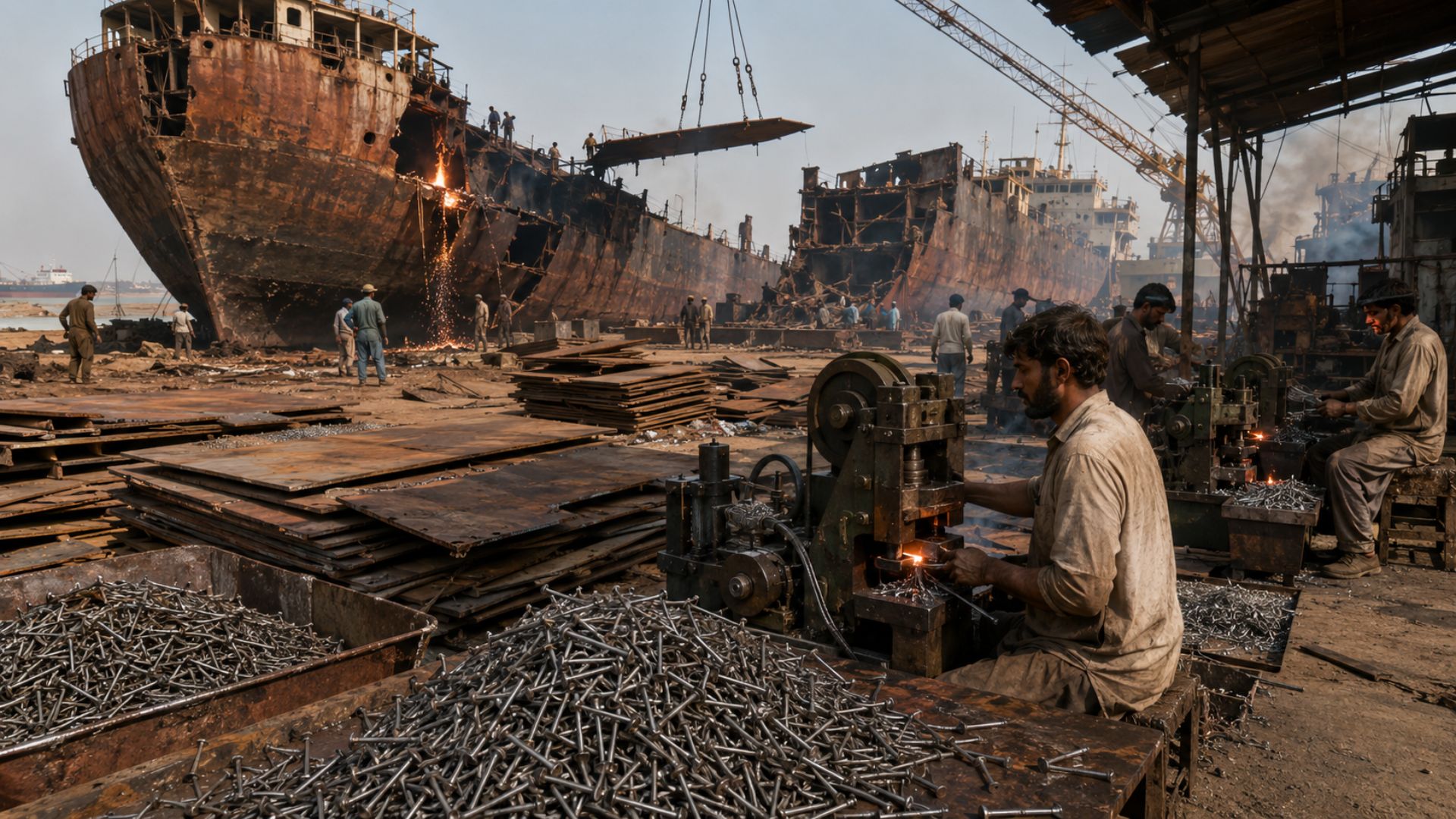

The iron that once crossed oceans becomes raw material again: heated, pressed, and molded into tiny pieces. The cycle impresses with its ingenuity and resource economy. But behind the shine of the newly forged metal, there is a sector marked by dangerous work, low wages, and serious risks to health and the environment.
Steel plates taken from old ships are being transformed into thousands of iron nails in large recycling hubs, such as those in Pakistan. In a heavy process of cutting, heating, and molding, completely rusted structures gain new life and supply a large part of the country’s steel industry, an impressive example of material reuse on an industrial scale, turning what would be scrap into a useful product.
The process, recorded in factory videos circulating on social networks, shows each step of this transformation, but it is necessary to go beyond the images to understand the full context. This activity, known as ship dismantling or recycling, is concentrated in a few countries, and while it is economically important and environmentally useful by reusing steel, it carries a dark side of dangerous working conditions and environmental impacts that cannot be ignored, as we will see throughout this report.
From Rusty Ship to Raw Material

In the dismantling yards, large steel plates are removed from the hulls of old vessels, covered in rust and marked by years of exposure to saltwater, and then cut into smaller pieces with tools capable of slowly penetrating the thick, worn metal, in a labor-intensive and exhausting task.
-
How to Prevent Brown Recluse Spider Bites: Common Hiding Spots and Free Tips to Reduce Risks

-
Natto: The Unusual Japanese Superfood Gaining Popularity on Social Media and Driving Record Exports
-
Brazilian Mayor Goes Undercover as Homeless for 24 Hours to Assess Public Services

-
15-Year-Old Entrepreneur Malu Lira Publishes 20 Children’s Books on Financial Education, Earns $500,000, and Expands Her Project to the Amazon Rainforest




Next, the steel goes to the heating area, where high temperatures make the rust disappear and the metal regain its shine.
The heated material then passes through machines that compress and roll the steel, transforming the old sheets into metal bars.
It is from these bars that, later on, nails will be born, in a cycle that returns utility to a structure that seemed doomed to disposal.
How iron nails are born

The steel bars enter machines that cut, press, and mold the material in a continuous sequence, and within seconds the first nails begin to emerge, one after the other, first the cut, then the compression, and finally the characteristic shape of the piece, with its point and head.
Even though they are small objects, the nails accumulate quickly as production continues nonstop.
Once ready, they proceed to separation and organization, while new bars continue feeding the process.
It is a curious contrast: colossal structures of ocean ships end up reduced to thousands of small pieces used in everyday construction, showing the versatility of steel as a recyclable material.
The great global shipbreaking hubs
This type of operation does not happen just anywhere in the world.
About a thousand ships are dismantled per year on the planet, and between 65% and 75% of them end up in just three major hubs in South Asia: Gadani, in Pakistan, Alang, in India, and Chattogram, in Bangladesh, which concentrate most of this global industry due to low costs and high demand for steel.
The Gadani hub in Pakistan is located on the coast of Baluchistan, just a few dozen kilometers from Karachi, along a stretch of beach about 10 kilometers long.
It was once the largest in the world in the 1980s and today is the third largest, employing about 6,000 workers and recovering over 1 million tons of steel per year, much of it sold in the domestic market, according to industry data.
The activity moves billions of rupees and has a real impact on the local economy.
The dark side that images do not show

Ship dismantling is considered one of the most dangerous jobs in the world: it is estimated that since the 1960s, about 2,000 people have died or been seriously injured just in Gadani, a number possibly underestimated due to the lack of official records, according to organizations monitoring the sector.
The risks are many.
Old ships may contain hazardous substances such as asbestos, residual oil, and toxic paints, and inhaling dust from these environments can cause severe lung damage or even death.
Salaries are often extremely low, with reports of pay in the range of a few dollars a day, and much of the workforce consists of migrant workers from poor regions, many of whom had never seen the sea before starting this job.
An environmental and geopolitical problem
Besides the human cost, there is an environmental cost and an international dimension to the issue.
The most common method in these hubs is to beach the ships directly on the shore and dismantle them there, which promotes soil and sea contamination by toxic waste, exacerbated by the burning of materials and improper disposal of hazardous substances, in places that do not always have emergency infrastructure.
There is also the geopolitical issue: although international laws seek to control the sending of contaminated ships to developing countries, legal loopholes and the use of so-called “flags of convenience” allow old vessels from wealthy nations to reach South Asia.
To try to change this scenario, the Hong Kong Convention of the International Maritime Organization came into force in June 2025, establishing mandatory rules for safer and more environmentally sound ship recycling, although its practical effects still depend on enforcement.
Why this matters, including for Brazil
The topic directly engages with important debates worldwide.
Steel recycling is, in itself, an environmentally valuable practice, as it reduces the need to extract and process new iron ore, saving energy and natural resources, and the challenge is precisely to reconcile this reuse with decent working conditions and environmental protection, something that Asian hubs are still striving to achieve.
For Brazil, which has a significant steel industry and also recycles large volumes of metal scrap, the case serves as a reflection on how to grow sustainably and responsibly.
It shows that reusing materials is the right path for the circular economy, but this needs to be accompanied by respect for workers’ lives and the environment, a balance that applies to any country and any industry.
The transformation of old ship plates into thousands of nails is one of those stories that reveal human ingenuity in reusing almost everything, giving new life to the steel that once crossed the seas.
Behind the shine of the newly molded metal, however, there is a harsh reality, made of risky work, low wages, and environmental challenges that deserve attention.
Recognizing the two sides of this industry, the smart recycling and the human cost, is essential for material reuse to advance in a truly sustainable and fair way worldwide.
And you, had you ever imagined that the nails used in constructions might have originated from the steel of old ships? What did you think of learning about both sides of this recycling industry? Leave your comment, respecting different opinions, share your thoughts on the topic, and share the article with those interested in industry, recycling, and sustainability.