Portuguese
  Spanish


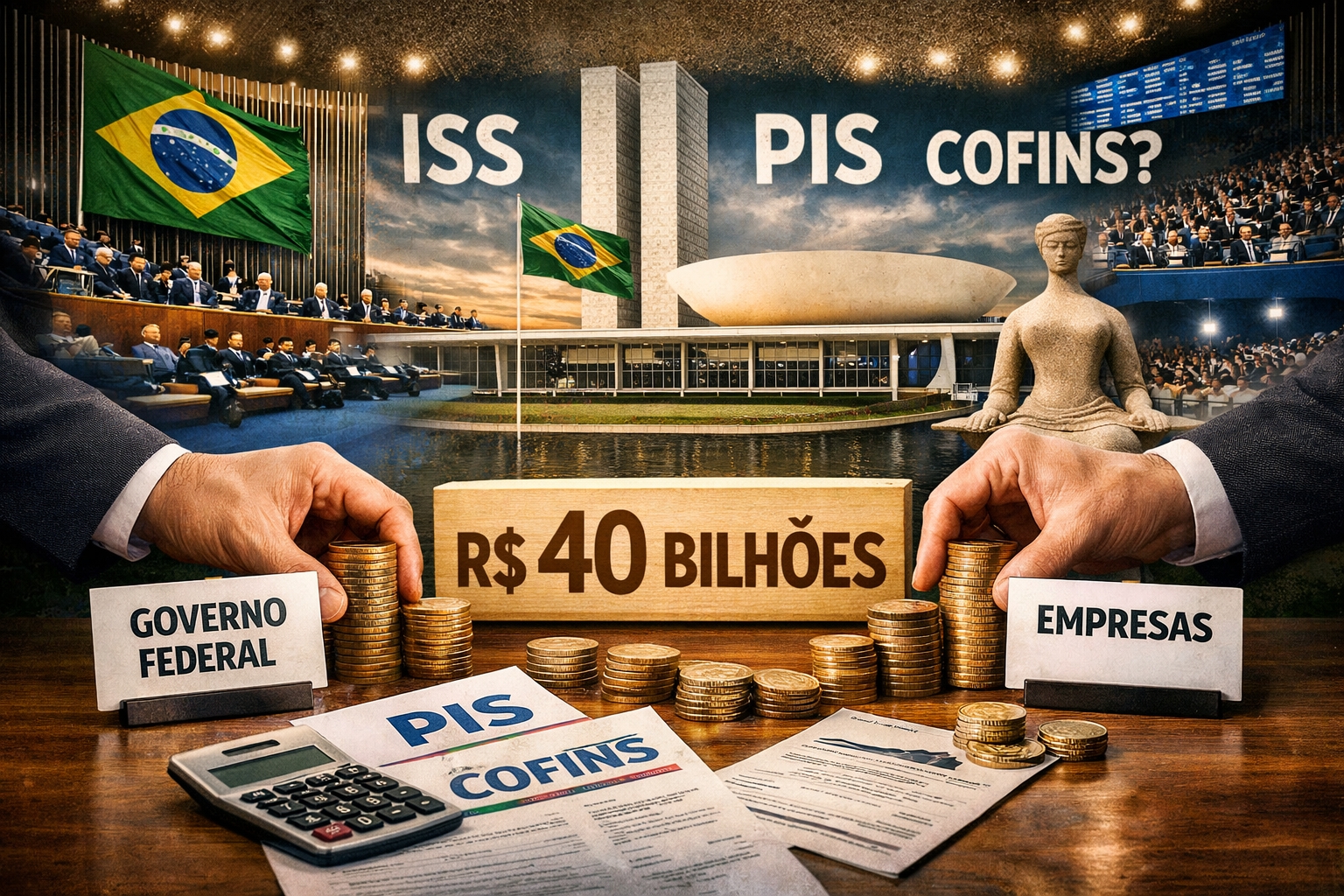

ISS Taxation of the PIS and Cofins Base Reaches Its Final Stage at the STF, Bringing Federal Government and Companies Face to Face in Brazil and Promising Relief of R$ 40 Billion for Taxpayers
STF, taxation, and ISS: a decision that could affect billions in Brazil. The discussion about taxation involving ISS, PIS, and Cofins has returned with full force to the STF, putting the Federal Government, tax attorneys, and Brazilian companies on opposing sides. What is at stake is not just a sophisticated legal thesis. We are talking about a possible impact of nearly R$ 40 billion for taxpayers in Brazil.
The central point is simple to understand but has enormous consequences: should the ISS, a municipal tax, be part of the calculation base for PIS and Cofins, which are federal taxes? If the Supreme Court decides that it should not, the revenue structure on services could change significantly.
For those who want to follow the proceedings officially, the process status can be consulted directly on the STF portal.
-
As Brazil Expands Social Welfare, Survey Reveals 40% Blame Poverty on Laziness, While 58% Cite Lack of Opportunities

-
China Tightens Control on Antimony, Driving Prices from $22,000 to Nearly $40,000 per Ton as U.S. Rushes to Bolster Strategic Reserves

-
BlackRock Freezes $1 Billion in Brazilian Renewable Energy, Impacting 1.5 GW of Planned Projects and Highlighting Investor Concerns Over Infrastructure Bottlenecks Cutting Up to 25% of Solar and Wind Generation
-
Labor Shortage: Despite Record Average Salary, 90% of Brazilian Bar and Restaurant Owners Struggle to Hire Key Roles Like Sushi Chefs and Head Cooks


The Origin of the Debate: The Effect of the “Century Thesis”
The controversy gained strength after the historic ruling in which the STF decided to exclude ICMS from the PIS and Cofins base — a case known as the “Century Thesis.” At the time, the Supreme understood that tax is not the company’s revenue, but rather an amount that merely transits through its cash.
The precedent was established in RE 574.706 (Theme 69), available on the STF portal itself.
From this decision, various cases involving the ISS began to apply the same reasoning. After all, if ICMS does not compose revenue, why should ISS?
However, in 2019, Minister Dias Toffoli indicated that the ISS case would have relevant differences. Thus, the STF opened a specific trial to analyze the municipal tax separately.
A Long, Interrupted, and Full of Twists Trial
The trial began in August 2020. The reporter, Minister Celso de Mello, voted in favor of the taxpayer, arguing that the ISS does not integrate the calculation base for PIS and Cofins.
Shortly after, Minister Dias Toffoli requested a review. The process became stalled.
In 2021, in the virtual plenary, the score ended tied at 4 to 4:
Against the taxpayers: Dias Toffoli, Alexandre de Moraes, Edson Fachin, and Luís Roberto Barroso.
In favor: Celso de Mello, Ricardo Lewandowski, Rosa Weber, and Cármen Lúcia.
When the case seemed close to a conclusion, Minister Luiz Fux requested a highlight, bringing the topic to the in-person plenary. A new postponement.
In August 2024, the trial resumed in person. André Mendonça voted alongside the reporter, in favor of the taxpayer. Gilmar Mendes voted against.
The score remained 5 to 5.
Only Luiz Fux’s vote was missing.
As attorney Luiz Roberto Peroba stated:
“For us tax attorneys, André Mendonça’s vote was the decisive vote because no one knew his viewpoint, as he hadn’t voted in the 2017 ICMS trial. When he voted in favor and it stood at 5 to 5, the expectation was for a victory for the taxpayer, because the only missing vote was Fux’s, who had voted in favor of the taxpayers in 2017.”
However, before the final vote, the session was suspended.
The Federal Government’s Attempt to Restart the Trial
In September, the Office of the Attorney General of the Union (AGU), which represents the Federal Government, filed a Declaratory Action of Constitutionality.
Institutional information from the AGU can be consulted here.
The strategy aimed to concentrate all discussions on the inclusion or exclusion of taxes in the federal contribution base in a single trial. If accepted, the measure could disregard votes already cast by retired ministers and restart the score.
Of the five votes in favor of the taxpayer, three had been given by ministers who had already left the Court.
With Minister Edson Fachin’s decision to put the trial on the agenda again for the 25th, the prevailing view among tax attorneys is that the risk of the maneuver has diminished. Still, the atmosphere remains uncertain.
The Billion-Dollar Impact for Taxpayers and for Brazil
According to estimates from the Federal Government itself, a favorable decision could result in refunds of approximately R$ 37 billion.
These amounts could return to companies through:
- Precatórios, which can be negotiated;
- Tax credits for compensation over the years.
In a scenario of fiscal pressure and a search for increased revenue, this possible refund represents a significant impact on public accounts.
The services sector, which accounts for more than 70% of Brazil’s GDP according to IBGE, would be broadly affected. Economic data can be consulted on the official IBGE website:
Even If Winning, Taxpayers May Not Gain Everything
There is still the possibility of modulation of the decision’s effects.
In his vote, Minister André Mendonça suggested that, if the thesis prevails, its effects might be limited over time. This means that the taxpayer could win the thesis but not receive fully retroactive amounts.
The modulation is provided for in Law 9.868/1999 and has already been applied in other relevant tax judgments.
What Is Really at Stake
The STF’s decision goes beyond a technical debate about calculation bases. It involves legal certainty, revenue collection, and the coherence of the Brazilian tax system.
On one side, the Federal Government seeks to preserve revenues.
On the other, taxpayers argue that tax is not revenue and cannot serve as a base for another tax.
If the final score is 6-5 in favor of the taxpayer, Brazil may witness another landmark chapter in the history of national taxation.
Now the question is: will the trial finally be concluded?
And you, what do you think about this dispute at the STF? Should ISS be excluded from the PIS and Cofins base?
This decision could structurally change taxation in Brazil. Leave your comment below and share this content with other professionals and lawyers following the topic. Qualified debate strengthens the legal and business environment.