Portuguese
  Spanish


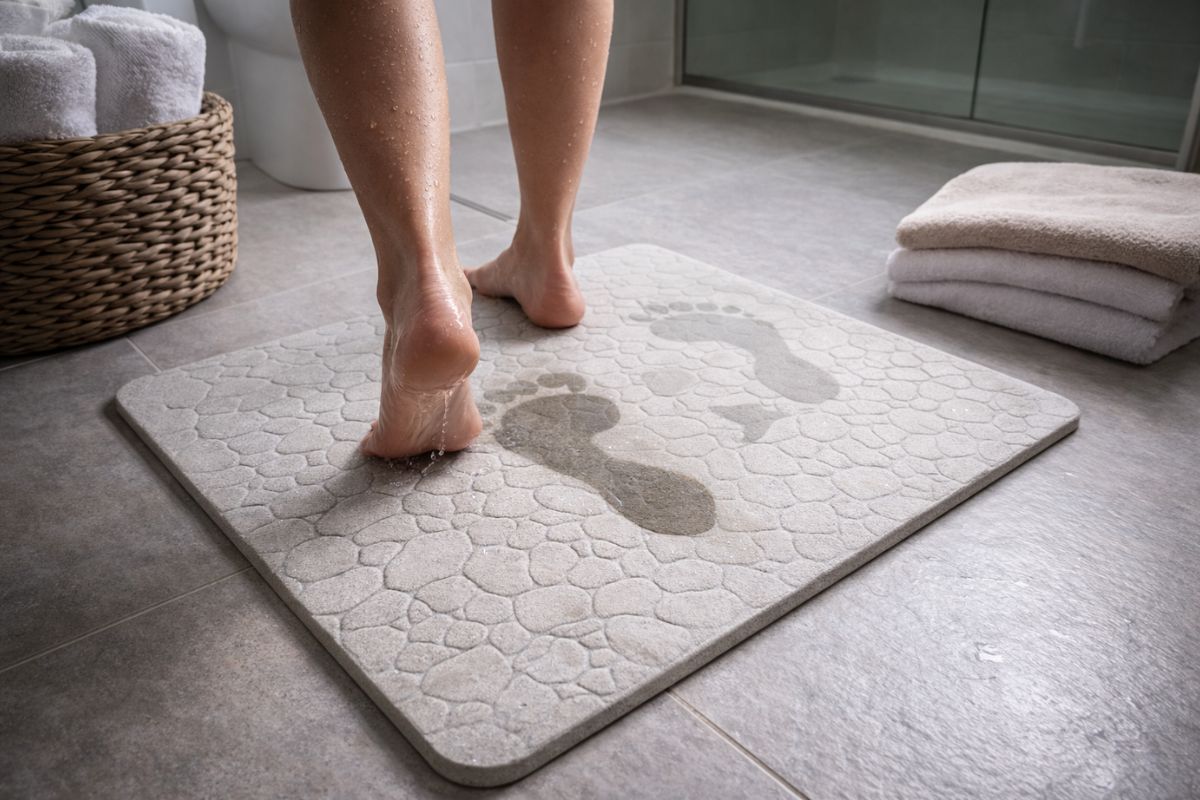

The stone mat made of diatomite, a sedimentary rock formed by fossilized microscopic algae over millions of years, is becoming the main alternative to the traditional fabric mat in the Brazilian bathroom. The material absorbs up to 1.5 times its own weight in water, dries in about 1 minute without intervention, and does not accumulate mold, bacteria, or odor, chronic problems of textile mats that stay wet for hours after bathing.
The secret of the stone mat lies in the microscopic structure of diatomite. Inside, the material has millions of micropores that function like a stone sponge: when stepping with wet feet, the water is absorbed in seconds and evaporates naturally through the ventilation of the environment. Unlike the fabric mat, which retains moisture and becomes an ideal environment for fungi and bacteria, the surface of diatomite remains dry and inhibits the proliferation of microorganisms without needing any chemical products.
The product was already popular in Japan and South Korea before arriving in Brazil, where it gained versions from brands like Lyor and Momo Lifestyle. The models available in the Brazilian market in April 2026 cost between R$ 60 and R$ 200, depending on the size and finish, and are sold on platforms like Amazon, Mercado Livre, and specialized decoration stores. The search for the term “stone mat bathroom” has grown significantly on e-commerce platforms in recent months, driven by viral videos on social media showing absorption tests comparing the product with traditional fabric mats.
How it works in practice and what are the care?

In practice, the stone mat is a rigid and thin slab, resembling marble or granite, positioned at the exit of the shower.
-
During the routine drainage of a lagoon in England, an employee found the nearly complete skeleton of a 10-meter, 180-million-year-old “sea dragon,” the largest and most complete marine reptile ever discovered in the United Kingdom.

-
A college in Peru turned a street billboard into a ‘factory’ for drinking water that pulls moisture from the air: in three months, the panel produced almost 9,500 liters in one of the driest capitals on the planet.
-
The coast of Pernambuco has more than a dozen deliberately sunken ships at the bottom of the sea, and what started as a junkyard has become one of the largest wreck diving parks in Brazil, a refuge for turtles and schools of fish.
-
A woman left São Paulo to help her 88-year-old father in the hinterland of Paraíba, found the abandoned family farm, switched cassava and cattle for organic fruits, and harvested 24 tons of melon and watermelon in the semi-arid region, proving that tradition, irrigation, and planning can transform forgotten land into a sustainable business.




When pouring a cup of water onto the surface, the puddle disappears in seconds.
The material is naturally slip-resistant, which reduces the risk of slips, one of the most common household accidents in bathrooms.
Maintenance is simple: just clean with a damp cloth periodically.
When the absorption capacity starts to decrease, which happens after months of use, a light sanding of the surface with the sandpaper that comes with the product restores the micropores and returns the original performance.
The estimated durability is several years, much longer than the lifespan of a fabric rug that needs to be washed frequently and replaced every few months.
Despite the advantages, the product has limitations.
Being a rigid slab, it does not offer the softness of a cushioned rug, which may be uncomfortable for those who prefer the feeling of stepping on fabric.
It is also heavier and may crack if dropped or subjected to strong impact.
In bathrooms with uneven flooring, the slab may not sit perfectly, compromising stability.
For those seeking a more hygienic bathroom without the persistent smell of mold that marks fabric rugs, the switch may be worthwhile.
Diatomite is 100% natural, without chemical components, and the product does not need to be machine washed, saving water and energy.
The fabric rug in the bathroom may be numbered.
Comment below: would you replace yours with a stone that absorbs water in seconds?