Portuguese
  Spanish


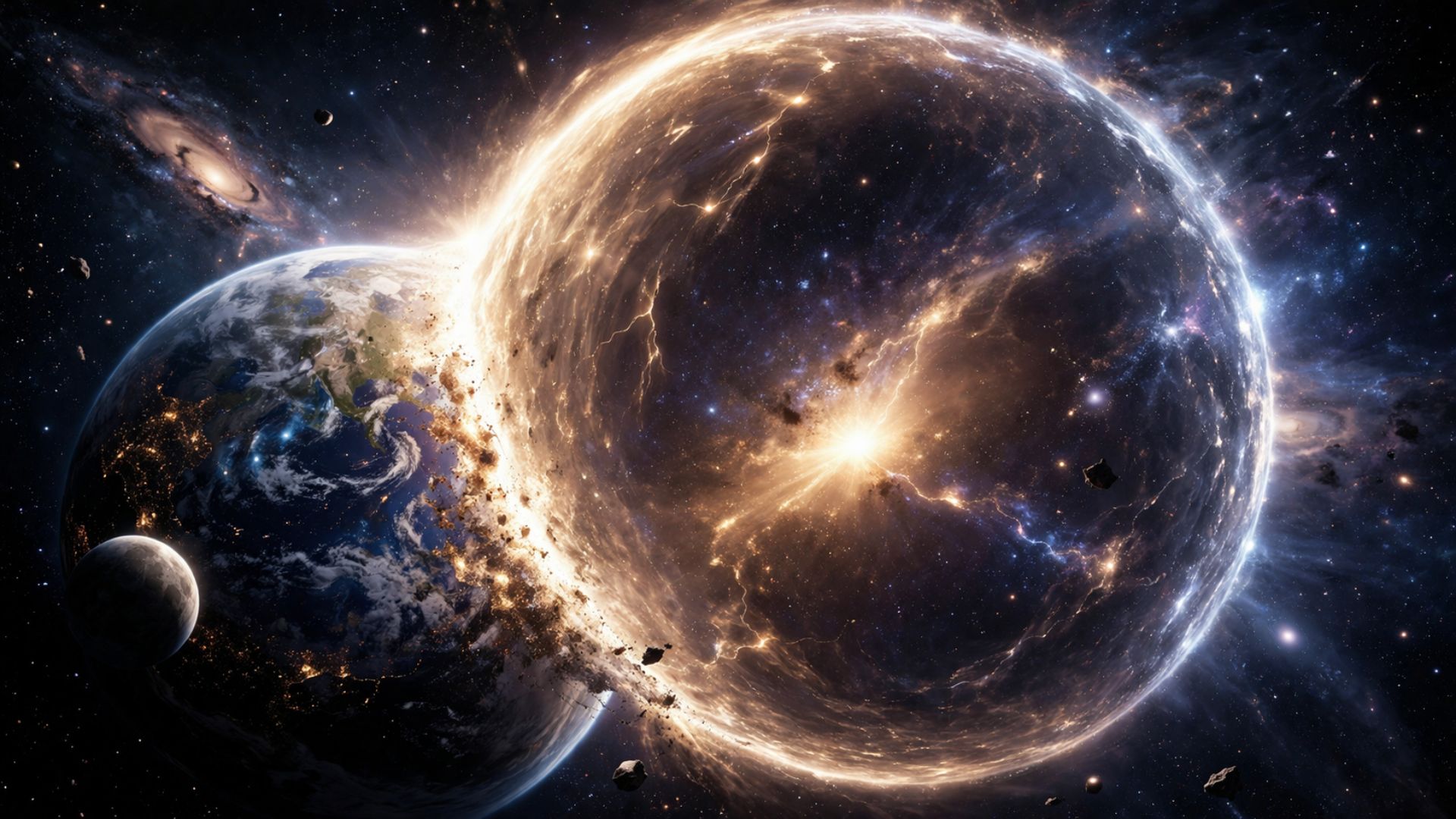

Laboratory simulation recreates extreme quantum phenomenon linked to the hypothesis of a sudden collapse of the Universe, exploring invisible transitions between energy states and the formation of rapidly expanding bubbles without detectable prior signs, with profound implications for modern physics.
An article published in Physical Review Letters presents a laboratory simulation of false vacuum decay, a quantum phenomenon associated with one of the most abrupt theoretical scenarios ever proposed for a possible transformation of the Universe.
Although the topic refers to a sudden end of the cosmos, the study does not indicate a real or imminent risk, offering above all a controlled way to investigate processes that, on a cosmological scale, remain beyond direct experimental reach.
Authored by Yu-Xin Chao and collaborators, the work used a programmable array of Rydberg atoms to reproduce characteristics of so-called bubble nucleation, a central concept in theories describing transitions between distinct energy states.
-
Scientists create robotic bird that uses articulated wings to maintain balance, mimicking hawks and flying with stability where common drones fail.

-
U.S. university performs surgeries with remotely controlled humanoid robots
-
A 12-year-old boy from the municipal network of Canoas won gold in the Brazilian Mathematics Olympiad, earning the school’s first national medal in history and standing out in a competition that brought together more than 18 million students, demonstrating how public education can uncover hidden talents in Brazil.
-
Why did a company that was already earning US$ 1 million decide to completely change its strategy? The answer begins with used bottles, worms, and an unexpected decision.



In this context, nucleation corresponds to the emergence of small regions of “true vacuum” within a metastable state, often described in the literature as a false vacuum, whose stability is only apparent and depends on specific conditions.
Although it may appear stable for long periods, the false vacuum does not necessarily represent the lowest possible energy state, which opens the door for an eventual spontaneous or induced transition to a more stable configuration.
Should this type of change occur on a cosmic scale, the transition could propagate rapidly, altering fundamental physical properties in the affected region, without any possibility of prior detection by observers.

Despite the theoretical impact of this hypothesis, there is no evidence that the Universe is currently in a false vacuum, and the authors themselves emphasize that the experiment neither reproduces nor predicts the end of the cosmos.
On the contrary, the central objective was to observe, in a controlled environment, how metastable states can decay and give rise to new configurations, contributing to the understanding of complex quantum transitions.
What is false vacuum in quantum physics
Unlike common sense, the concept of vacuum in physics is not limited to the absence of matter, involving defined energy states within quantum field theories that describe the fundamental behavior of the Universe.
Under certain conditions, a system can remain in a state that appears minimal but still possesses higher energy than the most stable configuration, thus characterizing the so-called false vacuum.
This type of state can persist for extremely long intervals without visible changes, until a transition occurs via quantum tunneling, a mechanism in which the change happens without following expected classical trajectories.
Over the last few decades, this idea has gained relevance in discussions about cosmology and particle physics, especially by suggesting that the Universe could be in a condition that is only apparently stable.
If a region were to transition to the true vacuum state, it would form a bubble with distinct physical properties, initiating a transition that could rapidly expand through space.
Theoretical models indicate that this expansion would occur at the speed of light, which would prevent any form of prior warning, as no information can propagate faster than this physical limit.
Even so, this possibility remains restricted to the realm of hypotheses, without observational evidence confirming its occurrence in the real Universe.
Experiment with Rydberg atoms and quantum simulation
Seeking to investigate this scenario on an accessible scale, the researchers turned to Rydberg atoms, whose electrons occupy highly excited orbits far from the nucleus, facilitating experimental control of their interactions.
Thanks to this characteristic, it becomes possible to manipulate these systems with high-precision lasers, allowing the construction of arrangements that simulate complex theoretical models of quantum physics.
In the described experiment, atoms were organized into a ring geometry and prepared to reproduce an antiferromagnetic Ising model, in which neighboring states tend to assume alternating configurations.
The application of selective lasers modified the system’s energy landscape, creating two distinct configurations that function as experimental analogs of the false vacuum and the true vacuum.
From this preparation, scientists monitored the system’s dynamics, observing how the metastable state decayed and how regions of the more stable configuration emerged over time.

The results indicated that the decay rate decreases exponentially as the inverse of the field responsible for breaking the system’s symmetry increases, in line with theoretical predictions.
This behavior reinforces the utility of Rydberg atoms as platforms for investigating collective quantum phenomena, including processes involving multiple particles interacting simultaneously.
Simulation does not indicate real risk to the Universe
It is important to note that the simulation does not allow determining when, how, or if the Universe could undergo such a transition, as it is an analogous model built to reproduce mathematical aspects of the phenomenon.
In this sense, the behavior observed in the laboratory helps test fundamental ideas about collective tunneling and bubble nucleation, without implying that the cosmos is in an unstable condition.
Other hypotheses about the fate of the Universe, such as thermal death associated with accelerated expansion or the Big Crunch linked to a possible gravitational collapse, involve extremely long timescales.
False vacuum decay, on the other hand, stands out for describing an abrupt transition, although it depends on conditions that have not yet been confirmed by scientific observation.
Even so, the value of the study lies less in cosmological speculation and more in the ability to reproduce, in a controlled environment, complex processes predicted by modern quantum mechanics.
This opens the way to investigate phenomena that cannot be observed directly, expanding the understanding of how quantum systems evolve under different conditions.
Why false vacuum research matters to science
In recent years, systems based on Rydberg atoms have become important tools for quantum simulations, allowing the monitoring of individual particle evolution with a high degree of experimental control.
This approach makes it possible to explore many-body problems, in which various particles interact simultaneously, generating collective behaviors difficult to predict by traditional methods.
In the context of the false vacuum, scientific interest lies in understanding how an apparently stable configuration can decay and give rise to a new phase with different properties.
Aspects such as bubble formation, expansion speed, and the influence of small perturbations in the system are considered fundamental to deepening knowledge about quantum transitions.
Furthermore, the study suggests avenues for future experiments in more complex systems, including distinct geometries and higher dimensions, which can bring theoretical models even closer to realistic situations.
By transforming an extreme hypothesis into an accessible experimental problem, the research expands the scope of scientific investigation into the fundamental limits and behaviors of the Universe.