Portuguese
  Spanish


Discovery With Special Crystal Allows Heat to Be Moved at High Speed, Paving the Way for More Efficient and Cooler Phones, Electric Cars, and Computers.
Overheating is a serious problem in electronic devices. Now imagine phones that never get hot, computers that use less energy, and electric cars that charge faster. A new discovery may turn this into reality.
Researchers at the University of Virginia have announced a breakthrough in the way heat is transferred in materials, and the study was published in the journal Nature Materials.
The Origin of the Problem
Every electronic device faces the same challenge: heat.
-
16-Year-Old from Brazil’s Sertão Wins Young Scientist Award for AI Predicting Rainfall with 94.5% Accuracy to Aid Farmers

-
Netherlands Reports First Child Euthanasia Case Since Rule Expansion for Minors

-
Brazilian Innovator Survives Homemade Submarine Dive in Paraty Despite Hatch Leak and False Oxygen Alarm
-
China Develops Custom 140-Ton Electric Mining Truck with 770 kWh Swappable Battery, Deploys 290 Units in Xinjiang’s Largest Zinc Mine



As they operate, devices generate heat, and if it is not dissipated properly, performance drops.
In more severe cases, they may even stop functioning. Today, cooling systems rely on metal heatsinks, fans, or liquids, which consume space and energy.
Patrick Hopkins, a professor of mechanical and aerospace engineering at the University of Virginia, states that this problem is being rethought. “Instead of letting heat escape slowly, we are directing it,” the researcher explained.
The New Technology
The university team used a special crystal called hexagonal boron nitride (hBN).
This material allows heat to be transferred in a completely different manner than what happens in current devices. Normally, heat moves in the form of vibrations called phonons. They are slow and lose energy along the way.
In the new method, scientists utilized something called hyperbolic phonon-polaritons (HPhPs), which are special waves capable of carrying heat at extremely high speeds. Instead of spreading out like waves in water, heat moves like a fast, focused, and efficient train.
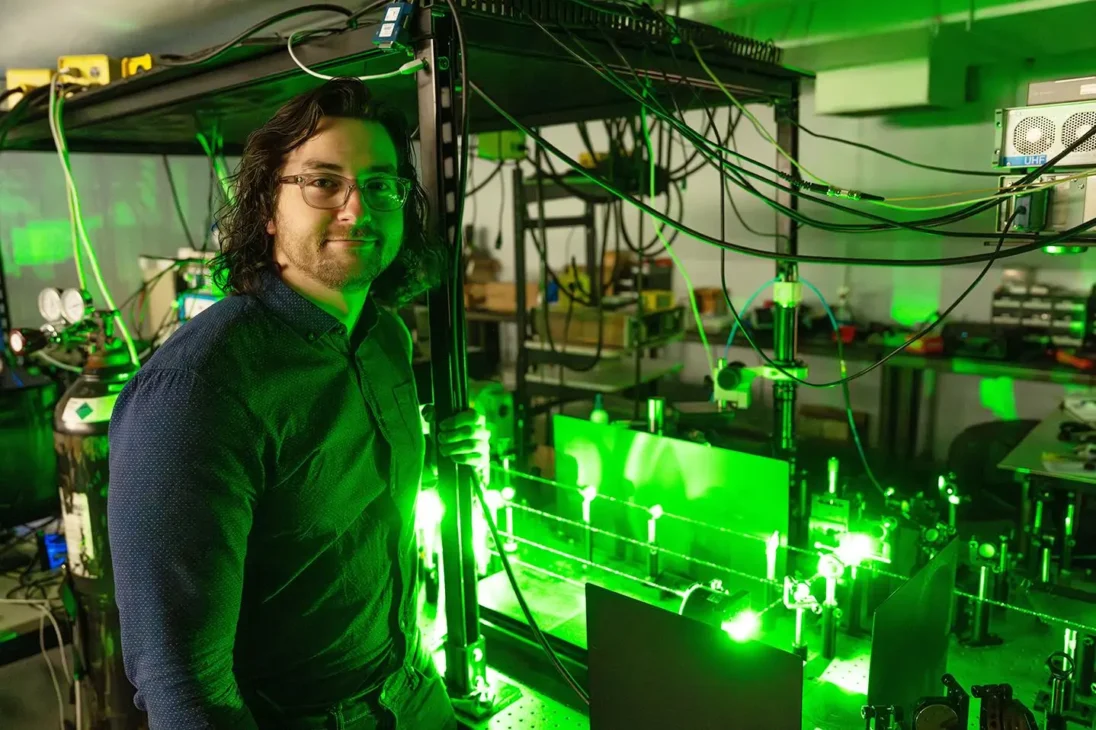
Will Hutchins, a doctoral student at the same university and the study’s lead author, explains: “We are seeing heat move in ways that previously seemed impossible in solids. It’s a completely new way to control temperature at the nanoscale.”
How They Did It
The experiment was conducted with a small gold plate placed on top of the hBN. When this structure was heated, the heat did not spread slowly, as expected.
Instead, it activated the special properties of the material and transformed into rapid waves that almost instantly transported heat away from the source.
This discovery shows that it is possible to control temperature more quickly and efficiently than any current technology. “It’s incredibly fast,” emphasizes Hutchins.
If applied on a large scale, this technology could change the entire electronics industry. Among the possible impacts, the researchers point to faster phones and laptops that do not overheat and consume less battery.
Electric cars could also benefit, with batteries that stay cool, charge faster, and last longer.
In data centers and artificial intelligence systems, the advancement could allow for more processing using less energy. And in the medical field, implants and imaging equipment could become more durable and precise.
Hopkins summarizes the significance of the discovery: “This could change everything, from processors to spacecraft.”
The research is still in its early stages, but the potential is great. With this new approach, the future of cooler, faster, and more efficient devices seems increasingly closer.