






 Portuguese
  Spanish


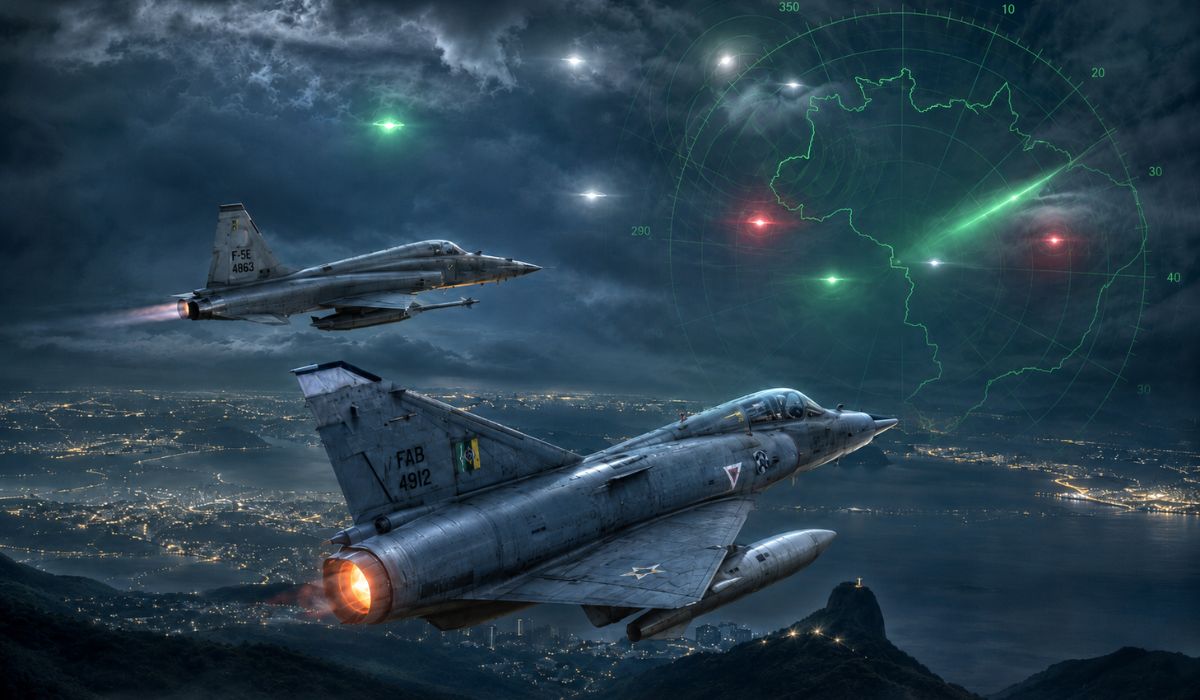

Official documents report a night when radars, pilots, and controllers tracked unidentified targets, mobilizing FAB fighters and leaving records that still fuel debates about Brazilian aviation.
On May 19, 2026, it marked 40 years since an episode recorded by official Aeronautics documents and preserved in the National Archive.
On the night of May 19 to 20, 1986, military radars detected unidentified flying objects, pilots reported lights in the sky, and the Brazilian Air Force deployed F-5 and Mirage fighters from the bases of Santa Cruz, in Rio de Janeiro, and Anápolis, in Goiás.
The case became known as the “Official Night of the UFOs”, “Night of the Flying Saucers” or “Festival of the Flying Saucers”.
-
UK Student Develops Solar Water Purification System Using Fresnel Lens, Wins Global Young Scientists Popular Vote

-
Giant Dredger “No Woman, No Cry” Arrived in Brazil in 2010 to Clear 1.8 Million m³ of Sand and Improve Port Logistics
-
UAE Installs 16 Giant Concrete Coffers in Abu Dhabi Waters to Build 600-Meter Quay for Mega-Yachts and Debut New Technique
-
Flexible PEX Plumbing Revolutionizes Bathrooms and Kitchens, Reducing Hidden Connections and Speeding Up Installations


The last expression appears associated with the communications of that night and was attributed to air traffic controller Sérgio Mota da Silva, who was operating in the tower of São José dos Campos airport, in the interior of São Paulo.
The acronym UFO stands for unidentified flying object.
In practice, the term indicates that a certain object or phenomenon seen in the sky was not recognized at that moment.
The classification does not, by itself, indicate extraterrestrial origin, military technology, or atmospheric phenomenon.
FAB radars recorded 21 unidentified flying objects
The first alerts came from the region of São José dos Campos, where lights of different colors were observed in the sky and also tracked by radar, according to the National Archive.
Hours later, radars in Anápolis, in Goiás, also indicated the presence of unidentified targets.
Official documentation records that over more than three hours, 21 UFOs were detected.
At a certain point in the early morning, the equipment even indicated 13 unidentified targets at the same time.
In the absence of recognition of the objects, the operation mobilized five fighters.
The aircraft took off with the mission to intercept and identify the detected points.
Despite the attempts, none of the pilots managed to get close enough to confirm the nature of the objects.
The reports describe lights that changed color, altitude variations, and movements considered unusual by the involved military personnel.

Military records mention abrupt acceleration and deceleration.
At times, according to the documents, the targets disappeared from radar screens or increased the distance from the fighters during approach attempts.
Audios from the Night of the Flying Saucers recorded the operation
Sérgio Mota da Silva, a flight controller in São José dos Campos, is among the professionals who reported the first occurrences of that night.
He observed luminous points in the sky and communicated the situation to the control centers.
In one of the recordings attributed to the communications of the episode, Mota stated: “Brasília, good evening and welcome to the flying saucer festival! It’s crazy here, man!”.
The phrase began to be reproduced in reports and materials about the case.
Other audios preserved by the National Archive also record the astonishment of pilots and operators during the operation.
In one of the communications, a pilot says: “Man, I can’t be seeing things (…) Luckily there’s a witness flying here”.
These statements are relevant because they are part of the sound records of the episode and help reconstruct the sequence of decisions made that night.
Even so, they do not replace the technical analysis of the documents, radars, and official reports.


Ozires Silva was in flight during the sightings
Ozires Silva also appears in the records of the episode.
In May 1986, he had left the presidency of Embraer and was newly appointed to the presidency of Petrobras.
Aeronautical engineer and reserve military officer, Ozires led the group that created Embraer in 1969.
On the night of the sightings, he was returning from Brasília in a Xingu aircraft, accompanied by pilot Alcir Pereira da Silva.
During the approach to São José dos Campos, the tower questioned the crew about the luminous points observed in the sky.
The commander confirmed the sighting, and the aircraft even tried to follow the objects, according to the report by the National Press based on documents from the National Archive.
The attempt did not result in identification of the targets.
The presence of Ozires in the reports increased the public visibility of the episode, especially due to his career linked to Brazilian aviation.
The fact, however, does not change the technical condition of the case: the objects remained without official identification.
FAB Report Cited Behavior of the Objects
The final report of the occurrence was signed by Air Brigadier José Pessoa Cavalcanti de Albuquerque.
The document stated that the observed phenomena seemed solid and reflected “in a certain way intelligence,” an expression used in the official text.
The report attributed this assessment to the objects’ ability to follow and maintain distance from the observers, as well as flying in formation.
The document itself noted that this did not necessarily mean that the objects were manned.
This formulation is one of the most cited excerpts of the case because it records a military assessment of the targets’ behavior.
At the same time, the report does not state that the objects had extraterrestrial origin nor does it present a definitive identification.
The day after the events, the then Minister of Aeronautics, Air Lieutenant Brigadier Octávio Júlio Moreira Lima, spoke to the press alongside pilots who participated in the operation.
He confirmed that radars had detected unidentified objects and that FAB fighters were deployed.
The press conference also contributed to the episode being called the “Official Night of UFOs.”
The expression was consolidated precisely because the occurrence was publicly recognized by military authorities, based on radar records and crew reports.
Documents on UFOs Were Preserved in the National Archive
Reports, audios, and other materials related to the case were incorporated into the collection of the National Archive.
They are part of the set of official documents on unidentified flying objects produced or forwarded by bodies linked to the Aeronautics.
The final report on the occurrence was released on September 25, 2009, after mobilization by researchers and entities dedicated to the subject.
Since then, part of the material can be consulted by those interested in the public collection.
Even with the release of documents, there is no definitive official explanation for what was recorded that night.
Over the years, hypotheses have been raised about atmospheric phenomena, radar failures, secret military operations, and extraterrestrial origin, but none of them have been officially confirmed as an answer for the 21 detected objects.
The case continues to be mentioned because it involves visual observation, radar records, recorded communications, military pilots, flight controllers, and Air Force authorities.


