






 Portuguese
  Spanish


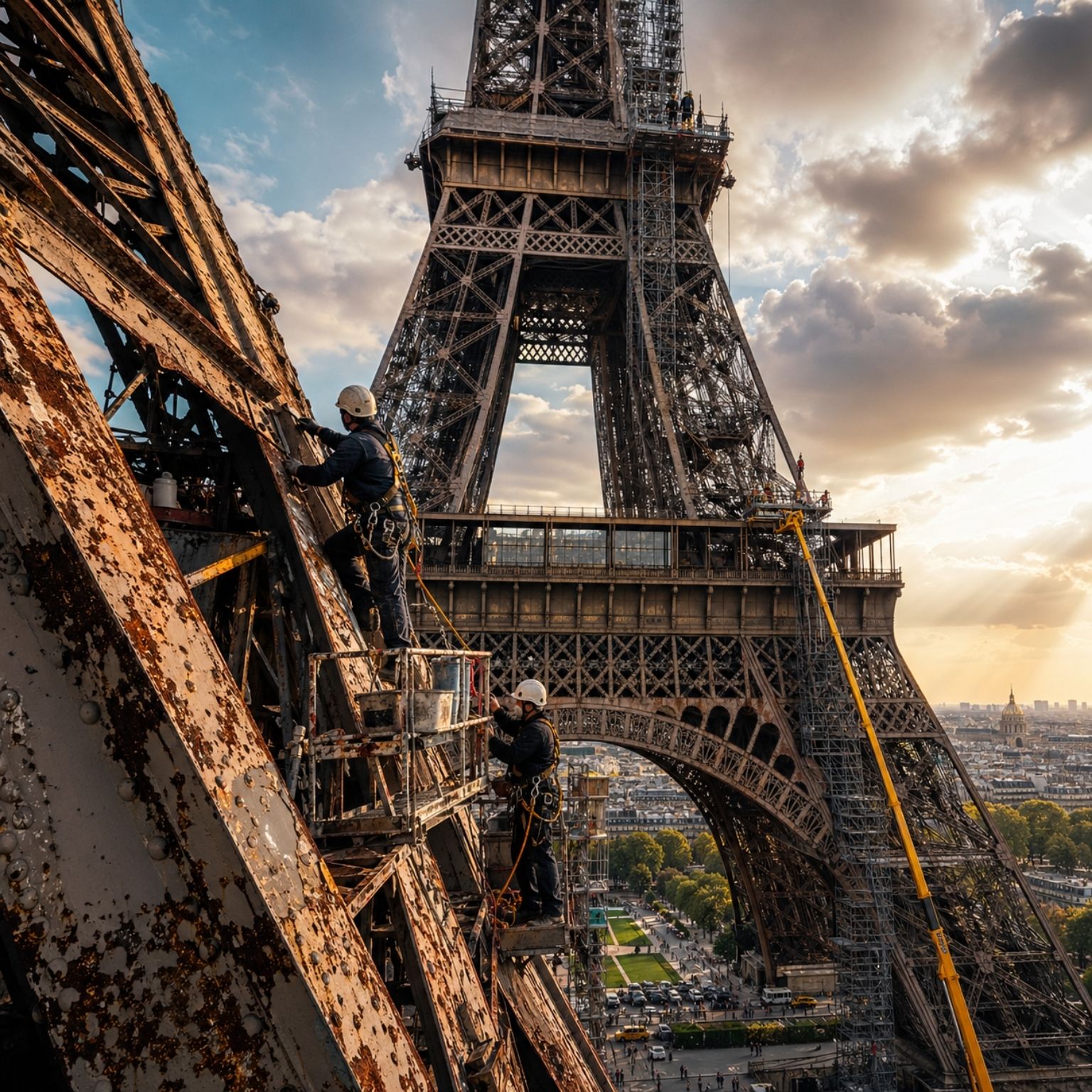


Paris watches the Eiffel Tower under corrosion, iron wear and constant maintenance, in a challenge that exposes the cost of keeping the city’s greatest symbol standing.
Paris has turned its attention back to the Eiffel Tower after iron wear, corrosion, and the limitations of recent maintenance exposed a problem that goes far beyond the monument’s appearance. The French capital’s landmark remains safe, according to experts cited in the report, but already requires more serious repairs, structural treatment, and continuous financial effort to prevent time from advancing on one of the planet’s most famous constructions.
The topic draws attention because it involves not only the image of Paris but also a historic structure about 300 meters tall, built in 1889, with approximately 7,300 tons of puddled iron and a total weight exceeding 10,000 tons when considering elevators, restaurants, and antennas. In 2024, after a strike and debate over revenues and conservation, a long-term maintenance plan of approximately 380 million euros until 2031 was approved, in an attempt to address a technical challenge that has been ongoing for years.
Why Paris raised the alarm about the Eiffel Tower

On paper, the Eiffel Tower remains the famous Iron Lady. In practice, the structure coexists with peeling paint, corrosion, and the need for deeper interventions than a simple repaint. The main point raised is that iron’s primary enemy remains the same since the monument’s origin: rust.
-
Brazilian Fishing Couple Spends 4 Years Building Solar-Powered Floating Home on the Paraguay River, Now a Navy-Approved Vessel with Leisure Area and Tour Demand

-
While the World Opens New Airports and High-Speed Trains, Brazil Rushes to Complete Projects Stalled for 40 Years
-
Brazil Invests in Massive Waterway to Transport Soybeans by Barge, Reducing Costly Truck Reliance
-
Bridge Rebuilt in Just One Year Reconnects Two Brazilian States


The very logic of the tower’s preservation has always been linked to paint. From the beginning, the recommendation was to perform a complete repaint every seven years, removing old paint, treating corrosion spots, and applying new layers. Over time, this routine became a complex, expensive, and delicate operation, carried out by teams working suspended a dozens of meters high.
How corrosion became a technical and financial challenge
The Eiffel Tower is not made of modern steel, but of puddled iron, a historic material that requires constant care. This helps explain why corrosion has become such a sensitive issue. The structure is open, works with the wind instead of rigidly confronting it, and depends on the integrity of the metal to maintain this behavior over time.
The challenge increases because preserving the tower doesn’t just mean painting the surface. The report shows that the ideal treatment would involve removing paint down to the metal, addressing corrosion spots, and renewing the structure’s protection. However, this runs into environmental, logistical, and economic limitations, especially in a dense city like Paris.
The numbers that explain the size of the problem
The data from the report itself helps to gauge the scale of the challenge. The main structure is about 300 meters tall, equivalent to an 81-story building. Its main levels are approximately 57 meters, 115 meters, and 276 meters high. The area to be covered in painting campaigns reaches about 250,000 square meters.
Each major maintenance campaign can last between one and a half and three years, using approximately 60 tons of paint. For the 2024 Olympics, a repainting project was launched with a budget of around 60 million euros, a value much higher than previous campaigns. The proposal was ambitious: to reach the metal, treat the corrosion, and extensively renew the structure.
What went wrong with the most recent maintenance
The project’s execution fell far short of what was planned. The presence of lead in the old paint layers imposed severe environmental restrictions and made broader removal difficult in the urban fabric of Paris. At the same time, the pandemic affected tourism, reduced revenues, and delayed the schedule.
The result was frustrating given the scale of the problem. According to the report, only about 5% of the structure received treatment as initially planned. This exposed a significant contradiction: the Eiffel Tower relies on heavy maintenance, but this maintenance is expensive, slow, requires technology, strict restrictions, and also impacts the monument’s operation.
Why the Eiffel Tower is not at immediate risk of falling
The discussion about corrosion naturally sparks fear, but the very foundation dismisses the idea of imminent collapse. Experts state that where the metal has been exposed, the identified corrosion is superficial and that the structure remains safe. In other words, the central problem is not one of immediate fall.
The real warning is different. More detailed reports indicate that the general condition of the metal is poor and that the tower needs much more than cosmetic maintenance. The risk, therefore, lies in the increasing cost of preserving a historical icon and the difficulty of sustaining this effort for many years without compromising revenue, visitation, and operation.
A structure that has always depended on maintenance to survive
The history of the Eiffel Tower shows that its permanence was never automatic. When it was completed, after 2 years, 2 months, and 5 days of construction, the tower had been conceived to impress at the 1889 Universal Exposition and was even seen by part of the cultural elite as an aggression to the Parisian landscape.
Furthermore, the original concession itself stipulated a limited term. After 20 years, the city could dismantle it and even sell the structure for scrap. The tower’s survival came because it gained practical utility, especially with wireless telegraphy, its use as an antenna, and its military importance in the first decades of the 20th century. In other words, the Eiffel Tower remained standing because it proved useful. Now, to get through the 21st century, it needs to prove preservable.
What changes in practice with the 380 million euro plan until 2031
The approval of a long-term maintenance plan of approximately 380 million euros until 2031 shows that the problem has finally gained a scale compatible with the tower’s importance. On paper, this represents progress, because it recognizes that the monument’s conservation requires much more than isolated actions.
In practice, however, the plan also makes it clear that Paris will have to live with a difficult debate. Treating the structure correctly may mean closing parts of the tower, reducing visitors, increasing operational costs, and pressuring the dispute over revenues among the monument’s administration, the city, involved companies, and workers. France’s most famous monument does not depend solely on engineering. It depends on constant money.
Why this problem goes beyond Paris’s postcard image


The Eiffel Tower is a global symbol, but it is also a historical iron machine subjected to wind, temperature, intense use, and natural aging. The base reminds us that the structure expands with heat, can grow about 15 centimeters in the European summer, and even shift laterally a few centimeters depending on solar incidence and wind action.
This shows that the tower was never a static object. It reacts to the environment, works with natural forces, and requires permanent technical monitoring. Behind the illuminated image that defines Paris for millions of people, there is a structure that needs painting, inspection, treatment, and long-term planning to continue representing the city.
What this means for the future of the Eiffel Tower
The debate opened by corrosion questions not only the tower’s appearance but also the model for preserving great historical monuments. The more famous the symbol, the greater the public expectation. But fame does not eliminate the bill. On the contrary, it can increase it.
In the case of the Eiffel Tower, the central question has become who pays, how they pay, and how far the collective willingness to preserve an icon that continues to attract millions of eyes goes, but demands high-level maintenance to remain standing for the next decades. The romanticism of the image remains intact for those who view it from afar. For those who care for the structure, however, the reality is much harsher, more expensive, and more urgent.
Do you think Paris and France are willing to bear the necessary cost to preserve the Eiffel Tower for the next 100 years?


