






 Portuguese
  Spanish


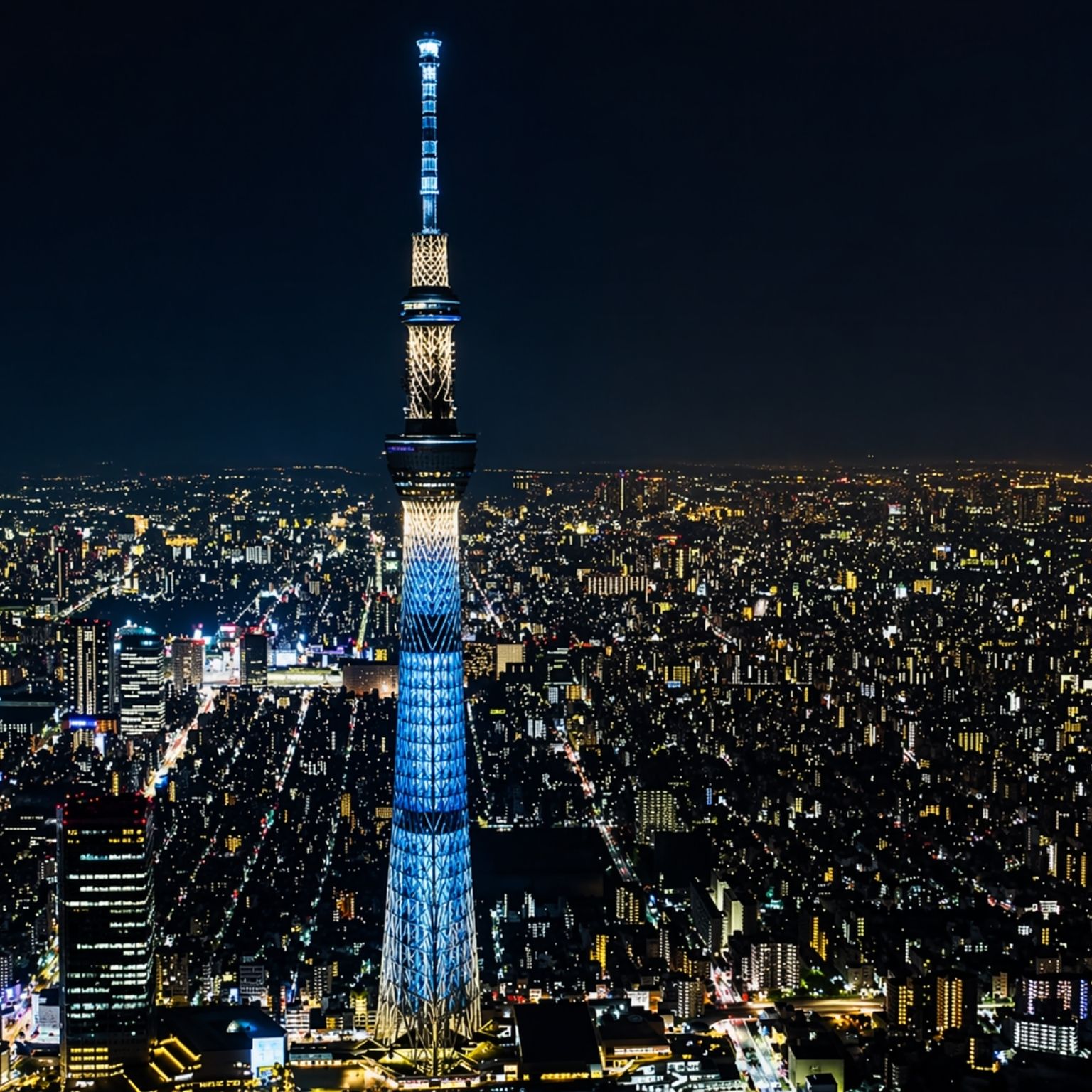


In Japan, the Tokyo Skytree became a strategic transmission tower by using a triangular foundation in mud and the shimbashira system, reducing oscillation by up to 50% to keep 35 million connected.
Building a 634-meter tower in the middle of Tokyo, on land that was once the soft bottom of an ancient bay, would be challenging anywhere. In Japan, this becomes a trial by fire: the region records about 1,500 tremors per year, and any overly tall superstructure can sway like a giant lever under wind and seismic shocks.
This was the equation engineers had to solve when erecting the Tokyo Skytree, the world’s tallest transmission tower, started in 2008 and completed in 2012. The mission was clear: to maintain a stable signal for the planet’s largest urban area, where over 35 million people live, and to ensure communication continues to function even when the city enters emergency mode.
Why Japan needed a 634-meter tower to maintain a stable signal

For many years, TV transmission in Tokyo primarily depended on the 333-meter Tokyo Tower, which covered the region well when the skyline was lower. But, entering the 21st century, tall buildings multiplied, weakening the signal. The problem became even more critical when Japan migrated to terrestrial digital transmission, which requires much greater stability.
-
Egypt Partners with China to Build 2 GW Wind Turbine Factory and 2,000 MW Wind Farm in Gulf of Suez, Aiming to Export Across Africa

-
Family of Six Leaves Georgia to Live in a $300,000 Cold War-Era Underground Bunker Since 2020: Unlikely 557 m² Home with 60 cm Concrete Walls
-
Self-taught Brazilian Mechanic Builds 10-Ton Aluminum Sailboat in Backyard, Now Navigates the Brazilian Coast at 50
-
Santa Catarina Launches $1.4 Billion, 145-Kilometer Highway Project with Six Lanes and Speeds Up to 120 km/h




The Skytree emerged as the answer: a 634-meter tower, with an observation deck at 450 meters, designed to maintain stable coverage within a radius of up to 100 kilometers across Greater Tokyo, even amidst thousands of tall buildings.
The triangular foundation in mud that holds the tower like an underground tripod

Before the first piece appeared above ground, the greatest risk was beneath. The base was built on soft sedimentary layers, with MUD and weak soil of low bearing capacity, a legacy of the ancient Tokyo Bay. In very tall towers, wind and earthquakes generate a “lever” effect: one side experiences intense compression, while the other can experience tensile forces, creating a tendency to pull out.
To deal with this, engineers applied the principle of friction foundations, with elements that “hold” the structure through friction with the surrounding soil. For the Skytree, this became a system of 131 reinforced concrete wall foundation elements, organized in a triangular layout beneath the base.
The system functions as three large clusters at the corners of the tower’s triangle. Each cluster uses reinforced concrete walls about 1.2 meters thick, descending to approximately 50 meters deep. These bases are connected by equally deep walls, forming a unified spatial anchorage underground. The tripod-like geometry distributes loads in three directions and increases resistance against torsion and overturning, precisely what a 634-meter tower needs to face in Japan.
37 thousand steel pieces and a geometry that changes from triangle to circle

The second challenge was space: the tower needed to be approximately twice as tall as the Tokyo Tower, but on a plot with only a quarter of the base area. This pushed the slenderness to a 9 to 1 ratio, increasing the risk of wind instability.
The solution adopted the principle of X bracing, which distributes wind loads through the external structural “skin”. The external load-bearing structure was assembled with 37,000 high-strength steel components. At the base, steel tubes with a maximum diameter of up to 2.3 meters and a thickness of 10 cm were used, forming thousands of triangular space trusses.
From a mechanical point of view, the triangle preserves its shape under lateral forces, and the open truss allows air to pass through the tower’s body, reducing direct wind pressure. This combination was calculated to withstand extreme winds of up to 80 meters per second, with a threshold associated with a 2,000-year recurrence interval.
Furthermore, the tower’s shape itself changes with height: it starts with a triangular section at ground level, like a tripod that enhances stability, and gradually transforms into a perfect circle. This geometric transition helps reduce air vortices behind the structure and limits lateral vibration, a decisive detail for such a slender structure in a seismic region of Japan.
The pagoda-inspired core that cuts up to 50% of earthquake sway
In a country on the Pacific Ring of Fire, tremors are not an exception. In a 634-meter tower, an earthquake not only displaces the structure laterally but can also create a risk of resonance between the ground and the building, amplifying the oscillation.
To reduce vibration, the Skytree uses a central concrete core called shimbashira, inspired by traditional pagoda towers. The core is about 8 meters in diameter and extends approximately 375 meters high within the tower’s body.
In the first 125 meters above the foundation, this core is directly connected to the steel structure to increase rigidity. Above that, it is no longer rigidly fixed and connects via a system of oil dampers, allowing the core and structure to oscillate out of phase during an earthquake. Calculation models and tests indicate that this system can reduce total displacement by up to about 50% in a strong seismic event.
At the base of the core, the tower also uses six rubber seismic isolation supports, about 1.4 meters thick. They function as a flexible layer that deforms to absorb part of the energy before it travels up the structure. The combination of the shimbashira core, oil dampers, and base isolation was designed to maintain operational stability in Japan, even under more severe tremors.
Top adjustments: 40 and 25-ton dampers and glass for 100 m/s winds


After exceeding 400 meters, the concern shifts to geometric precision. The main antenna is over 600 meters high, and small vibrations at the top can compromise the stability of the transmission system.
For this reason, the Skytree received two tuned mass dampers, weighing about 40 tons and 25 tons, installed at approximately 620 and 625 meters. They oscillate out of phase with the tower’s movement to cancel out some of the energy caused by strong winds at that height, stabilizing the transmission zone.
In the visitor areas, around the decks at approximately 350 and 450 meters, the enclosure structure uses over 10,000 multi-layered laminated glass panels, capable of withstanding winds of up to about 100 meters per second. In addition to safety, these panels help maintain sealing and pressure stability on the functional floors, ensuring reliable operation under extreme conditions in Japan.
What changes in practice: 35 million connected and a 100 km coverage radius
When it officially began operation in 2012, the Tokyo Skytree not only replaced the Tokyo Tower in the terrestrial digital broadcasting system. It reorganized the signal transmission capacity of Greater Tokyo, the world’s largest urban region, with over 35 million inhabitants.
With a height of 634 meters, the transmission antenna covers a radius of approximately 100 km, delivering reliable signal even in a dense urban setting full of tall buildings. And its role goes beyond TV: in a country prone to major earthquakes, typhoons, and regional-scale disasters, maintaining continuous communication is part of the city’s basic infrastructure. The Skytree was designed to operate stably even in emergency situations, from strong tremors to widespread blackouts.
Which of these Tokyo Skytree solutions impresses you the most: the triangular foundation in the mud, the steel skin with 37,000 pieces, or the shimbashira core that reduces oscillation by up to 50%?


