Portuguese
  Spanish


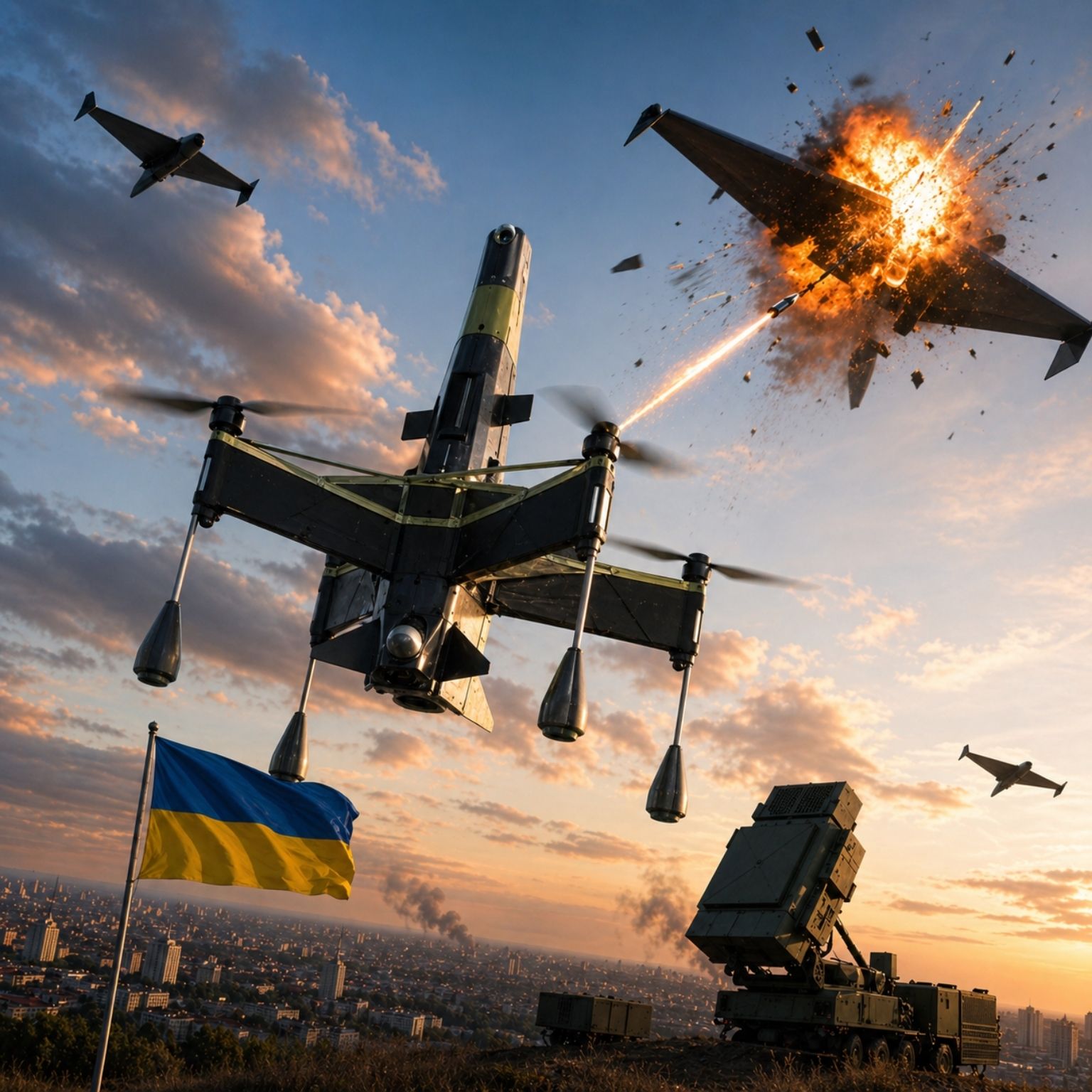

Jedi Drone enters operation in Ukraine as an air defense interceptor drone, with a speed of 350 km/h, a range of 40 km, and the ability to shoot down Russian attack and reconnaissance drones at a much lower cost than interceptor missiles.
The new Jedi interceptor drone has taken center stage in Ukraine’s strategy to counter the swarms of Russian drones that have been pressuring the country for years. According to the base, the model is already being used to locate, pursue, and eliminate aerial threats such as Shaheds, Gerans, Gerberas, Zala, and Supercam, expanding the defense of urban areas, critical infrastructure, and frontline units.
What stands out is the strategic and economic weight of this change. Instead of relying solely on expensive missiles to neutralize cheap drones, Ukraine is investing in a more affordable drone, launched from almost anywhere, capable of flying fast, operating at night, and acting scalably. This helps explain why the country sees the Jedi as an important piece to further raise interception rates and make Russian attacks less effective.
What is the Jedi drone and why is it attracting so much attention

The Jedi, referred to at the base as Jedi Shahed Hunter, is a helicopter-type interceptor drone with vertical takeoff. It was designed to hunt and destroy aerial targets, functioning as a specialized hunter against Russian attack and reconnaissance platforms.
-
Floating Solar Panels Aim for Rougher Seas with Norwegian Rope Mesh Technology, Following DNV Review, Opening New Clean Energy Opportunities in Coastal Areas

-
Olympus Mons: The Solar System’s Tallest Volcano, Over Three Times the Height of Mount Everest, Puzzles Scientists with Its Prolonged Volcanic Activity
-
Alaska’s 1,287 km Pipeline Built on 78,000 Metal Supports to Prevent Thawing, Survives Earthquakes and Remote Forests, Highlighting the Challenge of Hot Oil in a Harsh Environment
-
Brazilian Student Innovates Sustainable Ceramic Tableware Using Rice Husks and Recycled Glass, Achieving Up to 60% Waste Composition and Comparable Performance to Conventional Materials


The proposal stands out because the drone combines attributes that are usually very important in aerial combat: high speed, mobility, simple launch, and integration with an already operational defense network. Instead of relying on runways or catapults, the Jedi can be quickly deployed from different points, which expands its utility in a war scenario marked by sudden attacks.
The numbers that explain the strength of the new Ukrainian drone
The specifications presented at the base help to understand why the Jedi has gained so much relevance. The drone weighs just over 4 kilograms, carries a payload of up to 500 grams, and can reach altitudes close to 6 kilometers. Its operational range extends to 40 kilometers, which expands its coverage capacity in strategic zones.
The most impactful data, however, is its speed. The Jedi can reach up to 350 km/h, a number that places it well above several Russian drones mentioned in the base. Shaheds, for example, appear with a speed of around 185 km/h, which creates a clear advantage for the Ukrainian interceptor in the mission to pursue and shoot down these targets.
How the Jedi drone works in practice during attacks
The system’s operation goes beyond the flight itself. The base reports that ground teams coordinate communications, flight, and targeting, while nearby radars send real-time data to the drone. This allows the Jedi to automatically lock onto targets and pursue them with speed and precision.
Another important point is the sensor suite. The drone features a day and thermal imaging camera, which makes a difference in night attacks or low visibility conditions. As many Russian attacks occur at night, this capability increases the system’s efficiency and prevents the interceptor from relying solely on favorable visual conditions to operate.
What makes this drone different from a simple aerial collision
The base suggests that the Jedi was not designed merely to collide with other drones in the air. Since it can carry up to 500 grams, the model indicates the use of an explosive charge capable of hitting the target before it proceeds to the infrastructure or area it intended to attack.
This detail is strategic because some Russian drones mentioned in the text are described as relatively resilient. A simple collision might not be enough to consistently shoot them down. However, with fragmentation, proximity effect, and small explosions, the Jedi gains more capability to hit the enemy’s engines, propellers, control parts, and guidance systems.
What targets is the Jedi drone already being used against

According to the source, Ukraine’s Ministry of Defense confirmed in March 2026 that the Jedi was already in operation against various types of Russian drones. These include Shaheds, which appear as the backbone of the Kremlin’s drone arsenal, as well as Gerans and Gerberas.
The drone also demonstrated value against reconnaissance platforms like Zala and Supercam. This expands the system’s strategic impact, as it’s not just about blocking attacks. By shooting down observation drones, Ukraine also reduces Russia’s ability to collect data, map movements, and guide actions on the ground and in the air.
Why this advance can change Ukraine’s air defense
The introduction of the Jedi represents an evolution in Ukrainian tactics. The source describes this change as moving from more improvised combat against drones to a more defined, integrated, and scalable air defense layer. This means reinforcement for both the front line and rear areas.
In practice, mobile units can deploy this drone near villages, cities, logistics centers, bridges, substations, and energy facilities. Since launch is quick and operation can be done from various points, defense gains flexibility to respond to threats in different regions and moments of the conflict.
The numbers that show the leap in interceptions
The source provides a sequence of data that helps gauge Ukraine’s advance in aerial warfare. According to the cited report from the Center for European Policy Analysis, Ukraine suppressed or destroyed just over 80% of Russian aerial targets in December 2025. In February 2026, this rate exceeded 85%. By March, it reached close to 90%.
With the introduction of the Jedi, the presented expectation is that Ukraine will consistently shoot down at least 90% of Russian drones each month and even approach 95%. The source also cites the goal of Defense Minister Mykhailo Fedorov to identify 100% of aerial threats in real time and intercept at least 95% of missiles and drones.
Why the drone is seen as a cheaper and more scalable solution
One of the central arguments of the source is economic. Ukraine has already realized that using expensive missiles to shoot down cheap drones creates a clear disadvantage. The text cites a direct example: it makes no sense to launch a missile that can cost 1 million dollars to destroy a drone that costs less than 1,000.
In this scenario, the interceptor drone gains value because it costs only a fraction of a common interceptor missile, according to Ukraine’s Ministry of Defense. This allows for large-scale production, continuous use, and preservation of missile stocks for more dangerous threats, such as ballistic missiles and other high-impact targets.
What changes in practice with mass production and daily use
The source states that, in January 2026, military units were already receiving more than 1,500 interceptor drones daily to counter Shahed-type attacks. This volume helps explain why Ukraine sees the system as scalable and capable of keeping up with increased Russian pressure in the sky.
This changes the operational logic. Instead of saving each interception due to cost, defense can launch hundreds of drones every day, covering more areas and responding to more targets without the same financial burden. In a long war, this resource management gains decisive dimension.
How the drone weakens Russian swarms and protects infrastructure


The text shows that interceptor drones directly adapt to the Russian tactic of launching swarms, using low altitude, and exploiting darkness to hinder defense. The Jedi acts precisely against this model, moving interception to before the terminal phase of the attack.
With this, Ukraine can better protect sensitive areas, such as command posts, supply lines, ammunition depots, bridges, energy facilities, and other strategic points. By reducing the number of drones reaching the target, the country also decreases human losses, material damage, and pressure on more expensive defense systems.
Why shooting down reconnaissance drones also carries so much weight
The importance of the Jedi is not only in neutralizing explosive drones. When it shoots down reconnaissance platforms, it also cuts off the collection of information that guides Russian attacks. This weakens the enemy’s ability to observe positions, track movements, and prepare offensives with greater precision.
This effect amplifies the system’s value on the battlefield. Without these eyes in the sky, Russia loses part of its understanding of the terrain and must act with less information. For Ukraine, this creates space to reposition resources, move units, and better protect its assets without being monitored in the same way.
What this drone represents for the current phase of the war
The base presents the Jedi as a game-changer in a war increasingly dominated by drones. Instead of merely responding with traditional systems, Ukraine is now using a specialized, cheap, mobile drone adapted to the reality of the conflict.
This change helps to understand why the country treats interceptors as a central piece of its strategy. They reinforce air defense, save resources, expand the scale of response, and increase pressure on a Russian tactic that had been exploiting volume, low cost, and repeated attacks to wear down the adversary.
Do you believe the Jedi drone can become one of Ukraine’s most decisive weapons to curb Russian attacks in the coming months?