Portuguese
  Spanish


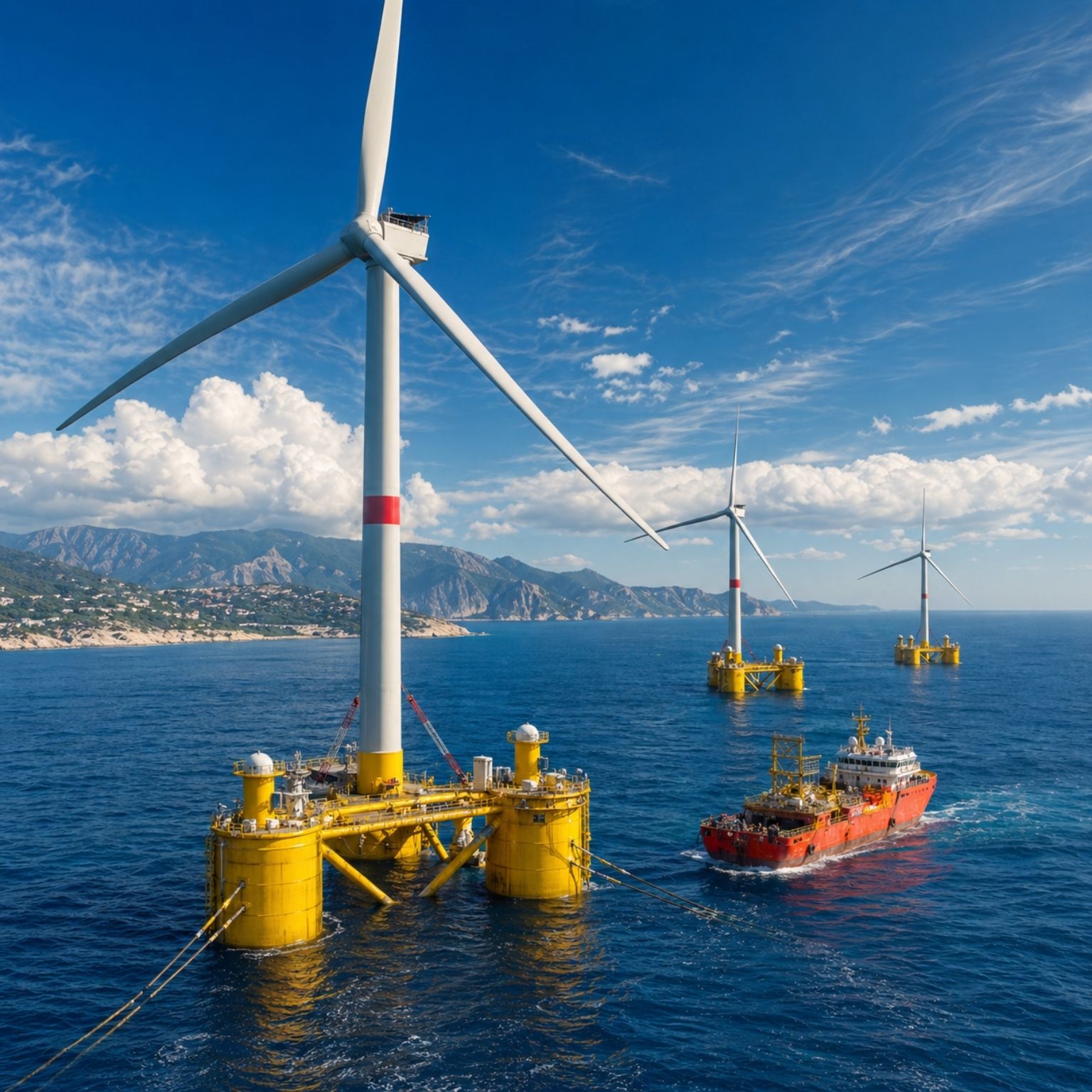

EFGL project turbine puts France at a new stage of floating offshore wind, with port assembly, structure on a floater, and open-sea installation to validate technology and technical choices for the future.
France has taken another step in the development of offshore wind energy with the EFGL project, described as the second offshore wind farm installed in the country. The new phase is noteworthy because it involves a large-scale turbine mounted on a floater, as well as a structure designed to test technical solutions at full scale before future expansions.
The operation combines port assembly, heavy lifting, maritime transport, and open-sea installation. According to the project, each turbine will be integrated with the floater while still at the port terminal and then towed to the installation site about 16 kilometers off the coast, in an area with a depth of nearly 70 meters. This setup makes EFGL a strategic test for the French floating wind industry.
What makes the EFGL turbine so important for France

The EFGL project is treated as a technical learning initiative. According to the source, the goal is to demonstrate that it is possible to build a large-scale turbine in an offshore environment, using prototypes to validate technology and technical decisions that can guide future projects.
-
Brazilian Researchers Develop Cost-Effective Method for Key Component of Green Hydrogen Electrolyzers, Enhancing Energy Efficiency and Equipment Longevity

-
1,700-Year-Old Roman Mosaic Discovered by Farmer Planting Cherry Trees in Turkey

-
Brazil launches $1.9 billion plan in response to El Niño, issuing national extreme heat alert and bolstering public health system

-
Polyformer Machine Converts PET Bottles into 3D Printer Filament, Reducing Costs and Expanding to Over 50 Countries



This point is important because offshore wind has been growing rapidly in recent years. In this scenario, France is using EFGL to field-test a turbine mounted on a floater and observe, in practice, how the structure, port integration, and open-sea installation can work at full scale.
The numbers that explain the project’s scale
The project data helps to size up the challenge. EFGL involves 3 wind turbines of 10 MW, each positioned on 3 floaters. The installation will be carried out approximately 16 kilometers from the coast, in waters about 70 meters deep.
Another noteworthy number is in the lifting operation. The nacelle needs to be lifted up to 120 meters during the turbine’s integration. This shows the degree of precision required in an assembly that combines height, weight, wind, and limited time for execution.
How the turbine will be assembled before heading to sea

The project’s operational logic begins at the port. The turbine will be built on the floater while still at the terminal, before being taken to sea by a company responsible for towing and offshore installation. This arrangement reduces dependence on full assembly at sea and concentrates a critical part of the operation on land.
In this process, the port plays a central role. The source indicates that Europort operates with concessions and port activities at the terminal, serving as the integration point for the assembly. Thus, the turbine assembly is no longer just an industrial stage but also depends on port logistics and synchronization between different companies.
Why the lifting operation is the most critical stage
The most sensitive phase of the project is the lifting, described in the source as the most important and critical operation. In it, the turbine’s nacelle needs to be lifted up to 120 meters, which requires heavy equipment, dedicated engineering, and precise execution within a short operational window.
This difficulty is increased because the port area mentioned in the project is very windy. Therefore, the teams had to work with narrow weather windows to carry out the integration. In operations of this type, wind and available time are no longer minor details and directly influence the schedule, safety, and cost.
The equipment used to lift the turbine in the port
To carry out the integration, the project uses a large CC8800 Boom Booster crawler crane, as well as 24 lines of SPMTs. The choice of this equipment shows that the turbine assembly requires heavy industrial-level transport and lifting capacity.
According to the source, the use of the crane made the operation faster and simpler than other logistical alternatives mentioned in the project. This reinforces the idea that the EFGL is not only testing the turbine itself but also the most efficient integration method for this type of floating installation.
What changes in practice with the turbine mounted on a floater
Mounting a turbine on a floater expands the possibility of bringing wind projects to deeper sea areas. In the case of the EFGL, the installation will take place in waters of about 70 meters, a condition in which floating structures gain relevance compared to more conventional solutions.
In practice, this opens up space to utilize coastal zones that were previously more difficult to explore. It also allows France to use the project as a learning showcase, observing how the turbine behaves from assembly in the port to offshore installation, with a focus on performance, construction method, and feasibility for new ventures.
Why the EFGL is seen as a validation project for the future
The source treats the EFGL as a prototype and validation project. This means that the value of the initiative lies not only in the installation of the 3 turbines, but in what they can teach about technology, technical choices, and integration between port, transport, and offshore operations.
This type of project tends to weigh heavily in the sector’s evolution because it reduces uncertainties. By testing a large-scale turbine on a floater, France creates a practical reference for future industry decisions, from the operational design to the choice of equipment and installation methods.
The role of the companies involved in the turbine assembly


Europort is mentioned in the source as responsible for operating the terminal and conducting port activities related to the project. The company in charge of the lifting takes on the most critical stage, with rapid crane mobilization, local client support, and the presence of a dedicated engineer and project manager.
This division shows that the EFGL turbine depends on a coordinated chain. Port, engineering, transport, and offshore installation need to work in sync for the structure to be mounted on the floater and then towed to its final point at sea.
Why the largest turbine on a floater draws so much attention
The source’s opening sentence summarizes the symbolic weight of the project: this will be the largest turbine ever placed on a floater. This detail gives the EFGL a dimension that goes beyond the work itself and transforms the initiative into a technical milestone for France.
More than just installing equipment, the project tests how far the industry can go in size, integration, and operation. In a rapidly growing sector, the largest turbine on a floater comes to represent a concrete attempt to scale up and accelerate the maturation of floating offshore wind in the country.
Do you believe that projects like the EFGL can definitively accelerate the large-scale installation of floating wind turbines in France?